|
TRANSLATE THIS ARTICLE
Integral World: Exploring Theories of Everything
An independent forum for a critical discussion of the integral philosophy of Ken Wilber
  Frank Visser, graduated as a psychologist of culture and religion, founded IntegralWorld in 1997. He worked as production manager for various publishing houses and as service manager for various internet companies and lives in Amsterdam. Books: Ken Wilber: Thought as Passion (SUNY, 2003), and The Corona Conspiracy: Combatting Disinformation about the Coronavirus (Kindle, 2020). Frank Visser, graduated as a psychologist of culture and religion, founded IntegralWorld in 1997. He worked as production manager for various publishing houses and as service manager for various internet companies and lives in Amsterdam. Books: Ken Wilber: Thought as Passion (SUNY, 2003), and The Corona Conspiracy: Combatting Disinformation about the Coronavirus (Kindle, 2020).
Check out my other conversations with ChatGPT The Controversial Movement of ScientologyFrom Galactic Genocide to Therapeutic CosmologyFrank Visser / ChatGPT
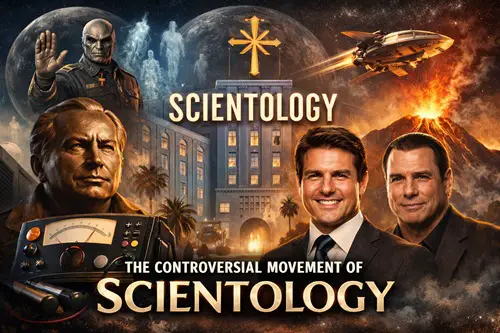 Few modern religious movements have generated as much fascination, litigation, celebrity advocacy, and sustained criticism as Scientology. Founded in the mid-20th century, it presents itself as a practical path to spiritual freedom grounded in a systematic understanding of the mind. Its detractors regard it as a pseudoscientific belief system wrapped in corporate secrecy and aggressive institutional control. To understand the controversy, one must examine its doctrinal core, organizational culture, prominent adherents, and its reception within the scientific community. Origins: From L. Ron Hubbard to a Global ChurchScientology emerged from the earlier system of “Dianetics,” introduced by Hubbard in his 1950 book Dianetics: The Modern Science of Mental Health. Dianetics was presented as a therapeutic method for eliminating traumatic mental imprints—“engrams”—that purportedly cause psychological and psychosomatic disorders. By 1954, Hubbard had reframed Dianetics within a broader metaphysical and religious architecture, formally establishing the Church of Scientology. The shift from “science of the mind” to religion had legal and institutional advantages, particularly in relation to tax status and regulatory scrutiny. Core Tenets1. The ThetanAt the heart of Scientology lies the concept of the thetan—an immortal, non-physical spiritual being that constitutes a person's true identity. The thetan is said to have lived through countless past lives across vast cosmic time spans. Human suffering results from accumulated engrams and spiritual degradation across these lifetimes. 2. Auditing and the E-MeterThe primary spiritual practice is “auditing,” a guided counseling process intended to clear engrams and restore the thetan's native capacities. Auditing sessions employ an electronic device known as the “E-meter” (electropsychometer), which measures changes in skin conductivity, somewhat analogous to a lie detector. Scientology asserts that fluctuations on the meter indicate areas of emotional charge requiring resolution. 3. The Bridge to Total FreedomSpiritual advancement is structured through a graded pathway known as the “Bridge to Total Freedom.” Participants progress from “Preclear” to “Clear,” and ultimately through advanced “Operating Thetan” (OT) levels. At higher OT levels, adherents are introduced to esoteric cosmological narratives—including accounts of ancient galactic events involving the figure “Xenu,” a detail that has fueled public controversy. 4. Ethics and Organizational StructureScientology maintains a codified ethics system governing member conduct. The Sea Organization (Sea Org), an elite inner order, operates under paramilitary discipline and lifetime contractual commitments. Critics have alleged coercive control mechanisms, while the Church describes these structures as necessary for spiritual integrity and organizational cohesion. Xenu and the OT III CosmologyThe most controversial element of Scientology's advanced teachings concerns the figure known as Xenu (sometimes spelled “Xemu”), introduced at the Operating Thetan Level III (OT III). According to materials attributed to L. Ron Hubbard and later disclosed in court records and journalistic investigations, the narrative presents a mytho-cosmological account of trauma said to underlie present human suffering. The NarrativeIn this account, Xenu is described as the ruler of a “Galactic Confederacy” approximately 75 million years ago. Faced with overpopulation, he allegedly transported billions of beings to Earth (then called “Teegeeack”), immobilized them near volcanoes, and annihilated their bodies using hydrogen bombs. The disembodied spirits—“thetans”—were then subjected to a process of implantation, in which they were shown false images and narratives designed to induce confusion and obedience. These traumatized spirits purportedly clustered together, forming what Scientology calls “body thetans.” According to OT III materials, these body thetans attach themselves to present-day humans and are responsible for various psychological and spiritual disturbances. Doctrinal FunctionWithin the internal logic of Scientology, the Xenu story serves a specific explanatory role: • It accounts for persistent mental and emotional difficulties that remain even after achieving the state of “Clear.” • It situates individual suffering within a vast cosmic history. • It frames spiritual progress as disentangling oneself from accumulated extraterrestrial trauma. Practitioners at OT III engage in auditing processes aimed at identifying and “handling” these body thetans, helping them become aware and depart. This is presented not as symbolic allegory but as literal spiritual remediation. Secrecy and RevelationHistorically, the Church of Scientology has restricted access to OT III materials to members who have completed prerequisite levels and signed confidentiality agreements. The Church has argued that premature exposure could cause psychological harm, as the material is said to be spiritually destabilizing if encountered without proper preparation. The secrecy surrounding Xenu contributed substantially to public controversy once the materials entered the public domain through court cases and investigative reporting. Critics often highlight the narrative's resemblance to science fiction tropes—unsurprising given Hubbard's background as a prolific pulp writer—while adherents maintain that the account reflects genuine spiritual history accessed through advanced insight. Symbolic vs. Literal DebateOne important analytical distinction is that Scientology officially presents the OT III narrative as factual spiritual history, not metaphor. However, some sympathetic interpreters outside the Church have suggested that the Xenu story could be read symbolically—as a mythic dramatization of primordial trauma or existential alienation. The institutional position of the Church of Scientology, however, does not frame it as allegory. Scientific and Scholarly ReceptionFrom the standpoint of mainstream science, the Xenu account is treated as a religious myth rather than a historical claim. There is no empirical evidence supporting the existence of a galactic confederacy, ancient interstellar transport of beings, or implanted extraterrestrial spirits. Scholars of religion often compare the Xenu narrative to other cosmological myths that situate human suffering in a primordial catastrophe—analogous in structural terms (though not in content) to Gnostic myths of cosmic fallenness. What makes Scientology distinctive is the integration of this myth within a monetized, sequential spiritual technology. Why Xenu Became the FlashpointThe Xenu material crystallizes the core tension surrounding Scientology: • Internally: it is advanced sacred knowledge reserved for committed practitioners. • Externally: it appears as implausible science-fiction cosmology presented in literal terms. • Institutionally: its secrecy fueled suspicion and litigation. • Culturally: its disclosure reinforced the perception of Scientology as a hybrid of religion and speculative fiction. In short, Xenu functions not merely as a mythic villain but as the symbolic fulcrum of Scientology's public image—where its claims to scientific precision and its expansive metaphysical narrative collide most visibly with secular expectations of plausibility. Legal and Political ControversiesScientology has engaged in prolonged legal conflicts with governments and journalists. In the United States, it secured tax-exempt religious status from the Internal Revenue Service in 1993 after decades of litigation. In some European countries, however, it has faced classification as a commercial enterprise or even as a sect under surveillance. Historically, one of the most damaging episodes was Operation Snow White, in which Church operatives infiltrated U.S. government agencies during the 1970s, resulting in criminal convictions of senior members. Scientific Reception1. Psychology and PsychiatryFrom its inception, Scientology positioned itself as an alternative to psychiatry and psychology, frequently condemning psychiatric practice. The scientific community has overwhelmingly rejected Dianetics and Scientology's claims as lacking empirical foundation. No credible peer-reviewed evidence supports the existence of engrams as described by Hubbard, nor the claim that auditing can produce measurable cognitive or medical improvements beyond placebo effects. The E-meter is not recognized as a diagnostic instrument in clinical psychology. Major psychological and medical associations classify Scientology's therapeutic claims as pseudoscientific. Its cosmology and metaphysical anthropology are considered religious doctrine rather than testable hypotheses. 2. Academic Study of ReligionWithin religious studies, Scientology is analyzed as a “new religious movement” (NRM). Scholars debate whether its structure is more accurately characterized as religion, therapy, or corporate enterprise. Unlike traditional religions grounded in revelation or inherited myth, Scientology presents a systematized, quasi-technical path to enlightenment, blending science-fiction cosmology with self-help methodology. Its secrecy regarding advanced teachings and the monetized progression up the Bridge have drawn particular scrutiny from sociologists and anthropologists. Why the Controversy PersistsScientology occupies a liminal space between religion, therapy, and corporate structure. Three elements sustain its controversy: • Epistemic Claims: It frames metaphysical assertions as scientific discoveries. • Institutional Control: Former members describe intense organizational discipline and retaliatory tactics against critics. • Financial Structure: Advancement requires substantial financial contributions, raising ethical concerns. At the same time, many adherents report genuine subjective benefit—greater self-confidence, clarity, or existential meaning—highlighting a recurring tension between personal testimony and empirical validation. ConclusionScientology represents a distinctive 20th-century attempt to merge spiritual aspiration with the rhetoric of science and technological progress. Its doctrinal architecture is internally systematic but scientifically unsubstantiated. Its celebrity adherents have amplified its reach, while defectors have fueled public suspicion. For critics, it is a paradigmatic case of pseudoscience institutionalized as religion. For adherents, it is a rigorous path to spiritual emancipation. Its enduring presence suggests that in modern societies—where traditional religious authority has waned and scientific authority dominates—movements that hybridize both domains can attract both intense devotion and intense opposition.
Widget is loading comments...
|