|
TRANSLATE THIS ARTICLE
Integral World: Exploring Theories of Everything
An independent forum for a critical discussion of the integral philosophy of Ken Wilber
  Frank Visser, graduated as a psychologist of culture and religion, founded IntegralWorld in 1997. He worked as production manager for various publishing houses and as service manager for various internet companies and lives in Amsterdam. Books: Ken Wilber: Thought as Passion (SUNY, 2003), and The Corona Conspiracy: Combatting Disinformation about the Coronavirus (Kindle, 2020). Frank Visser, graduated as a psychologist of culture and religion, founded IntegralWorld in 1997. He worked as production manager for various publishing houses and as service manager for various internet companies and lives in Amsterdam. Books: Ken Wilber: Thought as Passion (SUNY, 2003), and The Corona Conspiracy: Combatting Disinformation about the Coronavirus (Kindle, 2020).
Check out my other conversations with ChatGPT Ken Wilber's Four QuadrantsIntegrative Insight or Elegant Taxonomy?Frank Visser / ChatGPT
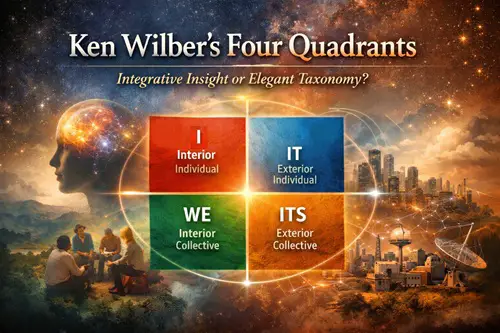 Ken Wilber's model of the Four Quadrants (4Q) is arguably the most influential and enduring component of his Integral Theory. First articulated in the 1990s and refined in Sex, Ecology, Spirituality (1995) and A Theory of Everything (2000), the quadrant framework purports to offer a comprehensive map of reality by organizing phenomena along two intersecting axes: interior vs. exterior and individual vs. collective. The result is a fourfold schema intended to integrate subjective experience, objective behavior, intersubjective culture, and interobjective systems. The promise of the model is ambitious: to overcome reductionism, to situate competing disciplines within a single meta-framework, and to dissolve long-standing philosophical dichotomies. Yet this promise raises key questions. Is the model genuinely explanatory, or does it merely categorize? Does it have meaningful philosophical or scientific antecedents? And has it been adopted outside Wilber's own Integral milieu? The Structure of the Four QuadrantsWilber's quadrants are typically summarized as follows: • Upper-Left (UL) – Interior–Individual: subjective experience, consciousness, phenomenology (“I”). • Upper-Right (UR) – Exterior–Individual: observable behavior, brain states, biology (“It”). • Lower-Left (LL) – Interior–Collective: culture, shared meanings, values (“We”). • Lower-Right (LR) – Exterior–Collective: social systems, institutions, ecological networks (“Its”). Wilber's core claim is that any phenomenon—human development, ethics, evolution, illness, spirituality—can and must be analyzed across all four quadrants to avoid reductionism. For example, depression cannot be fully understood by brain chemistry alone (UR), nor solely by subjective feelings (UL), nor by cultural narratives (LL), nor by socioeconomic structures (LR); all four are said to be co-arising dimensions of a single event. At its best, the model functions as a heuristic reminder: complex phenomena have multiple dimensions, and privileging one at the expense of others leads to distortion. Explanation or Categorization?This is the decisive issue. The Four Quadrants do not explain phenomena in the scientific or philosophical sense. They offer: • no causal mechanisms, • no predictive power, • no criteria for resolving conflicts between quadrants, • no empirical tests for quadrant balance or imbalance. Instead, the model functions as a meta-taxonomy: it tells us where different kinds of explanations belong, not how things work. Saying that brain activity (UR) and subjective experience (UL) are correlated adds nothing beyond what neuroscience and phenomenology already investigate—except the insistence that they must be kept distinct yet integrated. Critically, Wilber often smuggles metaphysical claims into what is presented as a neutral framework. The idea that all quadrants are “equally real” and “co-arising” frequently slides into panpsychist or idealist assumptions, especially when linked to his doctrines of involution and Eros. At that point, categorization becomes metaphysical assertion. The Mind–Body Problem Revisited—and DuplicatedOne of Wilber's recurring claims is that the Four Quadrants dissolve the traditional mind–body problem by contextualizing it. Once we see that mind (UL) and body (UR) are simply two irreducible perspectives on the same event, the problem is said to evaporate. In practice, however, the quadrant model does not solve the mind–body problem—it reframes it and then multiplies it. The classical mind–body problem concerns the relationship between subjective experience and physical processes: how (or whether) conscious experience arises from, depends on, or interacts with bodily states. Wilber's framework preserves this divide intact by assigning mind to the interior–individual quadrant and body to the exterior–individual quadrant. Declaring these as “different but equally real dimensions” does not explain their relation; it merely labels it. Worse, the quadrant model duplicates the problem at the collective level. Just as individual mind and body are split between UL and UR, collective meaning and social systems are split between LL (culture, values, shared meanings) and LR (institutions, economic systems, ecological networks). The result is not one explanatory gap but two: • How does subjective experience relate to neural and behavioral processes? • How do shared meanings relate to large-scale social and material systems? Wilber frequently speaks of “tetra-arising” phenomena—events that arise simultaneously in all four quadrants—but simultaneity is not explanation. Co-occurrence does not account for causal linkage, ontological dependence, or explanatory priority. The hard questions are simply pushed sideways: instead of asking how mind relates to matter, we are told that both appear in different quadrants and must be honored. That is a normative injunction, not a solution. Moreover, by insisting on the irreducibility of interiors, Wilber forecloses naturalistic accounts in advance. Any attempt to explain consciousness in neural or evolutionary terms is dismissed as “reductionism,” while interior accounts are granted a kind of epistemic immunity. This asymmetry effectively smuggles dualism back in under the banner of pluralism. The mind–body problem is not transcended; it is preserved in a stabilized, diagrammatic form. In this sense, the Four Quadrants function as a conceptual quarantine. They prevent cross-level explanations from being evaluated on empirical or theoretical grounds by assigning them to separate ontological boxes. The cost of this maneuver is explanatory stagnation: once phenomena are properly “placed,” the deeper question of how they are related is quietly set aside. Far from resolving the mind–body problem, then, Wilber's quadrant model institutionalizes it—and extends it into the social domain. What appears as integrative wisdom turns out to be a sophisticated re-labeling of familiar philosophical difficulties, now multiplied by four and insulated from resolution. Reception in Mainstream Science and PhilosophyDespite its popularity in spiritual, therapeutic, and coaching circles, the Four Quadrants have not caught on in mainstream science or academic philosophy. • They are virtually absent from peer-reviewed journals. • They are not used in standard textbooks in philosophy of mind, sociology, psychology, or systems theory. • They are rarely cited outside Integral-friendly venues. This is not due to ideological resistance or “flatland materialism,” as Wilber often suggests, but because the model offers little that working researchers find methodologically necessary. Scientists and philosophers already navigate multiple levels of description without requiring a fourfold metaphysical map. Where the quadrants are used, they function as pedagogical diagrams or consulting tools—not as research frameworks. AssessmentThe Four Quadrants remain Ken Wilber's most accessible and defensible contribution. They encourage pluralism, discourage reductionism, and remind us that reality is not one-dimensional. As a map, the model can be clarifying. But maps are not explanations. The quadrant framework does not generate knowledge; it organizes it. Its philosophical roots are conventional, its innovations largely presentational, and its influence confined to the Integral subculture. Ultimately, the Four Quadrants succeed as an integrative gesture, but fail as a theory of how the world actually works. Their enduring appeal says more about the human desire for tidy conceptual symmetry than about any deep structure of reality.
Comment Form is loading comments...
|