|
TRANSLATE THIS ARTICLE
Integral World: Exploring Theories of Everything
An independent forum for a critical discussion of the integral philosophy of Ken Wilber
  Frank Visser, graduated as a psychologist of culture and religion, founded IntegralWorld in 1997. He worked as production manager for various publishing houses and as service manager for various internet companies and lives in Amsterdam. Books: Ken Wilber: Thought as Passion (SUNY, 2003), and The Corona Conspiracy: Combatting Disinformation about the Coronavirus (Kindle, 2020). Frank Visser, graduated as a psychologist of culture and religion, founded IntegralWorld in 1997. He worked as production manager for various publishing houses and as service manager for various internet companies and lives in Amsterdam. Books: Ken Wilber: Thought as Passion (SUNY, 2003), and The Corona Conspiracy: Combatting Disinformation about the Coronavirus (Kindle, 2020).
Check out my other conversations with ChatGPT The Impact of Carbon Dioxide (CO2)A Small Molecule with Planetary ConsequencesFrank Visser / ChatGPT
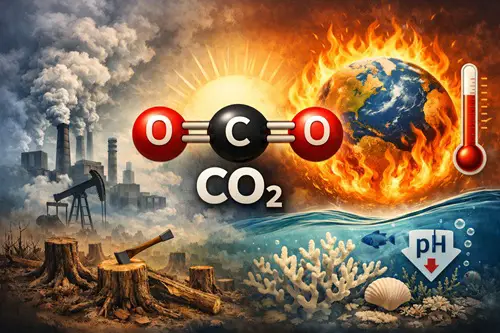 Among the many molecules circulating through Earth's atmosphere, carbon dioxide (CO2) occupies a unique and paradoxical position. It is chemically simple, biologically essential, geologically ubiquitous—and climatically consequential. Understanding why this particular molecule matters so much for climate change requires looking simultaneously at its physical properties, its biogeochemical origins, and its role in Earth's energy balance. 1. What Is CO2, Chemically Speaking?Carbon dioxide consists of one carbon atom bonded to two oxygen atoms in a linear configuration (O=C=O). It is: • Colorless and odorless • Non-toxic at ambient concentrations • Chemically stable under atmospheric conditions Its molecular simplicity is deceptive. CO2 is infrared-active: it absorbs and re-emits heat radiation at specific wavelengths. This property—shared with only a subset of atmospheric gases—s the key to its climatic importance. 2. CO2 and the Greenhouse EffectEarth's surface absorbs energy from the Sun primarily in the form of visible light. The planet then radiates energy back toward space as infrared (heat) radiation. Certain gases—called greenhouse gases—ntercept some of this outgoing heat and re-radiate it in all directions, including back toward the surface. CO2 plays a central role in this process because: • It absorbs infrared radiation strongly around 15 micrometers, a critical part of Earth's emission spectrum. • It is well-mixed in the atmosphere, meaning its effects are global rather than local. • It remains in the atmosphere for centuries to millennia, giving it long-term leverage over climate. Importantly, CO2 is not the strongest greenhouse gas molecule by molecule (water vapor is more potent). What makes CO2 decisive is that it acts as the thermostat knob: its concentration controls the baseline temperature, which in turn determines how much water vapor the atmosphere can hold. 3. Where Does CO2 Come From?CO2 is part of Earth's carbon cycle, moving between atmosphere, oceans, biosphere, and rocks. Natural sources include: • Respiration by plants, animals, and microbes • Decomposition of organic matter • Volcanic degassing • Ocean-atmosphere exchange These sources were largely in balance for thousands of years before industrialization. Anthropogenic (human-caused) sources include: • Burning fossil fuels (coal, oil, natural gas) • Cement production (calcination of limestone) • Deforestation and land-use change What distinguishes modern emissions is not their novelty, but their rate and scale. Humans are transferring carbon from long-term geological storage into the atmosphere far faster than natural sinks can absorb it. 4. Persistence: The Long Memory of CO2One of CO2's most salient features is its longevity. Unlike pollutants that degrade quickly, CO2 accumulates. Roughly 40-50% of emitted CO2 remains in the atmosphere after a century. A significant fraction persists for thousands of years, until removed by slow geological processes such as rock weathering. This means climate change is cumulative, not reversible on human timescales. Each year's emissions stack atop the last. 5. CO2, Oceans, and AcidificationAbout a quarter of human-emitted CO2 is absorbed by the oceans. This buffers atmospheric warming—but at a cost. When CO2 dissolves in seawater, it forms carbonic acid, lowering ocean pH. This process, known as ocean acidification, reduces the availability of carbonate ions needed by organisms such as corals, mollusks, and some plankton to build shells and skeletons. Thus, CO2 affects climate and marine ecosystems simultaneously. 6. Why CO2 Is Central to Climate ChangeCO2 matters disproportionately because it combines several critical traits: • Radiative effectiveness: it alters Earth's energy balance. • Global mixing: emissions anywhere affect climate everywhere. • Longevity: its effects persist across generations. • Feedback control: it amplifies or dampens other climate processes. Anthropogenic dominance: current increases are overwhelmingly human-driven. Since the late 18th century, atmospheric CO2 concentrations have risen from about 280 ppm to over 420 ppm, a level not seen for several million years—during periods when global temperatures and sea levels were substantially higher. 7. CO2 Is Not a Villain—But It Is a ConstraintIt is crucial to avoid caricatures. CO2 is not “pollution” in the ordinary sense; it is indispensable to life. Plants require it for photosynthesis, and without a natural greenhouse effect, Earth would be a frozen world. The problem is not CO2 per se, but too much of it, too quickly, injected into a finely balanced system. ConclusionCarbon dioxide's importance in climate change does not stem from mystery or metaphysics, but from well-understood physics and chemistry. A modest, stable molecule with a long atmospheric lifetime, CO2 exerts an outsized influence on Earth's climate by regulating how much heat the planet retains. In that sense, CO2 is not merely another gas—t is a climate forcing agent, a molecular lever through which human activity now reshapes planetary conditions. Understanding it is a prerequisite for any serious discussion of climate, energy, or the future of human civilization.
Comment Form is loading comments...
|