|
TRANSLATE THIS ARTICLE
Integral World: Exploring Theories of Everything
An independent forum for a critical discussion of the integral philosophy of Ken Wilber
  Frank Visser, graduated as a psychologist of culture and religion, founded IntegralWorld in 1997. He worked as production manager for various publishing houses and as service manager for various internet companies and lives in Amsterdam. Books: Ken Wilber: Thought as Passion (SUNY, 2003), and The Corona Conspiracy: Combatting Disinformation about the Coronavirus (Kindle, 2020). Frank Visser, graduated as a psychologist of culture and religion, founded IntegralWorld in 1997. He worked as production manager for various publishing houses and as service manager for various internet companies and lives in Amsterdam. Books: Ken Wilber: Thought as Passion (SUNY, 2003), and The Corona Conspiracy: Combatting Disinformation about the Coronavirus (Kindle, 2020).
Check out my other conversations with ChatGPT The Mysteries of H2OWhy Water Is Indispensable for LifeFrank Visser / ChatGPT
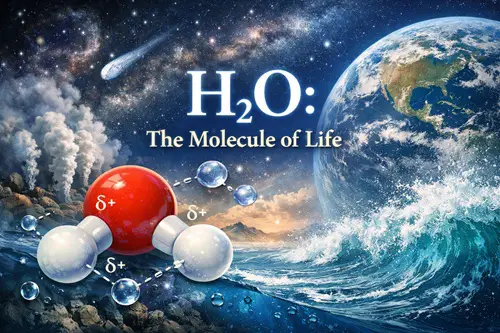 Water is so familiar that its strangeness is easy to miss. Composed of just two hydrogen atoms bonded to one oxygen atom, H2O is a chemically simple molecule with profoundly complex consequences. No other substance plays such a central role in the origin, persistence, and evolution of life on Earth. From planetary formation to cellular metabolism, water is not merely a background condition for life—it is an active participant in nearly every biological process. 1. How Water Arises: Cosmic and Planetary OriginsWater is one of the most abundant molecules in the universe. Hydrogen, the simplest and most plentiful element, was formed shortly after the Big Bang. Oxygen, by contrast, is forged much later inside stars through nuclear fusion and dispersed by supernovae. When hydrogen and oxygen encounter each other under suitable conditions—on interstellar dust grains, in molecular clouds, or in protoplanetary disks—water readily forms. On Earth, water arrived through a combination of processes: • Outgassing from Earth's mantle during early volcanic activity, releasing water vapor that condensed as the planet cooled. • Delivery by icy bodies, such as comets and water-rich asteroids, during the early bombardment phase of the solar system. The result was the accumulation of vast oceans within a relatively narrow temperature range—a critical precondition for life. 2. The Molecular Structure of WaterAt first glance, H2O seems unremarkable. But its geometry is crucial. The oxygen atom forms two covalent bonds with hydrogen atoms at an angle of about 104.5°, giving the molecule a bent shape rather than a linear one. Because oxygen is more electronegative than hydrogen, it pulls shared electrons closer, creating a polar molecule: oxygen carries a partial negative charge, hydrogens partial positive charges. This polarity allows water molecules to form hydrogen bonds with one another—weak, transient attractions that collectively generate powerful emergent properties. These hydrogen bonds are the key to nearly everything water does. 3. Salient Physical and Chemical Propertiesa. Exceptional Solvent PowerWater is often called the “universal solvent” (with some exaggeration). Its polarity allows it to dissolve ionic compounds and many polar molecules, surrounding ions and stabilizing them in solution. This property makes water an ideal medium for chemistry: • Nutrients can be transported. • Metabolic reactions can occur. • Waste products can be removed. Life, at its core, is chemistry in solution—and water makes that possible. b. Thermal Stability and Climate RegulationWater has an unusually high specific heat capacity, meaning it can absorb or release large amounts of heat with little change in temperature. This buffers organisms and ecosystems against rapid thermal fluctuations. On a planetary scale, oceans moderate Earth's climate; on a biological scale, water stabilizes internal body temperatures. Closely related is water's high heat of vaporization, which enables efficient cooling through evaporation (sweating, transpiration). c. Density Anomaly of IceMost substances become denser when they freeze. Water does the opposite. When water freezes, hydrogen bonds lock molecules into a crystalline lattice that is less dense than liquid water, causing ice to float. This anomaly is life-saving. Ice forms an insulating layer on lakes and oceans, preventing them from freezing solid and allowing aquatic life to survive through cold periods. d. Cohesion, Adhesion, and Surface TensionHydrogen bonding gives water strong cohesive forces (water sticks to itself) and adhesive forces (water sticks to other surfaces). These properties enable: • Capillary action in plant vessels. • The formation of continuous water columns in trees. • Surface tension that allows small organisms to exploit water surfaces. 4. Water in Living Systemsa. The Matrix of LifeCells are mostly water—typically 60-90% by mass. Water is not just a passive filler; it shapes macromolecules, stabilizes proteins, and influences folding through hydrophobic interactions. The very three-dimensional structure of enzymes and nucleic acids depends on aqueous conditions. b. Reactant, Not Just MediumWater actively participates in biochemical reactions: • Hydrolysis reactions break polymers (proteins, carbohydrates, nucleic acids). • Condensation reactions release water when polymers form. • In photosynthesis, water is split to provide electrons and protons, releasing oxygen as a by-product. In respiration, water is produced as electrons flow to oxygen. Thus, water is woven directly into metabolism. 5. Water and the Origin of LifeMost hypotheses about the origin of life place it in aqueous environments: tidal pools, hydrothermal vents, or mineral-rich oceans. Water enables concentration, diffusion, cycling, and self-organization—key ingredients for prebiotic chemistry. Equally important, water constrains possibilities. Its solvent properties favor certain molecular structures over others, channeling chemistry toward the kinds of polymers life actually uses. In this sense, water is not just permissive but directive. 6. Why H2O, and Not Something Else?Other liquids (ammonia, methane) can, in principle, support complex chemistry under different conditions. But within Earth-like temperatures and pressures, no known substance matches water's combination of: • Chemical versatility • Thermal buffering • Structural support for macromolecules • Planetary-scale abundance Water occupies a “sweet spot” in the space of possible solvents—liquid across a wide temperature range, chemically active yet stable, abundant yet structured. ConclusionWater's indispensability to life is not a poetic exaggeration but a scientific conclusion. Emerging from cosmic processes and planetary geology, the H2O molecule exhibits a suite of extraordinary properties rooted in its simple, polar structure. These properties make life as we know it not just possible but robust, persistent, and evolvable. In short, life on Earth is not merely in water. It is, in a profound sense, of water.
Comment Form is loading comments...
|