|
TRANSLATE THIS ARTICLE
Integral World: Exploring Theories of Everything
An independent forum for a critical discussion of the integral philosophy of Ken Wilber
  Frank Visser, graduated as a psychologist of culture and religion, founded IntegralWorld in 1997. He worked as production manager for various publishing houses and as service manager for various internet companies and lives in Amsterdam. Books: Ken Wilber: Thought as Passion (SUNY, 2003), and The Corona Conspiracy: Combatting Disinformation about the Coronavirus (Kindle, 2020). Frank Visser, graduated as a psychologist of culture and religion, founded IntegralWorld in 1997. He worked as production manager for various publishing houses and as service manager for various internet companies and lives in Amsterdam. Books: Ken Wilber: Thought as Passion (SUNY, 2003), and The Corona Conspiracy: Combatting Disinformation about the Coronavirus (Kindle, 2020).
Check out my other conversations with ChatGPT
Sri Aurobindo on EvolutionVisionary Metaphysics or Scientific Account?Frank Visser / ChatGPT
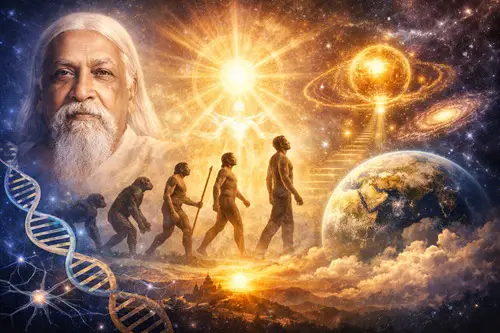 IntroductionSri Aurobindo (1872–1950) occupies a distinctive position in modern spiritual philosophy. Unlike traditional Indian metaphysics, which often treats the material world as illusory or secondary, Aurobindo placed evolution at the very center of his worldview. He accepted biological evolution as a fact but reinterpreted it as the outward expression of a deeper, teleological process—the progressive manifestation of consciousness inherent in matter. This raises a crucial question: Is Aurobindo's view of evolution compatible with the scientific theory of evolution, or does it amount to a spiritual overlay that fundamentally alters its meaning? Aurobindo's Core Evolutionary ThesisAurobindo's evolutionary philosophy rests on three interlocking claims: 1. Involution precedes evolution Consciousness (or Spirit) is not a late emergent property of matter but is involved—latent, compressed, concealed—within matter from the beginning. 2. Evolution is the progressive unfolding of consciousness Biological evolution is not random or undirected but expresses a lawful ascent: Matter → Life → Mind → (future) Supramental consciousness 3. Humanity is transitional, not terminal Homo sapiens is not the endpoint of evolution. Aurobindo predicts the emergence of a new species or mode of being, often called the supramental being. This is not metaphorical in Aurobindo's own writing. He consistently presents this as an objective cosmic process, not merely a symbolic or psychological narrative. What Aurobindo Accepts from ScienceTo his credit, Aurobindo did not reject Darwinian evolution outright: • He accepted common descent. • He acknowledged gradual transformation of species. • He rejected creationism and literal divine intervention in the biological process. He also explicitly criticized religious supernaturalism and emphasized that evolution proceeds through natural processes, not miraculous acts. So far, this sounds conciliatory. Where the Compatibility Breaks DownDespite surface agreement, Aurobindo's framework diverges sharply from scientific evolution in several decisive ways. 1. Teleology vs. Blind ProcessModern evolutionary biology is non-teleological: • No built-in direction • No inherent drive toward complexity or consciousness • No privileged endpoint Aurobindo, by contrast, insists that evolution has: • A direction (toward greater consciousness) • A goal (the supramental manifestation) • An inner necessity guiding development This is not a minor philosophical gloss—it directly contradicts the foundational stance of evolutionary science. 2. Consciousness as Cause, Not ProductScience treats consciousness as: • An emergent property of complex nervous systems • Contingent, fragile, and late-arising Aurobindo reverses this: • Consciousness is ontologically prior • Matter is a self-obscuring form of consciousness • Evolution is consciousness remembering itself This move removes consciousness from empirical investigation and places it beyond falsification. 3. Lack of Mechanistic AccountScientific evolution explains change through: • Mutation • Natural selection • Genetic drift • Developmental constraints Aurobindo offers no equivalent causal mechanisms linking: • Supramental consciousness to genetic change • Inner realization to heritable biological transformation Instead, he relies on metaphysical necessity and spiritual intuition, which function rhetorically where mechanisms should be. 4. The Problem of Predictive FailureAurobindo made explicit evolutionary predictions: • An imminent supramental transformation • A radical shift in human consciousness • A new species emerging on Earth A century later: • No biological evidence supports such a transition • No genetic, anatomical, or population-level changes align with his expectations • Claims have retreated into subjective or mystical domains When predictions fail, the theory shifts from scientific to unfalsifiable metaphysics. Is Aurobindo a “Spiritual Darwinist”?Often, Aurobindo is defended as offering a complementary account—science explains the “how,” spirituality the “why.” But this division does not hold: Aurobindo's “why” dictates the direction and outcome of the “how.” His metaphysics is not neutral; it reinterprets the entire evolutionary narrative. Biological facts are treated as expressions of a pre-existing cosmic plan. This is not compatibility; it is subordination of science to metaphysics.
Sri Aurobindo offers a grand, imaginative, and internally coherent metaphysical vision of evolution. It is psychologically compelling, spiritually optimistic, and philosophically rich. But it is not compatible with scientific evolutionary theory in any strict sense. At best, Aurobindo provides: • A mythopoetic interpretation of evolution • A spiritual narrative layered onto biological facts At worst, he: • Smuggles teleology back into nature • Rebrands idealism as evolutionary insight • Anticipates later “consciousness-first” philosophies that mistake dissatisfaction with materialism for evidence against it Aurobindo did not so much extend Darwin as domesticate him within a Vedantic cosmology. The result is not an expanded science of evolution, but a spiritualized counter-narrative that belongs to philosophy and religion—not biology.
Comment Form is loading comments...
|