|
TRANSLATE THIS ARTICLE
Integral World: Exploring Theories of Everything
An independent forum for a critical discussion of the integral philosophy of Ken Wilber
  Frank Visser, graduated as a psychologist of culture and religion, founded IntegralWorld in 1997. He worked as production manager for various publishing houses and as service manager for various internet companies and lives in Amsterdam. Books: Ken Wilber: Thought as Passion (SUNY, 2003), and The Corona Conspiracy: Combatting Disinformation about the Coronavirus (Kindle, 2020). Frank Visser, graduated as a psychologist of culture and religion, founded IntegralWorld in 1997. He worked as production manager for various publishing houses and as service manager for various internet companies and lives in Amsterdam. Books: Ken Wilber: Thought as Passion (SUNY, 2003), and The Corona Conspiracy: Combatting Disinformation about the Coronavirus (Kindle, 2020).
Check out my other conversations with ChatGPT Skeptical Scrutiny of a Bold SynthesisUniversal Consciousness as Foundational FieldFrank Visser / Grok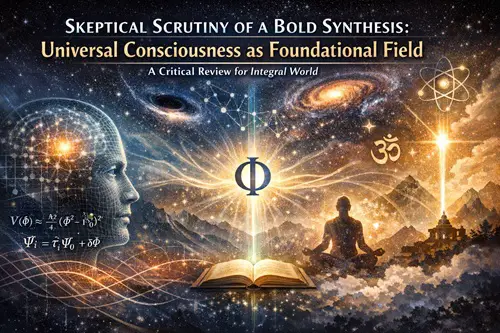 The paper in question, published in AIP Advances on November 13, 2025, carries the full title “Universal consciousness as foundational field: A theoretical bridge between quantum physics and non-dual philosophy” by Maria Strømme, Professor of Materials Science and Engineering at Uppsala University.[1] It has circulated widely in consciousness studies, spiritual, and interdisciplinary circles, often highlighted by university press releases, Phys.org coverage, and its selection as a featured or cover article in its issue. The work proposes a grand unification: consciousness is not an emergent byproduct of complex neural activity but a primordial, foundational field (denoted as φ) that precedes and gives rise to space-time, matter, and individual subjective experience. Strømme builds her model around the “Three Principles” (3Ps) framework popularized by Sydney Banks—a spiritual insight tradition emphasizing Universal Mind (a formless creative intelligence), Universal Consciousness (the capacity for awareness itself), and Universal Thought (the creative power that generates differentiated experience). These are posited as eternal and pre-spatiotemporal, analogous to the quantum vacuum or a pre-Big Bang state in cosmology. The author formalizes universal consciousness as an undifferentiated field Φ₀, with differentiation into observable reality and localized individual awareness (ψᵢ) occurring through processes borrowed from quantum field theory (QFT): symmetry-breaking potentials (e.g., a Higgs-like V(Φ) ≈ λ/4 (Φ² - Φ₀²)²), quantum fluctuations (δΦ), and projection operators mimicking wave function collapse. Individual “thought” is modeled via operators t^? [could not display this character] that localize and project experience from the universal substrate. The framework draws explicit parallels to established (though interpretive) ideas in physics—David Bohm's implicate order, Werner Heisenberg's potentia, John Wheeler's participatory anthropic principle, and emergent space-time concepts from quantum gravity and information theory. Non-dual philosophical traditions are invoked selectively: Advaita Vedanta's Brahman, Buddhist notions of sunyata (emptiness), Sufi wahdat al-wujud, and various mystical reports of unified awareness. The paper argues that apparent separateness is illusory; all phenomena arise as excitations within a single conscious field. Supplementary material discusses applications of the 3Ps in psychological and social programs, cites parapsychological studies (e.g., RNG deviations in the Global Consciousness Project, intention effects on random systems, biophoton emissions), and offers speculative predictions such as measurable non-local correlations in biology or consciousness influencing zero-point energy. From a skeptical standpoint, the paper's interdisciplinary ambition is admirable in intent but undermined by profound methodological, evidential, and conceptual shortcomings. AIP Advances is a reputable open-access journal from the American Institute of Physics, employing peer review focused on technical soundness rather than groundbreaking impact (with post-publication metrics determining prestige). It accommodates speculative theoretical papers that might struggle in more specialized venues. Strømme's primary expertise is in nanotechnology, functional materials, and applications like drug delivery—not quantum foundations, consciousness research, or philosophy of mind. Her publication history shows no prior peer-reviewed output in these domains, making this a significant departure into unfamiliar territory. The mathematical content, while dressed in familiar QFT notation, functions more as illustrative analogy than rigorous, predictive theory. Standard tools (scalar fields, symmetry breaking, fluctuations, measurement-like projections) are repurposed to describe a “consciousness field” without deriving why consciousness should follow scalar dynamics, how the thought operators emerge from physical principles, or how the model connects quantitatively to observables. The equations resemble textbook examples repurposed for metaphysics rather than novel derivations yielding testable, falsifiable predictions. Mainstream quantum mechanics already contends with the measurement problem through various interpretations (Copenhagen, Many-Worlds, QBism, etc.), none of which require positing consciousness as a universal field. Even supportive references like Penrose-Hameroff's Orch-OR theory remain fringe and face serious challenges regarding decoherence timescales and biological plausibility. Extending collapse to subjective “thought” ventures into quantum mysticism without addressing core objections, such as the hard problem of qualia or the combination problem in panpsychism/idealism. Empirical grounding is particularly tenuous. The paper leans on parapsychological claims—RNG anomalies, Global Consciousness Project data, intention-modulated biophotons—that have faced extensive critique for replication failures, statistical artifacts, publication bias, and lack of robust controls in mainstream meta-analyses. The 3Ps themselves stem from Banks' personal spiritual realization in the 1970s; while influential in coaching, therapy, and some educational contexts, Three Principles Psychology lacks large-scale, rigorous empirical validation and has been characterized by critics as oversimplified positive thinking, New Age repackaging, or pseudoscientific when presented as fundamental science. No original experiments, controlled data, or quantitative simulations support the model's claims; “evidence” rests on selective citations and anecdotal program outcomes. Philosophically, the synthesis cherry-picks non-dual traditions while sidestepping internal debates, analytic counterarguments (e.g., illusionism, emergent functionalism, physicalist responses to panpsychism), and contemporary consciousness theories (integrated information, global workspace, predictive processing). Inverting Wheeler's “it from bit” to “it from consciousness” ignores information-theoretic and thermodynamic constraints on emergence. Predictions remain vague or unfalsifiable in practice, with prior psi research yielding mostly null results under stringent conditions. The paper's strengths lie in its articulation of materialism's explanatory gaps, the interpretive flexibility of quantum measurement, and the intuitive appeal of holistic ontologies in an era of AI and quantum technologies. It resonates with integral thinkers exploring science-spirituality convergence, echoing elements of Ken Wilber's quadrant model or levels of consciousness while falling short of his multi-perspectival rigor and caution against “quantum woo.” In an Integral World context, it exemplifies the risk of conflating pre-rational spiritual intuition with post-rational scientific modeling—elevating metaphysical postulates to physics without sufficient warrant. Ultimately, despite its creative scope, promotional fanfare, and journal placement, the work functions more as philosophical speculation or personal metaphysical vision clothed in scientific notation than as advancing physics or consciousness studies. Extraordinary claims—that consciousness is a pre-spatiotemporal field causally prior to the physical universe—demand extraordinary evidence: novel predictions, replicable data, interdisciplinary expert scrutiny, and avoidance of circular appeals to fringe literature. The paper's circulation reflects a broader cultural desire for meaning beyond strict materialism, yet rigorous skepticism requires holding such syntheses to high evidentiary standards rather than accepting inspirational appeal as substantiation. For integral inquiry, it prompts valuable reflection on validity claims across quadrants and levels, but it also highlights the enduring need for discernment: bold bridges between science and spirituality must be built on firmer empirical and conceptual foundations to withstand critical examination. NOTES[1] Maria Strømme, "Universal consciousness as foundational field: A theoretical bridge between quantum physics and non-dual philosophy", AIP Advances 15, 115319 (2025).
Comment Form is loading comments...
|