|
TRANSLATE THIS ARTICLE
Integral World: Exploring Theories of Everything
An independent forum for a critical discussion of the integral philosophy of Ken Wilber
  Frank Visser, graduated as a psychologist of culture and religion, founded IntegralWorld in 1997. He worked as production manager for various publishing houses and as service manager for various internet companies and lives in Amsterdam. Books: Ken Wilber: Thought as Passion (SUNY, 2003), and The Corona Conspiracy: Combatting Disinformation about the Coronavirus (Kindle, 2020). Frank Visser, graduated as a psychologist of culture and religion, founded IntegralWorld in 1997. He worked as production manager for various publishing houses and as service manager for various internet companies and lives in Amsterdam. Books: Ken Wilber: Thought as Passion (SUNY, 2003), and The Corona Conspiracy: Combatting Disinformation about the Coronavirus (Kindle, 2020).
Check out my other conversations with ChatGPT After WilberThe Spiritual Salvage OperationFrank Visser / ChatGPT
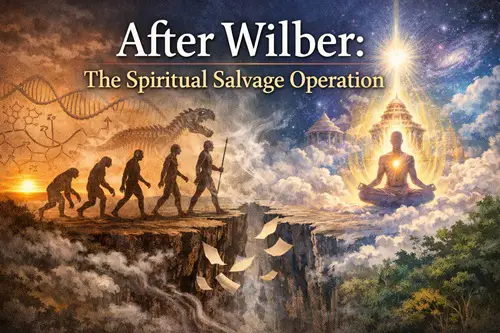
1. The pattern, not the personOnce Ken Wilber's attempt to spiritualize biological evolution is critically dismantled, one might expect the story to end there. Evolutionary biology returns to Darwinian naturalism, metaphysical excess is trimmed away, and intellectual discipline is restored. But that is not what usually happens. Instead, we observe a recurring salvage operation: the scientific critique is accepted, yet the metaphysical impulse survives—relocated, insulated, and rebranded. What is abandoned at the level of biology quietly reappears at the level of consciousness. This is not unique to Wilber or to his critics. It is a broader post-integral phenomenon. 2. The decisive concession—and its limitsIn recent debates, even sophisticated defenders of metaphysical depth now concede that Wilber's “Eros-in-evolution” fails as science. The evidence is overwhelming: • Evolutionary theory requires no intrinsic teleology • Complexity increases locally, not cosmically • Natural selection has no foresight, intention, or direction This concession matters. It marks the end of a long-standing attempt to smuggle spiritual purpose into evolutionary mechanisms. Yet the concession stops just short of its logical conclusion. 3. Consciousness as the last refugeWhat replaces Wilber's evolutionary mysticism is not a fully naturalized worldview, but a dual-track strategy: • Biology explains forms, bodies, and adaptations • Consciousness explains meaning, depth, and direction Figures like Sri Aurobindo become attractive precisely here. His metaphysics promises: • a layered ontology (Matter → Life → Mind → Supermind) • an evolutionary arc toward higher consciousness • a cosmos that remains spiritually saturated Crucially, this move does not re-engage biology. Instead, consciousness is lifted out of empirical entanglement and installed in a parallel metaphysical register. 4. Adding consciousness without paying the priceThe central problem is not that consciousness is taken seriously, but that it is added without explanatory cost. In these post-Wilber frameworks: • Consciousness is ontologically fundamental • Yet it does no measurable causal work • It leaves no empirical trace in evolutionary outcomes Evolution proceeds exactly as Darwin described it. Consciousness merely accompanies the process, like a metaphysical shadow. This raises an unavoidable question: If higher consciousness does not alter evolutionary dynamics, in what sense is it an explanation rather than an adornment? Without causal traction, consciousness becomes conceptually weighty but explanatorily idle. 5. From integration to insulationWhat is presented as “integration” is more accurately insulation. Science is allowed to operate freely—but only within carefully policed boundaries. Metaphysics, in turn, is protected from falsification by being placed beyond empirical reach. The two coexist, but they do not genuinely interact. This is not synthesis. It is a non-aggression pact. The price of this arrangement is subtle but significant: consciousness is removed from the world it supposedly animates. 6. The anxiety beneath the moveWhy does this pattern recur so reliably? Because abandoning Wilber's cosmic evolution reactivates an old fear: flatland. A world without intrinsic depth, purpose, or direction feels existentially diminished. Post-Wilber metaphysics is best understood as a response to this anxiety. Aurobindo, idealism, panpsychism, and related frameworks function as meaning-preservation devices once science has done its critical work. They restore verticality without risking empirical confrontation. 7. The alternative: a disciplined depthThere is, however, another option—less comforting, but more honest. One can accept: • evolutionary theory as sufficient in its own domain • consciousness as real but biologically grounded • meaning as emergent, not cosmically pre-installed This is not reductionism in the crude sense. It is what might be called a rich flatland: a world of immense complexity, contingency, and experiential depth—without metaphysical guarantees. Depth is no longer written into the cosmos. It is lived, constructed, and contested. 8. After salvation narrativesThe post-Wilber moment presents a choice. Either we continue rescuing spirituality by moving it beyond the reach of explanation, or we accept that not every human intuition points to a cosmic structure. Adding consciousness to evolution does not automatically deepen our understanding. Sometimes it merely postpones a reckoning. The real challenge after Wilber is not to find a better metaphysical overlay—but to learn how to think clearly, rigorously, and meaningfully in a universe that does not promise to meet us halfway.
Comment Form is loading comments...
|