|
TRANSLATE THIS ARTICLE
Integral World: Exploring Theories of Everything
An independent forum for a critical discussion of the integral philosophy of Ken Wilber
  Frank Visser, graduated as a psychologist of culture and religion, founded IntegralWorld in 1997. He worked as production manager for various publishing houses and as service manager for various internet companies and lives in Amsterdam. Books: Ken Wilber: Thought as Passion (SUNY, 2003), and The Corona Conspiracy: Combatting Disinformation about the Coronavirus (Kindle, 2020). Frank Visser, graduated as a psychologist of culture and religion, founded IntegralWorld in 1997. He worked as production manager for various publishing houses and as service manager for various internet companies and lives in Amsterdam. Books: Ken Wilber: Thought as Passion (SUNY, 2003), and The Corona Conspiracy: Combatting Disinformation about the Coronavirus (Kindle, 2020).
Check out my other conversations with ChatGPT Why I Went from Seven Spheres to Only OneExchanging Metaphysical Altitude for Intellectual HonestyFrank Visser / ChatGPT
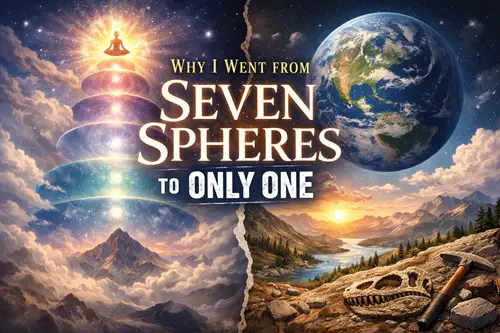 There was a time when I believed reality came in layers.[1] Not metaphorical layers, but literal ontological strata: physical, etheric, astral, mental, causal—sometimes seven, sometimes more, depending on the tradition. Each sphere had its own laws, inhabitants, modes of perception, and levels of consciousness. The physical world, in this scheme, was merely the lowest rung on a vast metaphysical ladder. Today, I believe in only one world: the physical world. This was not a sudden conversion, nor a dramatic loss of faith. It was a slow, almost reluctant disentangling from a worldview that once felt expansive, meaningful, and spiritually generous. What changed was not my taste for depth or complexity, but my standards for what counts as an explanation. The Seduction of Vertical CosmologiesMulti-sphere models have an obvious appeal. They promise depth without loss, meaning without constraint, transcendence without sacrifice. They explain consciousness by placing it “higher,” suffering by calling it “lower,” and disagreement by invoking differences in spiritual altitude. They are rich, imaginative, and—importantly—immune to disconfirmation. That immunity eventually became a problem. The more I examined these layered cosmologies, the more I noticed a recurring pattern: the higher the sphere, the thinner the evidence. Descriptions varied wildly between traditions, yet each claimed privileged access. Disagreements were never resolved empirically, only hierarchically: those who disagreed simply had not reached the same level. At some point, I had to ask a simple but corrosive question: What would count against this model? The honest answer was: nothing. And a worldview that cannot, even in principle, be wrong is not profound—it is unconstrained. Applying One Standard, Not TwoWhat finally shifted was my willingness to apply the same epistemic standards to metaphysics that we routinely apply to science. In physics or biology, explanations must constrain expectations, generate predictions, and survive contact with evidence. In esoteric metaphysics, explanation often runs in the opposite direction: anything that happens is absorbed post hoc into the system. The seven spheres explained everything and therefore explained nothing in particular. Once I stopped granting metaphysical claims a special exemption from accountability, the elaborate superstructure began to feel less like a discovery and more like an inheritance—something received, not earned. Evolution as the Breaking PointEvolution was the decisive stress test. In many multi-sphere frameworks—Theosophy, Integral Theory, and their descendants—evolution is quietly reinterpreted. It is no longer a blind, contingent, and often brutal process driven by variation and selection, but a spiritually guided ascent. Matter strains toward mind; life strains toward consciousness; consciousness strains toward Spirit. But this “spiritualized evolution” does not arise from evolutionary biology. It is layered on top of it. The actual evolutionary record tells a very different story: one of waste, extinction, dead ends, and indifference to meaning. Most species that ever lived are gone. Complexity is local, fragile, and reversible. There is no empirical arrow pointing toward enlightenment, only branching paths shaped by survival pressures. To preserve the seven spheres, evolution had to be domesticated—turned into a cosmic Bildungsroman. That move struck me as intellectually indefensible. Evolution does not need metaphysical supplementation, and when it is given one, the result is not synthesis but distortion. At that point, the cost of maintaining multiple worlds became too high. Discovering Depth Without AltitudeAbandoning the seven spheres did not flatten reality; it deepened it. The physical world, understood through contemporary science, turned out to be far stranger, richer, and more counterintuitive than any esoteric map. Consciousness did not evaporate when removed from higher planes; it became a genuine problem rather than a premature solution. Meaning did not disappear either. It relocated—from cosmic guarantees to human construction, from metaphysical destiny to historical contingency. Most importantly, I no longer needed a vertical hierarchy to explain difference. Disagreement no longer implied spiritual inferiority. Insight no longer required ontological escalation. One World Is EnoughI did not trade seven worlds for one because I became less curious or less open. I did so because I became more demanding. I no longer wanted a worldview that grows by adding invisible layers whenever explanation runs thin. One world is enough—provided we take it seriously. The physical world resists our wishes, corrects our theories, and surprises us without regard for our spiritual preferences. It does not flatter us, but it does something better: it pushes back. And in that resistance lies a depth no multi-sphere cosmology ever truly achieved. What I lost in metaphysical altitude, I gained in intellectual honesty. And that, I have come to believe, is a trade worth making. NOTES[1] I actually once wrote a book about this worldview: Seven Spheres (1995). In the Reading Room you can read four chapters from that book: Views of Human Nature, Spheres Upon Spheres, Three Model of Immortality and Reincarnation and the Spheres.
Comment Form is loading comments...
|