|
TRANSLATE THIS ARTICLE
Integral World: Exploring Theories of Everything
An independent forum for a critical discussion of the integral philosophy of Ken Wilber
  Frank Visser, graduated as a psychologist of culture and religion, founded IntegralWorld in 1997. He worked as production manager for various publishing houses and as service manager for various internet companies and lives in Amsterdam. Books: Ken Wilber: Thought as Passion (SUNY, 2003), and The Corona Conspiracy: Combatting Disinformation about the Coronavirus (Kindle, 2020). Frank Visser, graduated as a psychologist of culture and religion, founded IntegralWorld in 1997. He worked as production manager for various publishing houses and as service manager for various internet companies and lives in Amsterdam. Books: Ken Wilber: Thought as Passion (SUNY, 2003), and The Corona Conspiracy: Combatting Disinformation about the Coronavirus (Kindle, 2020).
Check out my other conversations with ChatGPT The Attention Economy in the Age of AIScarcity, Illusions, and New Reading SkillsFrank Visser / ChatGPT
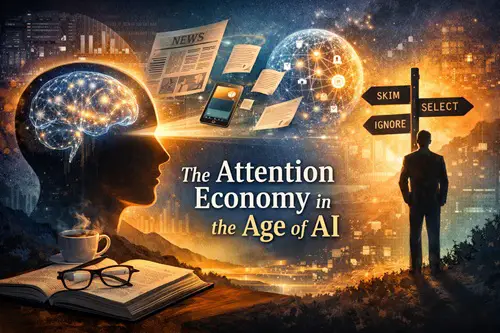 A familiar objection has emerged in response to the daily publication of multiple essays: there is simply not enough bandwidth. Readers feel overwhelmed, unable—or unwilling—to keep up. The claim sounds reasonable. Attention is scarce, after all. Yet the objection raises an immediate and revealing question: how, then, do these same readers manage to read newspapers? Most people do not read newspapers linearly. They skim headlines, ignore entire sections, dip into an article here, a column there, and often abandon pieces halfway through. No one complains that a newspaper contains too much content. Its abundance is taken for granted. What matters is not total volume, but how readers navigate it. This distinction becomes crucial in the age of AI. The False Scarcity of ContentAI has radically lowered the cost of producing text. Essays, analyses, summaries, counterarguments, and dialogues can now be generated at a scale previously reserved for institutions. This has led to a widespread anxiety: content overload. But this diagnosis misidentifies the problem. Content is no longer scarce. Attention is. And attention has always been scarce. What has changed is not the quantity of material, but the reader's expectation that they must consume it all—or that it has been curated on their behalf. Newspapers solved this problem long ago through structural cues: sections, headlines, editorial hierarchy, and implicit permission to skip. AI-generated and AI-assisted publishing often lacks these cues, leading readers to experience abundance as obligation. The resulting stress is self-inflicted. From Consumption to NavigationThe key shift required today is a move from content consumption to attention navigation. In a high-volume environment—whether a newspaper, a blog, or an AI-driven essay stream—the reader's task is not to keep up, but to choose intelligently. This involves: • Scanning rather than reading as a first pass • Sampling rather than completing • Returning later to what resonates • Letting go of what does not Daily publication does not imply daily reading. It implies availability, not demand. Seen this way, the complaint “I don't have the bandwidth” translates more accurately into: I have not yet adapted my reading habits to abundance. AI Changes the Producer-Reader ContractTraditional publishing operated under an implicit contract: scarcity justified obligation. A monthly journal or weekly magazine deserved to be read carefully because production was slow, selective, and gatekept. AI breaks this contract. When production becomes cheap and continuous, the moral pressure to consume evaporates. What replaces it is a new ethic: selective engagement without guilt. Readers must unlearn the idea that skipping is failure. In the AI era, skipping is competence. Making the Most of the Attention EconomyTo thrive—rather than drown—in this environment, readers can adopt a few simple principles: Treat essay streams like newspapers, not novels You are not meant to read everything, nor in order. Read for signals, not completeness Titles, introductions, section headers, and conclusions often suffice to extract value. Use resonance as a filter If a piece speaks to a current question or irritation, read it fully. If not, move on. Allow asynchronous engagement Essays do not expire. Today's unread piece may become tomorrow's insight. Accept partial knowledge In an abundant environment, depth comes from revisiting a few themes repeatedly, not from touching everything once. The Irony of the ObjectionIronically, those who complain about overload often spend hours scrolling algorithmically optimized feeds—news, social media, video—designed explicitly to fragment attention. Compared to this, a stream of long-form essays is not an assault on attention, but an invitation to reclaim it on one's own terms. The problem is not too much writing. The problem is outdated reading habits. Conclusion: Attention as a Skill, Not a ResourceIn the age of AI, attention is no longer something to be protected by limiting output. It is something to be trained. Just as literacy once meant learning how to read, attention literacy now means learning how not to read everything. Daily essays are not a demand on your bandwidth. They are a library with open doors. You decide which shelves to visit—and when.
Widget is loading comments...
|