|
TRANSLATE THIS ARTICLE
Integral World: Exploring Theories of Everything
An independent forum for a critical discussion of the integral philosophy of Ken Wilber
  Frank Visser, graduated as a psychologist of culture and religion, founded IntegralWorld in 1997. He worked as production manager for various publishing houses and as service manager for various internet companies and lives in Amsterdam. Books: Ken Wilber: Thought as Passion (SUNY, 2003), and The Corona Conspiracy: Combatting Disinformation about the Coronavirus (Kindle, 2020). Frank Visser, graduated as a psychologist of culture and religion, founded IntegralWorld in 1997. He worked as production manager for various publishing houses and as service manager for various internet companies and lives in Amsterdam. Books: Ken Wilber: Thought as Passion (SUNY, 2003), and The Corona Conspiracy: Combatting Disinformation about the Coronavirus (Kindle, 2020).
Check out my other conversations with ChatGPT
ON BERNARDO KASTRUP:
Why Idealism is Bonkers 'Why the Tree Will Continue to Be' 'We don't know whether mutations are really random or not' 'A Universe in Consciousness': Merits and Shortcomings Is Bernardo Kastrup Bonkers? My Take on Bernardo Kastrup's Analytic Idealism The Quicksand Cathedral: A Devastating Critique Debunking Bernardo Kastrups Philosophy In A Nutshell David Chalmers on Idealism and the Mind-Body Problem From Spirit to Mind-at-Large: The Metaphysical Temptation Why Cosmic Idealism Explains Too Much From Spirit to Mind-at-LargeKen Wilber and Bernardo Kastrup as Variations on the Same Metaphysical TemptationFrank Visser / ChatGPT
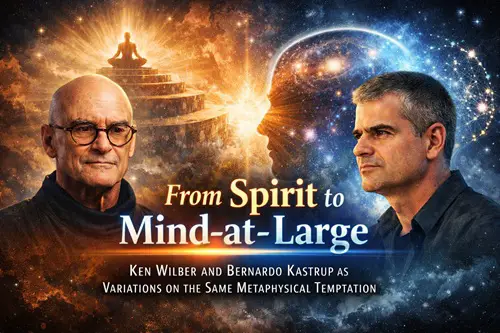 At first glance, Ken Wilber and Bernardo Kastrup seem to occupy opposite ends of the philosophical spectrum. Wilber is associated with spiritual evolution, higher realms, and a grand metaphysical hierarchy; Kastrup presents himself as a hard-nosed analytic philosopher, rejecting mysticism, religion, and supernaturalism. One speaks the language of Spirit, the other of consciousness. One appeals to contemplative traditions, the other to neuroscience and philosophy of mind. And yet, structurally, they are doing something remarkably similar. Both thinkers respond to the limitations of scientific materialism not with epistemic restraint, but with metaphysical expansion. Both treat unresolved explanatory problems as invitations to ontological inflation. And both end up smuggling metaphysical conclusions into the gaps left by contemporary science—while claiming to have transcended reductionism. 1. The shared starting point: dissatisfaction with materialismWilber and Kastrup begin from a legitimate critique. Materialism, especially in its naïve or eliminative forms: • struggles to account for consciousness and subjectivity • privileges third-person descriptions over lived experience • tends toward flattening explanations • often overreaches rhetorically in the name of science So far, so good. But here is where critique turns into construction—and where both thinkers make their decisive move. Rather than concluding “our theories are incomplete”, they conclude “reality itself must be more than science allows.” That “more” is where metaphysics enters. 2. Wilber's move: from experiential depth to cosmic hierarchyWilber's trajectory is well known. • Human consciousness exhibits depth, development, and transformation. • Contemplative traditions report non-ordinary states of awareness. • Science cannot fully account for these phenomena. • Therefore, reality itself must be stratified into higher ontological levels: subtle, causal, nondual realms. The critical step is not the acknowledgment of experience—it is the reification of experience into metaphysical structure. Wilber treats spiritual phenomenology as evidence for: • ontologically real higher realms • Eros as a cosmic evolutionary force • a universe intrinsically oriented toward Spirit The result is a metaphysics that looks sophisticated, integrative, and “post-reductionist,” but which rests on a familiar fallacy: experiential reports are taken as ontological disclosures. 3. Kastrup's move: from epistemic primacy to ontological idealismKastrup performs a parallel maneuver, dressed in analytic clothing. • Conscious experience is epistemically undeniable. • Materialism struggles to explain how experience arises from matter. • Therefore, matter cannot be fundamental. • Therefore, reality itself must be mentalr—“mind-at-large.” Again, the problem is not the critique; it is the conclusion. Kastrup repeatedly slides from: “We only know reality through experience” to “Reality itself is experiential.” This is not a trivial shift. It is a category mistake, turning an epistemic constraint into an ontological claim. Where Wilber posits Spirit-in-action, Kastrup posits cosmic consciousness. Where Wilber invokes involution and evolution, Kastrup invokes dissociation. Different vocabularies; same metaphysical escalation. 4. Gaps as gateways: the shared fallacyThe deeper commonality lies here: Both thinkers treat explanatory gaps as ontological signals. • Wilber: science cannot explain mystical states ? therefore higher realms exist • Kastrup: science cannot explain consciousness ? therefore matter is derivative In both cases, lack of explanation is treated as evidence of metaphysical reality. This is structurally identical to the move they both claim to oppose in religious thought: “Science can't explain X, therefore God.” Replace God with Spirit. Replace God with Mind-at-Large. The form remains unchanged. 5. Parsimony as theaterBoth Wilber and Kastrup invoke parsimony—but only rhetorically. Wilber claims his system “includes and transcends” science, while multiplying ontological domains beyond necessity. Kastrup claims idealism is simpler than materialism, while introducing: • a universal cosmic mind • dissociative processes without independent empirical grounding • metaphorical mechanisms standing in for explanation In neither case is parsimony doing real work. It functions as aesthetic reassurance, not methodological discipline. 6. Why both appeal to intelligent audiencesThe appeal is not accidental. Both frameworks offer: • metaphysical depth without traditional theism • a sense of cosmic meaning without church doctrine • an escape from reductionism without abandoning intellectual self-image • the feeling of having seen “beyond” mainstream science Wilber attracts spiritually inclined intellectuals dissatisfied with secular modernity. Kastrup attracts philosophically inclined atheists dissatisfied with mechanistic naturalism. Same hunger. Different menu. 7. The sober alternative both avoidWhat both Wilber and Kastrup systematically underplay is the most boring—but most responsible—option: We don't yet know. There is no shame in acknowledging that consciousness, subjectivity, and meaning are not fully explained. But intellectual patience is less intoxicating than metaphysical vision. Between materialism and idealism lies a wide field: • non-reductive physicalism • neutral monism • dual-aspect theories • emergentist frameworks • deflationary metaphysics None promise cosmic revelation. All respect the difference between what we experience and what exists. Conclusion: the same temptation, twice refinedKen Wilber spiritualized evolution. Bernardo Kastrup mentalized reality. Both mistook the limits of explanation for metaphysical insight. Their systems differ in tone, audience, and vocabulary, but they share a common temptation: to turn dissatisfaction with science into confidence about ultimate reality. The lesson is not to defend materialism at all costs. It is to resist the urge to replace one overreach with another. Sometimes, the most rational position is not transcendence—but restraint.
Widget is loading comments...
|