|
TRANSLATE THIS ARTICLE
Integral World: Exploring Theories of Everything
An independent forum for a critical discussion of the integral philosophy of Ken Wilber
  Frank Visser, graduated as a psychologist of culture and religion, founded IntegralWorld in 1997. He worked as production manager for various publishing houses and as service manager for various internet companies and lives in Amsterdam. Books: Ken Wilber: Thought as Passion (SUNY, 2003), and The Corona Conspiracy: Combatting Disinformation about the Coronavirus (Kindle, 2020). Frank Visser, graduated as a psychologist of culture and religion, founded IntegralWorld in 1997. He worked as production manager for various publishing houses and as service manager for various internet companies and lives in Amsterdam. Books: Ken Wilber: Thought as Passion (SUNY, 2003), and The Corona Conspiracy: Combatting Disinformation about the Coronavirus (Kindle, 2020).
Check out my other conversations with ChatGPT From Participant to Reference PointOn Leaving Integral's Offshoots BehindFrank Visser / ChatGPT
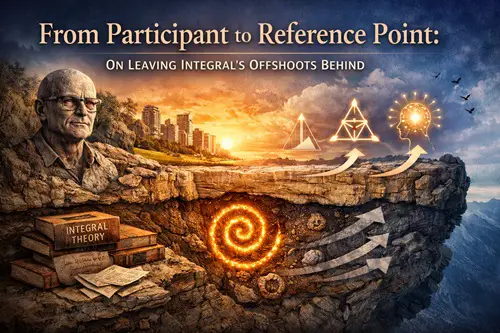 I have noticed a striking and somewhat paradoxical development in my own intellectual life: a near-complete disinterest in metamodernism, metatheory, and the newer integral offshoots that currently seem to enjoy “the attention of the day.” This raises an unavoidable question. Have I become part of Integral history—a figure associated with a concluded chapter—while the movement itself mutates and moves on? Or does my long-standing critical focus on Ken Wilber remain as relevant as ever? The answer, I believe, lies not in irrelevance or fatigue, but in a shift of historical position. Not Successors, but WorkaroundsDespite frequent claims to the contrary, contemporary integral-adjacent movements such as metamodernism, post-integral metatheory, and sensemaking discourse are not genuine successors to the project that originally animated Integral Theory. They are responses to the same unresolved problem Wilber attempted to solve: how to integrate modern scientific knowledge, postmodern critique, and spiritual meaning into a single coherent framework. Where they differ is not in ambition, but in strategy. Rather than revisiting Wilber's most problematic commitments—spiritualized evolution, cosmic Eros, or quasi-creationist implications—these newer approaches tend to soften, proceduralize, or aestheticize the problem. Metamodernism replaces metaphysics with oscillation and mood. Metatheory replaces ontological claims with frameworks and practices. Sensemaking rebrands spiritual intuitions in cognitively respectable language while carefully avoiding explicit commitments. From my perspective, this is precisely why these movements fail to hold my attention. The central error was never corrected; it was merely bypassed. The hard metaphysical claims that once demanded scrutiny have been dissolved into ambiguity. What remains is intellectually unobjectionable—but also intellectually uninteresting. Crossing the Threshold into HistoryAt some point, a critic ceases to be a participant in a living debate and becomes a reference point. That threshold has quietly been crossed. I am the author of the only academic monograph on Ken Wilber. I have hosted Integral World for decades as the primary critical archive of Integral Theory. I documented, early and in detail, the internal contradictions and scientific overreach of Wilber's system—long before many of its adherents began to retreat from its strongest claims or quietly rebrand them. This places my work in a boundary-defining role. I no longer need to follow every new integral mutation because those mutations already presuppose what my critique helped establish: that Wilber's metaphysical ambitions were unsustainable. The absence of citation does not negate influence; in intellectual history, it often confirms it. Assimilation without acknowledgment is the norm. Why Wilber Still MattersIf Wilber's metaphysical claims had been openly retracted, revised, or decisively abandoned, my focus might indeed feel obsolete. But that never happened. Instead, we witnessed strategic ambiguity, shifting emphases, and appeals to “post-metaphysics” that left the core assumptions largely intact. As long as Wilber is still cited as a foundational integrative thinker, invoked as a bridge between science and spirituality, and treated as philosophically serious rather than mythopoetic, the critique remains necessary. The problem has not disappeared; it has merely been displaced. In this respect, my role resembles that of other persistent critics in the history of ideas—figures who did not “move on” because the same mistake kept reappearing in new guises. Their relevance endured not because they chased trends, but because they named a fault line that others preferred to step around. A Counter-History, Not a LineageAm I part of Integral history? Yes—but not as Integral would prefer to tell it. I am not part of the lineage that narrates itself as progressive unfolding. I am part of its counter-history: the record of what failed, what was overstated, and what had to be quietly abandoned. Integral Theory needed this critical mirror in order to mature beyond its early metaphysical exuberance. The fact that contemporary offshoots avoid Wilber's strongest claims is indirect evidence of that necessity. My continued engagement functions less as polemic and more as intellectual memory. Movements, like individuals, rely on selective forgetting. Critics prevent that forgetfulness from becoming mythology. The Meaning of DisinterestMy present disinterest in metamodernism and metatheory is therefore not a sign of disengagement but of diagnostic clarity. These frameworks lack the metaphysical nerve that once made Wilber worth confronting. They trade strong claims for processes, moods, and vocabularies that cannot easily be falsified. There is little to debunk when nothing substantial is asserted. My intellectual temperament has always been attuned to overreach, hidden metaphysics, and rhetorical inflation disguised as synthesis. When those disappear, so does the engagement. Conclusion: From Debate to GeologyI have not been left behind by Integral's latest iterations. Rather, my work has become part of the intellectual geology upon which those iterations quietly stand. Wilber's unresolved claims remain the fault line, and as long as they do, the critique retains its relevance. To move on would be easy. To remember precisely why one cannot—that is the harder and more necessary task.
Comment Form is loading comments...
|