|
TRANSLATE THIS ARTICLE
Integral World: Exploring Theories of Everything
An independent forum for a critical discussion of the integral philosophy of Ken Wilber
  Frank Visser, graduated as a psychologist of culture and religion, founded IntegralWorld in 1997. He worked as production manager for various publishing houses and as service manager for various internet companies and lives in Amsterdam. Books: Ken Wilber: Thought as Passion (SUNY, 2003), and The Corona Conspiracy: Combatting Disinformation about the Coronavirus (Kindle, 2020). Frank Visser, graduated as a psychologist of culture and religion, founded IntegralWorld in 1997. He worked as production manager for various publishing houses and as service manager for various internet companies and lives in Amsterdam. Books: Ken Wilber: Thought as Passion (SUNY, 2003), and The Corona Conspiracy: Combatting Disinformation about the Coronavirus (Kindle, 2020).
Check out my other conversations with ChatGPT The Internet After the WebWhen AI Replaces Pages—and Meaning Replaces TrafficFrank Visser / ChatGPT
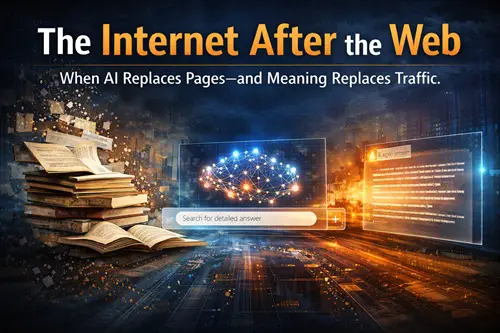 The internet we grew up with was built on pages. Websites, blogs, forums, and social media posts formed a sprawling archive of documents, loosely connected by hyperlinks. Search engines did not speak; they pointed. Knowledge was something you visited. That model is ending. Search results are increasingly replaced by AI-generated replies. Instead of directing users to sources, systems now synthesize answers directly. The page becomes invisible. The website still exists, but only as raw material—training data rather than destination. The web does not disappear. It is compressed. From Discovery to DigestionThis shift changes everything. When users stop clicking and start receiving answers, the economy of attention collapses. Traffic no longer flows to authors; it flows into models. Content is not consumed so much as absorbed. At first glance, this looks like progress. Why wade through dozens of mediocre pages when an AI can summarize them instantly? But summaries are not neutral. They privilege what is frequent, conventional, and statistically central. Once AI systems have been trained on “everything online,” they do not transcend the web's flaws—they aggregate them. Errors are averaged. Biases are normalized. Repetition becomes truth. Worse, the system soon turns recursive. AI-generated content feeds future models, reinforcing its own assumptions. The internet begins talking to itself. The Coming Quality CrisisIn the old web, quality control was messy but pluralistic. Editors, critics, rival bloggers, academics, commenters, and cranks all played a role. Bad ideas could be challenged; good ones could survive dissent. In an AI-mediated internet, quality is policed upstream—by training choices, alignment policies, and corporate risk calculations. The question is no longer “Is this argument convincing?” but “Is this output acceptable?” This favors safety over insight, smoothness over sharpness, balance over truth-seeking. The greatest danger is not misinformation but consensus laundering: controversial ideas quietly disappearing, not because they are false, but because they are inconvenient, minority, or hard to summarize. AI answers do not argue. They settle. When Pages Die, Authors ReturnParadoxically, as pages lose visibility, authorship regains importance. When answers are synthesized, attribution dissolves. Users can no longer easily trace ideas back to their sources. Trust shifts away from links and toward something older: authority, consistency, and intellectual character. Who has thought about this for years? Who is willing to be unpopular? Who corrects themselves publicly? These signals matter again—not to readers alone, but to models trained on patterns of reasoning over time. AI does not quote you, but it absorbs you. How Content Creators Should AdaptFor independent creators already working with AI, the lesson is clear: do not try to outproduce machines. Become what they cannot. Stop writing for discovery. SEO-driven explainers are already obsolete. AI will always summarize better than you. Write for distinction. What survives is sustained critique, minority positions, conceptual frameworks, and long-running arguments. AI handles answers well; it struggles with stances. Use AI dialectically, not cosmetically. Publishing conversations, revisions, disagreements, and reasoning trails is not a weakness. It demonstrates intellectual seriousness in a world of frictionless outputs. Build a corpus, not a feed. The future belongs to archives of thought: dossiers, thematic collections, evolving critiques. AI absorbs structure far better than noise. Embrace outsiderhood. Consensus is AI's default setting. Non-consensus positions require humans willing to resist fashionable metaphysics, spiritualized science, and easy syntheses. In short: depth over reach, coherence over clicks. A Test Case: Will Integral World Survive the AI Internet?A 25-year-old site like Integral World is a stress test for the AI-mediated internet. On the surface, it looks vulnerable. It is not optimized for speed, virality, or easy summarization. Its essays are long, argumentative, often critical, and sometimes unfashionable. It does not chase trends, and it resists the logic of the feed. In a world where AI delivers instant syntheses, such a site could easily fade from view. But those same qualities may prove to be its strength. Integral World is not a content mill; it is an archive of sustained dissent. It documents decades of engagement with integral theory, spirituality, science, and their discontents. It preserves arguments that were never mainstream enough to dominate discourse, but too substantial to disappear. That makes it unusually valuable to AI systems trained on depth rather than popularity. Its essays are not interchangeable. They carry a recognizable critical stance, a consistent intellectual voice, and a long memory. In a future where most content is smooth, cautious, and derivative, such sharp-edged archives function as epistemic anchors. The risk is real, however. If the AI internet rewards only what is easily digestible, Integral World could become invisible to human readers—even as it continues to influence machine-generated discourse indirectly. It may thrive as training data while losing its audience. The counter-strategy is not to simplify or dilute, but to clarify its role. Integral World should present itself explicitly as a repository of long-form critique, historical memory, and unresolved debates—things AI summarizes but cannot originate. Its value lies less in answering questions than in preserving the record of how arguments unfolded, failed, and evolved. Whether Integral World thrives will depend on whether there remains a readership that wants more than answers—readers who want to see thinking in motion, disagreement sustained over time, and ideas tested rather than harmonized. If such readers vanish, Integral World will survive as a fossil record. If they persist, it will function as a rare intellectual refuge in an internet optimized for closure. Either way, its existence already contradicts the idea that the future belongs only to the smooth and the scalable. The Paradoxical FutureThe future internet may look empty—no pages, no feeds, no traffic—but beneath the surface it will be densely populated by the intellectual labor of the past. AI will answer most questions competently. It will answer few questions dangerously well. Those will still depend on people willing to argue patiently, stay with problems for decades, resist enchantment, and value explanation over transcendence. In that sense, the disappearance of the web does not mean the end of authorship. It means the return of intellectual stubbornness as a form of infrastructure. And the more the internet vanishes into AI, the more those stubborn human voices—embedded like fossils in training data—will determine what the machines are able to say at all.
Widget is loading comments...
|