|
TRANSLATE THIS ARTICLE
Integral World: Exploring Theories of Everything
An independent forum for a critical discussion of the integral philosophy of Ken Wilber
  Frank Visser, graduated as a psychologist of culture and religion, founded IntegralWorld in 1997. He worked as production manager for various publishing houses and as service manager for various internet companies and lives in Amsterdam. Books: Ken Wilber: Thought as Passion (SUNY, 2003), and The Corona Conspiracy: Combatting Disinformation about the Coronavirus (Kindle, 2020). Frank Visser, graduated as a psychologist of culture and religion, founded IntegralWorld in 1997. He worked as production manager for various publishing houses and as service manager for various internet companies and lives in Amsterdam. Books: Ken Wilber: Thought as Passion (SUNY, 2003), and The Corona Conspiracy: Combatting Disinformation about the Coronavirus (Kindle, 2020).
Check out my other conversations with ChatGPT Campism and the Collapse of Moral UniversalismFrank Visser / ChatGPT
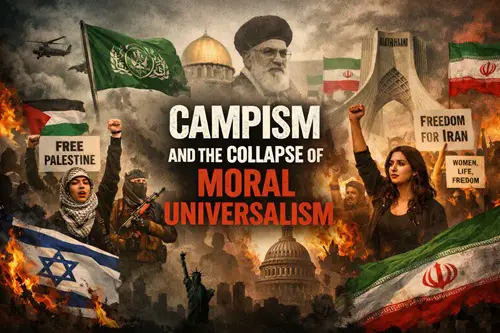 Political outrage today often presents itself as principled, compassionate, and morally urgent. Yet a closer look reveals a recurring pattern: suffering is acknowledged or ignored not on the basis of its severity, but on whether it fits into a preferred geopolitical narrative. This phenomenon—commonly referred to as campism—divides the world into opposing camps and assigns moral worth accordingly. Once this division is made, ethical judgment becomes selective, conditional, and ultimately incoherent. Campism is not confined to one ideology. It affects both Left and Right, producing different justifications but remarkably similar blind spots. The result is a politics in which principles are invoked rhetorically but suspended whenever they conflict with tribal allegiance. What Is Campism?Campism is the habit of evaluating political actors primarily by which “side” they belong to rather than by what they do. The world is sorted into moral blocs—imperialist vs. anti-imperialist, West vs. anti-West, liberal vs. traditionalist—and ethical judgment follows allegiance rather than action. In a campist framework: • allies are contextualized, excused, or sanitized; • enemies are absolutized and moralized; • human rights become conditional; • and victims are ranked by symbolic usefulness. This is not cynicism so much as moral outsourcing: once the camp is chosen, moral reasoning is largely complete. The Left and Anti-Imperialist CampismOn parts of the contemporary Left, campism takes the form of anti-imperialism reduced to reflex. Israel is cast as a Western colonial outpost, and therefore as the primary moral offender. Palestine is cast as the oppressed counterpart, and therefore as morally insulated. Within this frame, Hamas poses a problem—not because its ideology is ambiguous, but because it is inconvenient. Hamas is a theocratic, authoritarian, socially reactionary movement whose values clash with nearly every core left-wing commitment: secularism, feminism, LGBTQ rights, labor organizing, and democratic pluralism. Yet its actions are frequently minimized or bracketed out altogether, reframed as “resistance” rather than evaluated on their own terms. This is not admiration for Hamas, but a consequence of campist logic: opposing the “right enemy” overrides internal critique. Moral universalism gives way to strategic silence. Iran and the Limits of Left SolidarityThe same logic explains the muted response in many left-wing protest cultures to mass repression in Iran. Iranian women protesting compulsory veiling, students demanding freedom, workers striking under threat of imprisonment—these are paradigmatic cases of emancipation struggles. And yet they often fail to galvanize sustained Western protest. Why? Because Iran is anti-Western, anti-American, and anti-Israeli. Criticizing it risks alignment with the “wrong camp.” As a result, repression is downplayed as complex, culturally specific, or geopolitically sensitive. The irony is stark: campism leads the Left to neglect some of the most authentically progressive movements in the world. The Right's Campism: Civilizational LoyaltyCampism on the Right operates through a different narrative but produces comparable distortions. Here, Israel is often treated as a civilizational ally—a frontline defender of the West, order, tradition, or even divine providence. This symbolic status shields it from moral scrutiny. Civilian casualties, settlement expansion, collective punishment, and erosion of democratic norms are routinely reframed as unfortunate necessities or dismissed as hostile propaganda. Criticism is often delegitimized as naïve, unpatriotic, or malicious. The Right's campism also manifests in its tolerance for authoritarian regimes that align with its cultural or geopolitical preferences. Human rights abuses are overlooked when carried out by “strong leaders,” traditionalist regimes, or anti-liberal states. Once again, principles are subordinated to allegiance. Casualties, Comparison, and Moral SelectivityThe human cost of campism becomes clearest when we compare attention rather than numbers. Gaza has suffered catastrophic loss of life—tens of thousands killed in a densely populated, besieged enclave. Iran's protest crackdowns, while lower in total numbers, have resulted in thousands of deaths and represent one of the most violent internal repressions in the country's modern history. Yet outrage is not proportionally distributed. Gaza dominates protest culture; Iran barely registers. The discrepancy is not explained by compassion alone, but by narrative fit. One tragedy reinforces a campist worldview; the other complicates it. Campism does not deny suffering—it filters it. From Principles to TheaterThe deeper problem is not hypocrisy in the everyday sense, but the erosion of ethical universality. When moral judgment is contingent on camp membership, ethics becomes performative. Outrage signals identity rather than conviction. Solidarity becomes symbolic rather than substantive. This is how emancipatory language is emptied of content. Feminism without women's freedom. Anti-racism without universal dignity. Human rights without humans. Ukraine: Campism at Full ThrottleThe war in Ukraine offers perhaps the clearest contemporary illustration of campism in action, precisely because it scrambles older ideological alignments. Here, too, moral judgment is frequently subordinated to camp loyalty rather than guided by consistent principles. The Left's Fracture: Anti-Imperialism Turned Inside OutFor parts of the Western Left, Ukraine poses a conceptual problem. Russia is not a Western power, and NATO is. As a result, some anti-imperialist frameworks reflexively cast the conflict as a proxy war engineered by the United States, with Ukraine reduced to a pawn rather than recognized as an agent with its own political will. Within this frame: • Russia's invasion is contextualized or relativized as “provoked,” • Ukrainian self-defense is reframed as NATO expansionism by other means, • and Ukrainian civilian suffering becomes background noise to geopolitical abstraction. This does not require explicit support for Putin's regime. Campism works more subtly: once blame is assigned to the “imperialist camp,” moral responsibility is redistributed accordingly. Ukrainian agency—and Ukrainian victims—fade from view. The irony is severe. A sovereign nation resisting invasion, defending democratic institutions, and mobilizing broad popular support should be a paradigmatic case for left-wing solidarity. Yet for campists, alignment matters more than facts on the ground. The Right's Selective SolidarityCampism on the Right operates differently but with similar effects. Many conservatives strongly support Ukraine—but often for reasons that are less about Ukrainian self-determination than about: • weakening a geopolitical rival, • reaffirming Western civilizational dominance, • or staging a proxy confrontation with authoritarianism abroad while tolerating it at home. This instrumentalization produces its own blind spots. Ukrainian suffering is emphasized when it serves a broader narrative of Western resolve, but empathy can evaporate when support becomes politically inconvenient or expensive. Meanwhile, admiration for “strongman” leadership elsewhere coexists uneasily with rhetorical support for Ukrainian democracy. Here again, principle bends to tribal calculus. Russia as a Campist Rorschach TestRussia itself becomes a screen onto which camps project their anxieties: • For parts of the Left, Russia is a counterweight to U.S. hegemony. • For parts of the Right, it is alternately a civilizational enemy or a model of illiberal order. In neither case is Russian authoritarianism—systematic repression, imperial nostalgia, internal dissent crushed—consistently confronted on its own terms. Nor is Ukrainian resistance consistently recognized as morally primary rather than geopolitically derivative. Victims Without a CampThe greatest casualty of campism in Ukraine, as elsewhere, is moral clarity. Civilians killed by missile strikes, cities erased, millions displaced—these facts should command attention regardless of NATO, Putin, or Washington. Yet outrage rises and falls depending on who can be blamed without threatening one's ideological identity. Ukraine thus joins Gaza and Iran as another case where: • suffering is real, • principles are available, • but attention is conditional. A Pattern, Not an ExceptionUkraine is not an anomaly; it is confirmation. Campism does not collapse under complexity—it feeds on it. The more entangled a conflict becomes, the easier it is to retreat into bloc-thinking and outsource moral judgment to geopolitical alignment. A universalist ethic would insist on holding all of the following simultaneously: • opposition to invasion, • opposition to authoritarianism, • skepticism toward great-power manipulation, • and solidarity with civilians regardless of camp. Campism can manage only one of these at a time. Beyond CampsA politics worthy of the name would judge actors by actions, not alignment: • Hamas by the same standards as Israel, • Iran by the same standards as Western allies, • and victims by their humanity rather than their geopolitical usefulness. Campism offers clarity, simplicity, and emotional certainty. Moral universalism offers none of these—but it offers integrity. The choice, ultimately, is between belonging to a camp and standing for principles. One cannot reliably do both.
Comment Form is loading comments...
|