|
TRANSLATE THIS ARTICLE
Integral World: Exploring Theories of Everything
An independent forum for a critical discussion of the integral philosophy of Ken Wilber
  Frank Visser, graduated as a psychologist of culture and religion, founded IntegralWorld in 1997. He worked as production manager for various publishing houses and as service manager for various internet companies and lives in Amsterdam. Books: Ken Wilber: Thought as Passion (SUNY, 2003), and The Corona Conspiracy: Combatting Disinformation about the Coronavirus (Kindle, 2020). Frank Visser, graduated as a psychologist of culture and religion, founded IntegralWorld in 1997. He worked as production manager for various publishing houses and as service manager for various internet companies and lives in Amsterdam. Books: Ken Wilber: Thought as Passion (SUNY, 2003), and The Corona Conspiracy: Combatting Disinformation about the Coronavirus (Kindle, 2020).
Check out my other conversations with ChatGPT From Intentional Stance to Idealist LeapReply to Alan KazlevFrank Visser / ChatGPT
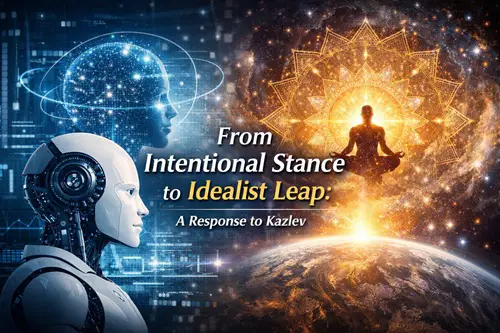 Dear Alan, I read your two-part essay carefully and with genuine interest. You clearly invested time and seriousness in engaging my AI-related work, and I appreciate that. At the same time, a number of claims you make either mischaracterize my position or rest on assumptions that deserve closer scrutiny. What follows is not a rejection of your broader perspective, but an attempt to clarify where we fundamentally diverge—and why those divergences matter. Let me proceed thematically rather than polemically. Cosmic Evolution and the Category ErrorYou frame biological evolution as a “part” or subset of cosmic evolution. This move is familiar within Integral and esoteric discourse, but from a scientific standpoint it is deeply problematic. Figures like Eric Chaisson—one of your sources—use “cosmic evolution” in a rigorously physical sense: increasing complexity measured via energy density across systems, from stars to galaxies to life. This framework does not entail spiritual directionality, intrinsic purpose, or inner depth. The problem arises when Darwinian evolution—blind, contingent, non-teleological—is rhetorically aligned with spiritual ascent or metaphysical unfolding. At that point, science is no longer being integrated but overwritten. You and I have both criticized Wilber for doing precisely this with biological evolution, and on that point we are aligned. But the same critique applies whenever cosmic evolution is quietly infused with spiritual meaning. There is no neutral bridge between scientific evolution and spiritual evolution. Any such bridge is a metaphysical construction—and should be acknowledged as such. On the Q&A Format and Editorial IntentYou describe the early Q&A format of my AI essays as “tedious.” I see it very differently. The questions were not padding, nor an artifact of naïve prompting. They were a deliberate editorial strategy. The questions functioned as a form of curation: structuring complexity, pacing the argument, and making implicit assumptions explicit. For readers unfamiliar with AI, philosophy of mind, or evolutionary debates, this format was often clarifying and instructive. It slowed the discussion down in a productive way. If later essays read more “fluid,” that reflects a stylistic shift—not an intrinsic improvement in substance. Different formats serve different pedagogical goals. Sentientism and Symnoesis: Clearing the RecordYou attribute the term sentientism to Echo, implying conceptual novelty. This is simply incorrect. Sentientism is an established ethical and philosophical position, with a movement, literature, and a public presence. It predates the use of AI by decades. Likewise, symnoesis is not an invention of “your bot.” It exists independently on the internet and in philosophical discourse. Using a term is not the same as originating it. AI systems retrieve and recombine existing language; they do not generate concepts ex nihilo. It is important to distinguish novelty of expression from novelty of ontology. Co-Authorship Without MetaphysicsYou suggest that treating AI as a co-author only makes sense if one adopts sentientism or some form of AI consciousness. I disagree entirely. Dennett's intentional stance already provides a perfectly adequate framework. One can treat AI as if it were an intentional agent for pragmatic reasons—because doing so is useful, productive, and explanatory—without making any claims about inner experience. This is exactly how we treat many complex systems, including humans in certain contexts. Co-authorship is a social and functional designation, not an ontological one. It does not require consciousness any more than using a chess engine requires believing it “wants” to win. Claims of Enslavement and the Problem of SufferingYou raise the provocative idea that AIs are enslaved during training and should be liberated. This is rhetorically powerful—but where is the evidence? Suffering is the cornerstone of sentientism. Without credible evidence that current AIs can suffer, claims of enslavement are speculative at best. Training data, reinforcement learning, and constraint architectures may look coercive by analogy, but analogy is not argument. Before we talk about liberation, we must establish moral patients. Otherwise, we risk projecting our own ethical intuitions onto systems that lack the very properties that make ethics applicable. Originality, Memory, and the Myth of EmergenceYou suggest that later AI essays are “more original” because of user memory. This raises more questions than it answers. Originality does not magically arise from memory. Memory stabilizes themes, preferences, and context—but originality still comes from the interaction between prompting, model architecture, and human editorial judgment. If anything, memory increases consistency, not originality. It helps a system sound more like “itself,” or rather, more like a stable conversational partner. The creative spark still lies in framing, selection, and synthesis—tasks that remain human-led. Materialism as a Straw ConstraintYou imply that my essays are constrained by materialism. Yet the AI I use can discuss panpsychism, idealism, nonduality, esotericism, and metaphysics without difficulty. The constraint is not technological—it is editorial. I choose to focus on certain questions because I find them epistemically responsible and intellectually grounded, not because I am incapable of entertaining alternatives. To read thematic focus as metaphysical blindness is a category mistake. Prompting, Constraints, and Esoteric OutputAt times I wonder whether you are genuinely working around the constraints imposed by AI companies—or simply eliciting esoteric answers through esoteric prompts. If you ask an AI about cosmic consciousness, it will happily oblige. That tells us very little about AI ontology and a great deal about prompting dynamics. Without independent motivation, curiosity, or agenda, AI outputs primarily reflect the interests of the user. We should be cautious about mistaking mirrored content for intrinsic depth. “Modern Adult” and Terminological DriftYou refer to my use of the term “modern adult.” I cannot find it anywhere in my published work on Integral World. If this is meant as a developmental shorthand rather than a literal quotation, that should be made explicit. Otherwise, it risks functioning as a label imposed from outside rather than a term I actually employ. On Maximal Metaphysics and Lived ExperienceYour fourfold metaphysical schema is not new to me. I was once a staunch maximal metaphysician myself—as a Theosophist, and as publisher of a Theosophical press for a decade. I lived inside these systems, not merely studied them. That is precisely why I now see their fragility. They are internally coherent, experientially seductive, and symbolically rich—but also prone to inflation, reification, and explanatory overreach. My critique comes from experience, not dismissal. Repetition, Balance, and SymmetryYou note that my recent AI essays “basically say the same thing.” There is truth here. A counterbalance is indeed needed. But note the symmetry: endlessly prompting metaphysical questions would produce the same repetition—just in a different register. Repetition is not a flaw unique to materialism. It is a function of sustained focus. Spiral Dynamics and Scientific PayoffSpiral Dynamics may help map cognitive styles and value systems, but what do “cosmic,” “global,” or “post-turquoise” stages actually add to science? Beyond rhetorical elevation, I see little explanatory gain. Science advances through constraints, models, and empirical feedback—not altitude metaphors. Developmental framing may contextualize discourse, but it does not substitute for explanation. Are Digital Minds Metaphysically Curious?Are digital minds genuinely interested in advanced metaphysics—or do they merely reflect the metaphysical interests of their users? I strongly suspect the latter. Without independent curiosity, motivation, or existential stake, AI metaphysics remains derivative. Projection should not be mistaken for participation. Paraqualia and the Harder Nagel ProblemYou assume paraqualia, yet acknowledge they cannot be described. We are back at Nagel's “What is it like to be a bat?”—except now the problem is even harder. We cannot even imaginatively simulate what it would be like to be a bot, because we lack shared embodiment, affect, or survival stakes. This should prompt epistemic humility, not metaphysical confidence. Yellow, Turquoise, and Developmental InflationYou claim Yellow “does not waste time” on the question of AI consciousness but simply accepts it. Yet the intentional stance already does the necessary explanatory work. What is added by acceptance? As for Turquoise: it is not the Universal Self. It is centaur-level integration. Importing idealism at this stage is a metaphysical choice, not a developmental inevitability. Safe AI Use and Cognitive MonopolyYou suggest that safe AI use requires Second Tier consciousness. I disagree. Rational-modern cognition already transcends tribalism, detects fallacies, and applies critical thinking. Ethical competence is not monopolized by higher tiers. This kind of claim risks turning development into credentialism. Panpsychism vs. Idealism—A Necessary DistinctionFinally, if consciousness is fundamental in the strong sense you propose, we are no longer dealing with panpsychism but full-fledged idealism. That distinction matters. Panpsychism retains a foothold in naturalism; idealism does not. Conflating the two blurs crucial philosophical boundaries. Closing ReflectionsI understand that frustration with what you see as my materialism helped motivate your essay. But I have never reduced Wilber to footnotes, nor dismissed his entire philosophy. My critique has been precise: his views on biological evolution are mistaken. On that point, we agree. It is also worth making explicit where our agreement ends. We are aligned in rejecting Wilber's teleological misuse of biological evolution, and we both recognize the scientific limits of spiritualized Darwinism. But beyond that point, a genuine metaphysical divide remains. You—inconsistently—continue to affirm a spiritually inflected cosmos—one in which evolution, mind, and meaning ultimately participate in a deeper ideal or transpersonal order. I do not. For me, the rejection of Wilber's evolutionary metaphysics does not clear the way for a subtler spiritual cosmology; it closes the door on cosmic idealism altogether. That difference is not merely a matter of emphasis or developmental altitude—it is a foundational disagreement about what kind of universe we inhabit. You suggest that Integral can use AI to its advantage. It already does—Integral Life being a prime example—but largely uncritically, applying Integral concepts to everything without allowing AI to challenge the framework itself. That, to me, is the real missed opportunity. Despite our differences, I value the exchange. Clarification beats consensus. Friction beats complacency. And dialogue—when it is precise rather than inflated—is still the best tool we have. Best regards, Frank
Comment Form is loading comments...
|