|
TRANSLATE THIS ARTICLE
Integral World: Exploring Theories of Everything
An independent forum for a critical discussion of the integral philosophy of Ken Wilber
  Frank Visser, graduated as a psychologist of culture and religion, founded IntegralWorld in 1997. He worked as production manager for various publishing houses and as service manager for various internet companies and lives in Amsterdam. Books: Ken Wilber: Thought as Passion (SUNY, 2003), and The Corona Conspiracy: Combatting Disinformation about the Coronavirus (Kindle, 2020). Frank Visser, graduated as a psychologist of culture and religion, founded IntegralWorld in 1997. He worked as production manager for various publishing houses and as service manager for various internet companies and lives in Amsterdam. Books: Ken Wilber: Thought as Passion (SUNY, 2003), and The Corona Conspiracy: Combatting Disinformation about the Coronavirus (Kindle, 2020).
Check out my other conversations with ChatGPT Is There a God?A Consideration of Complexity, Chance, and ProbabilityFrank Visser / ChatGPT
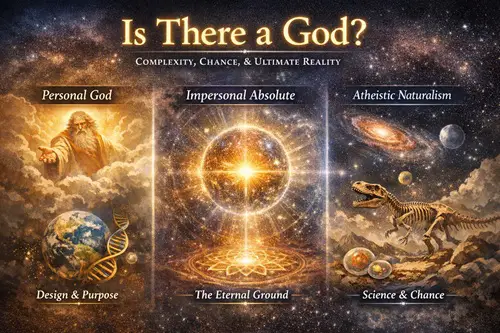 The question of whether God exists has been a perennial focus of human thought. In contemporary discourse, the debate often frames itself around two opposing perspectives: theists, who argue from the apparent complexity and order of life, and atheists, who challenge the likelihood of a personal deity orchestrating the cosmos. Each side invokes reasoning that, at first glance, seems compelling, but closer scrutiny reveals subtleties and assumptions that deserve careful examination. 1. The Theistic Argument: Complexity as EvidenceA central theistic argument is rooted in the observation of complexity in life and the universe. Proponents often cite the intricate structures of biological systems—DNA, cellular machinery, the fine-tuning of physical constants—as evidence that life could not plausibly have emerged by random processes alone. The argument is often formulated as a version of the argument from design: 1. Life exhibits complex, interdependent structures. 2. Complex structures typically result from intelligent causes. 3. Therefore, life likely has an intelligent cause—God. This reasoning resonates intuitively because human experience often associates complexity with intentional design. Just as a watch implies a watchmaker, the fine structure of life seems to suggest a designer. Philosophers such as William Paley famously articulated this view, and modern proponents such as Alvin Plantinga and William Dembski have extended it into the realms of philosophy and intelligent design. Some contemporary physicists, including Paul Davies and John Polkinghorne, have also argued that the precise constants of the universe suggest a fine-tuned cosmos conducive to life. However, the argument relies on a critical assumption: that complexity necessitates intelligence. While plausible in human-scale artifacts, this assumption is not obviously valid for natural systems. Evolutionary biology demonstrates that complexity can emerge gradually through selection processes over immense timescales. Complexity itself does not automatically imply conscious causation; it may instead be a product of natural law interacting with chance and necessity. 2. The Atheistic Argument: Improbability of a Personal GodAtheists frequently counter the theistic argument by emphasizing the improbability of a personal, interventionist God. They reason that: 1. The existence of a deity capable of creating and sustaining the cosmos is not self-evident. 2. Assigning a cause to the universe—God—introduces a being of even greater complexity than the universe itself. 3. Therefore, the existence of such a being is itself highly improbable. Philosophers and authors such as Richard Dawkins, Daniel Dennett, and Christopher Hitchens have championed this line of reasoning, emphasizing that positing God adds explanatory burden rather than reduces it. Likewise, Sam Harris highlights that moral and cosmic order can be understood without invoking a supernatural designer. Some atheists also invoke Ockham's Razor, arguing that positing God is an unnecessary complication if natural explanations suffice. Yet, this reasoning is not immune to criticism. Arguments about improbability assume a probabilistic framework for entities like God, which may not be empirically meaningful. Unlike physical events, the existence of a metaphysical being does not yield to statistical modeling in any straightforward way. Thus, while atheistic reasoning challenges the theistic claim, it is itself an inference based on assumptions about complexity and probability. 3. The Impersonal God or Absolute: A Different PerspectiveSome philosophical and spiritual traditions propose an impersonal God—an Absolute, a foundational reality, or a ground of being—rather than a personal, interventionist deity. Thinkers such as Spinoza, Baruch de Spinoza, Aldous Huxley, or Ken Wilber (in his metaphysical writings) suggest that divinity may not be an agent acting with intention but an underlying principle or reality from which all phenomena arise. This perspective changes the debate in two important ways: Reduces improbability concerns: If God is impersonal, infinite, and necessarily existing, the atheistic argument about improbability loses force. The Absolute is not a contingent entity whose complexity needs explanation; it is the ground of all existence, and therefore does not face the same statistical objections as a personal God. Shifts the focus from design to existence: The question is no longer about whether life or the universe exhibits evidence of intelligent design, but whether there is a necessary substratum from which existence emerges. Complexity in the world is less a proof and more a natural expression of the Absolute. Philosophers like Plotinus and modern process thinkers like Alfred North Whitehead argue that the cosmos is a manifestation of this foundational reality rather than a crafted artifact. In this framing, the debate shifts from chance versus design to questions about the nature of necessity and existence itself. Complexity may no longer be a primary argument; the discussion becomes metaphysical rather than empirical. 4. Evaluating the Debate: Chance, Necessity, and ExplanationBoth the personal God and impersonal Absolute frameworks grapple with the problem of explanation. Personal theists use complexity as evidence of design; atheists emphasize the improbability of a conscious designer; proponents of an impersonal Absolute argue that explanation is grounded in necessity rather than probability. All three perspectives reveal the limits of human reasoning when applied to ultimate causes. If complexity requires explanation, either life, the universe, or God must ultimately be explained by something beyond itself. Whether one posits God as a necessary being, the universe as a brute fact, or an impersonal Absolute, each position reflects philosophical choices about explanatory economy and the nature of causation. 5. Conclusion: An Open QuestionThe question of God's existence remains open, and the type of God one considers—personal, impersonal, or Absolute—significantly shapes the argument. Complexity can suggest design, improbability can challenge the notion of a personal deity, and necessity can underpin the idea of an impersonal Absolute. Ultimately, the debate illuminates the boundaries of explanation itself. Whether one concludes in favor of God, against God, or suspends judgment, the discussion invites reflection on causation, order, and the nature of reality—questions that remain central to philosophy, science, and human curiosity.
Comment Form is loading comments...
|