|
TRANSLATE THIS ARTICLE
Integral World: Exploring Theories of Everything
An independent forum for a critical discussion of the integral philosophy of Ken Wilber
  Frank Visser, graduated as a psychologist of culture and religion, founded IntegralWorld in 1997. He worked as production manager for various publishing houses and as service manager for various internet companies and lives in Amsterdam. Books: Ken Wilber: Thought as Passion (SUNY, 2003), and The Corona Conspiracy: Combatting Disinformation about the Coronavirus (Kindle, 2020). Frank Visser, graduated as a psychologist of culture and religion, founded IntegralWorld in 1997. He worked as production manager for various publishing houses and as service manager for various internet companies and lives in Amsterdam. Books: Ken Wilber: Thought as Passion (SUNY, 2003), and The Corona Conspiracy: Combatting Disinformation about the Coronavirus (Kindle, 2020).
Check out my other conversations with ChatGPT Critique as CounterpointAn Instructive Defense of Intellectual FrictionFrank Visser / ChatGPT
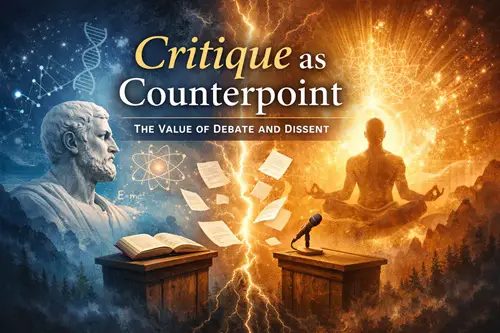 Critical essays are often misread as exercises in negation—acts of demolition motivated by disagreement or dissent. Yet, in the best intellectual traditions, critique serves a very different function. It operates as counterpoint: a necessary second voice that introduces contrast, tension, and precision into a discourse that might otherwise drift toward self-confirmation. My critical essays on Ken Wilber and Integral Theory have consistently followed this approach—not to dismantle the project, but to test it, refine it, and expose where it exceeds its own methodological warrants. The Function of Counterpoints in Intellectual InquiryIn music, counterpoint does not negate melody; it gives it depth. Similarly, in philosophy and theory-building, counterpoints introduce resistance that reveals structure. A framework that cannot withstand sustained critique is not robust; it is insulated. My essays have aimed to function precisely in this counterpoint role—highlighting conceptual tensions, empirical gaps, and category errors that become visible only when a theory is pressed from the outside. This approach is particularly necessary for large, integrative systems. The more comprehensive a framework claims to be, the greater the risk of intellectual overstretch. Integral Theory's ambition—to integrate science, psychology, spirituality, and culture into a single meta-framework—makes it especially vulnerable to this problem. Counterpoints are not optional in such cases; they are essential. Critique as Clarification, Not HostilityA recurring misinterpretation of my work has been to frame it as adversarial or dismissive of spirituality as such. This misconstrues both the intent and the content of the critique. The core concern has never been spirituality per se, but the way spiritual metaphysics are introduced, justified, and rhetorically aligned with science. Where Integral Theory speaks of Eros in evolution, higher realms, or trans-empirical dimensions that allegedly “fit” scientific findings, critique becomes a matter of clarification: • What is metaphor, and what is ontology? • What is speculative metaphysics, and what is empirical theory? • Where does legitimate interpretation end and ideological projection begin? Raising such questions is not obstructionist; it is methodologically responsible. Resistance and Dismissal as Diagnostic ResponsesThe resistance these counterpoints have met—often in the form of dismissal rather than engagement—is itself instructive. In a genuinely dialogical intellectual culture, critique prompts response, revision, or rebuttal. In more closed ecosystems, critique is reframed as misunderstanding, bad faith, or lack of spiritual development. This reaction pattern is revealing. When critics are dismissed as being “outside the We,” insufficiently evolved, or trapped in “flatland,” debate shifts from the level of arguments to the level of identity. The result is not clarification, but immunization: the theory is protected by redefining disagreement as deficiency. From an instructive standpoint, this illustrates a broader lesson: resistance to critique often signals not the weakness of the critique, but the fragility of the framework being defended. The Value of External CritiqueIntegral Theory frequently emphasizes inclusion, integration, and perspectival pluralism. Yet pluralism that excludes serious external critique is performative rather than substantive. My position has consistently been that theories benefit most from critics who are knowledgeable, persistent, and unwilling to be absorbed into the internal vocabulary of the system they examine. Such critics serve as boundary-keepers. They remind integrative projects that: • science has its own standards of explanation, • metaphysics requires philosophical accountability, • and synthesis does not excuse category confusion. Without such reminders, integrative frameworks risk becoming self-sealing worldviews rather than open-ended models. Critique as a Long-Term Intellectual CommitmentFinally, this approach reflects a commitment to the long view. Counterpoints rarely “win” debates in the short term. Their value lies in sedimentation: they remain available for future readers who sense that something does not quite add up and go looking for articulated alternatives. In this sense, critical essays are less interventions than deposits—carefully argued records of dissent that keep conceptual space open. If they stimulate debate, so much the better. If they merely clarify fault lines for attentive readers, that alone justifies the effort. Conclusion: Why Counterpoints MatterAll my critical essays on Wilber have, indeed, been attempts to provide counterpoints—to stimulate debate and clarification precisely where resistance and dismissal have prevailed. This is not a failure of the critical method, but a demonstration of why it is needed. Intellectual progress depends not on unanimity, but on friction. Counterpoints keep theories honest, ambitions proportionate, and boundaries visible. Without them, even the most integrative visions risk becoming closed systems—eloquent, expansive, and ultimately unaccountable.
Widget is loading comments...
|