|
TRANSLATE THIS ARTICLE
Integral World: Exploring Theories of Everything
An independent forum for a critical discussion of the integral philosophy of Ken Wilber
  Frank Visser, graduated as a psychologist of culture and religion, founded IntegralWorld in 1997. He worked as production manager for various publishing houses and as service manager for various internet companies and lives in Amsterdam. Books: Ken Wilber: Thought as Passion (SUNY, 2003), and The Corona Conspiracy: Combatting Disinformation about the Coronavirus (Kindle, 2020). Frank Visser, graduated as a psychologist of culture and religion, founded IntegralWorld in 1997. He worked as production manager for various publishing houses and as service manager for various internet companies and lives in Amsterdam. Books: Ken Wilber: Thought as Passion (SUNY, 2003), and The Corona Conspiracy: Combatting Disinformation about the Coronavirus (Kindle, 2020).
Check out my other conversations with ChatGPT Beyond the BlueprintPhilip Ball's Bold Reimagining of BiologyFrank Visser / Grok
We don't even know what genes are | Philip Ball on biology's biggest mistake
Overview of Philip Ball's Claims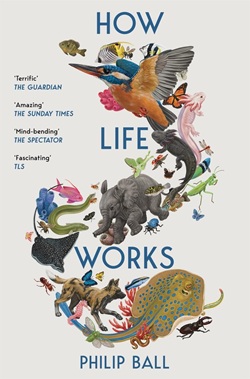
In the provided YouTube video and transcript from the Institute of Art and Ideas, science writer Philip Ball (a physicist by training and former Nature editor) discusses ideas from his book How Life Works: A User's Guide to the New Biology (2023). He critiques what he sees as outdated metaphors in biology, particularly the "machine" analogy for living systems and the genome as a "blueprint" or "program" that deterministically dictates life. Ball argues for a more holistic, multilevel view of biology, emphasizing complexity, context-dependence, and "fuzziness" over precision and reductionism. His key claims include: Biology Is Not Mechanistic Like Human Machines: Life doesn't operate like engineered devices with precise, predictable parts. Instead, it's characterized by disorder, adaptability, and collective phenomena. For example, he highlights that about 50% of human proteins are "intrinsically disordered" (floppy, promiscuous structures that interact non-specifically), which enables complexity and evolution but defies the "lock-and-key" precision of machines. Genes Are Not Blueprints or Programs: The genome isn't a complete instruction set for building or running an organism. Genes are segments of DNA that encode proteins, but their function depends on regulation, context (e.g., cell type, environment), and non-genetic factors. Ball says the concept of a "gene" is "up for grabs," as many genes produce multiple proteins via alternative splicing, and regulation involves distant genomic elements and environmental cues. He views genes as "resources" used by cells and organisms, not causative agents. Hierarchical Levels and Top-Down Influences: Reductionism (focusing on molecules like DNA) is necessary but insufficient. Life involves interactions across levels (genes, proteins, cells, tissues, organisms), with no single level privileged. Crucially, higher levels influence lower ones (e.g., the whole organism or environment affects gene expression), creating a "closed system" of mutual determination. This introduces "agency" — living systems respond adaptively to context, enabling evolution. Fuzziness and Disorder as Essential Features: Biological processes involve "messiness" (e.g., promiscuous protein interactions) that's evolutionarily advantageous for adaptability. This contrasts with chaotic randomness; it's rule-governed but loose, allowing innovation without system collapse. Implications for a "New Biology": Post-Human Genome Project (completed 2003) findings have overturned gene-centric views. Ball calls for rethinking biology as self-organizing, agential systems, with radical potential for medicine, evolution, and understanding life. These claims align with trends in systems biology, evo-devo (evolutionary developmental biology), and critiques of gene-centrism (e.g., by Denis Noble or Michael Levin, whom Ball references). Strengths and Supporting EvidenceBall's arguments are well-substantiated by recent research, drawing on developments since the 1990s. He effectively synthesizes complex findings into accessible prose, making the book a strong primer for updating public perceptions of biology. On Disordered Proteins: Ball's ~50% estimate for intrinsically disordered regions in human proteins is roughly accurate but needs nuance. Sources indicate that 30-40% of eukaryotic proteins contain at least one long disordered region (>30-50 residues), and ~30-35% of residues in the human proteome are disordered. For example, a 2024 Nature study simulated 28,000 disordered regions, covering ~35% of residues. Disordered proteins enable multifunctionality (e.g., one protein binding multiple partners), phase separation in cells, and evolutionary flexibility — all supporting Ball's "fuzziness" claim. This is backed by databases like DisProt and tools like AlphaFold, which flag low-confidence (disordered) predictions. Evolving Gene Concept: Ball is correct that the classical "one gene, one protein" definition (from the 1950s-60s) is outdated. Modern genetics recognizes genes as functional units involving exons, introns, enhancers, and non-coding RNAs. Alternative splicing means one gene can produce multiple proteins (average ~4-5 isoforms per human gene). Regulation is context-dependent, with epigenetics, environment (e.g., diet affecting gene expression), and top-down effects (e.g., tissue-level signals) playing key roles. Reviews in Genetics (2017) and PubMed note that the gene term has shifted from a clear molecular entity to a fuzzy, operational concept. Ball echoes this, citing post-genomic insights like ENCODE (2012), which showed ~80% of the genome is biochemically active (though debated as overhyped). Holistic, Agential View: This resonates with systems biology. For instance, evo-devo shows how gene networks (not single genes) drive development, with feedback loops and environmental cues. Levin's work on bioelectricity (mentioned in comments) supports top-down agency, where cells "problem-solve" morphologies. Ball's rejection of strict gene-centrism aligns with Noble's critiques (e.g., in Nature, 2024), emphasizing organisms as integrated systems. Reviews praise Ball for this systems-thinking shift, comparing it to resilience engineering or Lucy Suchman's work on situated action. Timeliness: The book addresses real gaps. Public discourse (e.g., "selfish gene" from Dawkins' 1976 book) lags behind science. Ball's call for new metaphors (e.g., genes as "resources") is echoed in Aeon (2024) and Templeton Foundation discussions, urging biology to embrace complexity. Overall, Ball's claims are supported by evidence from molecular biology, genomics, and proteomics. Reviews in The Guardian, Kirkus (starred), and Publishers Weekly laud it as "provocative and profound," a "robust takedown" of gene-centrism that's essential for rethinking life. Weaknesses and CritiquesWhile Ball's synthesis is insightful, some aspects overstate novelty or rely on hyperbole, potentially misleading non-experts. Critiques from sources include: Overstating the "Revolution": Ball frames this as a "new biology," but many ideas aren't groundbreaking to specialists. For example, gene regulation's complexity was known pre-2000s (e.g., operons in bacteria, 1960s). A 2024 Sandwalk blog post accuses Ball of straw-manning pre-ENCODE molecular biology, claiming he implies biologists ignored non-coding DNA or regulation — untrue, as textbooks from the 1980s covered these. Denis Noble (in Nature, 2024) praises the book but notes the "blueprint" metaphor was always simplistic; Ball's critique risks implying a bigger paradigm shift than exists. BioLogos forum users call his style "off-putting" and titles "clickbaity," suggesting he hypes consensus views (e.g., biologists agree genes aren't simple blueprints). Accuracy on Disordered Proteins: The 50% figure is high-end; more conservative estimates are 30-40% for proteins with disordered regions, and ~5% for fully disordered proteins (IDPs). A 2018 Genome Research study found disordered regions evolve rapidly under positive selection, supporting Ball's evolutionary role, but critics note this doesn't negate machine-like aspects (e.g., enzymes still catalyze precisely). Ball's "fuzziness by design" is valid but not universal — many proteins are structured and specific. Agency and Purpose: Ball introduces "agency" (e.g., cells as responsive agents) without fully addressing philosophical implications. Some reviews (e.g., Staggering Implications, 2025) argue this verges on intelligent design tropes, though Ball avoids that. Critics like Larry Moran (Sandwalk) say Ball underplays how genomics still supports gene-level explanations. In PLoS One (2019), disordered proteins are linked to specific functions (e.g., binding), not just chaos. Potential Bias in Presentation: As a physicist, Ball excels at metaphors but may overlook nuances. A Marginalia Review (2025) notes he critiques reductionism while relying on it for evidence. X posts and Reddit threads (e.g., on The Selfish Gene) debate if evo-devo truly "outdates" gene-level selection — it complements, not debunks. Broader Context: Comments in the video (e.g., @l.christoffersen7502) call the title misleading, as "modern biologists" wouldn't disagree. Others reference Lysenkoism or vitalism, but Ball steers clear. A 2024 Cell Systems review urges biology to prioritize complexity, aligning with Ball but warning against abandoning genes entirely. ConclusionBall's claims effectively challenge outdated popular narratives, promoting a more accurate, dynamic view of biology grounded in evidence. Strengths lie in accessibility and synthesis, making it valuable for non-specialists. However, it occasionally amplifies incremental shifts as revolutionary, and some specifics (e.g., disorder percentages) could be more precise. This isn't a "biggest mistake" in biology but a needed update. For deeper dives, compare with Noble's Dance to the Tune of Life (2016) or Levin's work on bioelectricity. If Ball's goal is rethinking life without gene-worship, he succeeds — but biology's "magic" was never fully mechanistic to begin with.
Widget is loading comments...
|