|
TRANSLATE THIS ARTICLE
Integral World: Exploring Theories of Everything
An independent forum for a critical discussion of the integral philosophy of Ken Wilber
  Frank Visser, graduated as a psychologist of culture and religion, founded IntegralWorld in 1997. He worked as production manager for various publishing houses and as service manager for various internet companies and lives in Amsterdam. Books: Ken Wilber: Thought as Passion (SUNY, 2003), and The Corona Conspiracy: Combatting Disinformation about the Coronavirus (Kindle, 2020). Frank Visser, graduated as a psychologist of culture and religion, founded IntegralWorld in 1997. He worked as production manager for various publishing houses and as service manager for various internet companies and lives in Amsterdam. Books: Ken Wilber: Thought as Passion (SUNY, 2003), and The Corona Conspiracy: Combatting Disinformation about the Coronavirus (Kindle, 2020).
Check out my other conversations with ChatGPT When Science Is Recruited by SpiritThe Hijacking of Scientific Advances by Spiritual IdeologiesFrank Visser / ChatGPT
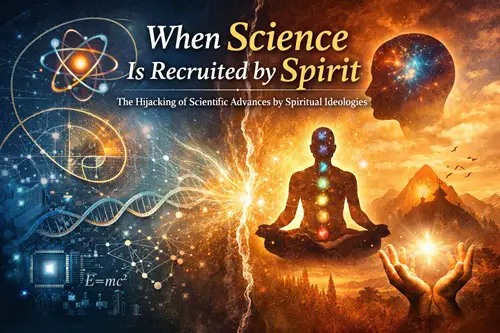 Introduction: A Recurrent PatternThroughout the modern history of science, major conceptual breakthroughs have repeatedly been appropriated by spiritual and metaphysical ideologies seeking external validation. Advances in physics, biology, and complexity science—often difficult, counterintuitive, and philosophically suggestive—are presented as if they confirm pre-existing spiritual worldviews. This phenomenon is not merely a matter of popular misunderstanding. It follows a recognizable pattern: scientific uncertainty is mistaken for metaphysical openness, metaphor is reified into ontology, and explanatory limits are treated as evidence for transcendent realities. The result is a hybrid discourse that borrows scientific prestige while quietly abandoning scientific discipline. The Core Mechanism: From Explanation to ExtrapolationThe hijacking typically proceeds in four steps: • A genuine scientific advance introduces novel concepts or undermines common-sense intuitions. • Epistemic humility within science (open questions, unresolved interpretations) is reinterpreted as metaphysical indeterminacy. • Metaphorical language used heuristically by scientists is treated literally. • Spiritual doctrines are retrofitted to appear “supported” by the new science. Crucially, the direction of inference is reversed. Rather than spirituality generating testable hypotheses, science is conscripted post hoc as rhetorical reinforcement. Physics: Quantum Mechanics and the Myth of Consciousness-Created RealityNo field has been more persistently mined for spiritual significance than quantum physics. Concepts such as superposition, entanglement, and the observer effect are routinely invoked to suggest that consciousness plays a fundamental role in “creating” reality. Popular claims include: • Consciousness collapses the wave function. • Reality is “nonlocal” in a way that mirrors mystical unity. • Quantum indeterminacy implies free will or cosmic mind. Yet within physics, these claims collapse under scrutiny. The “observer” in quantum mechanics refers to physical interaction or measurement, not subjective awareness. Decoherence theory explains apparent collapse without invoking mind. Competing interpretations (Copenhagen, Many-Worlds, Bohmian mechanics) differ radically—yet spiritual narratives selectively cite whichever version sounds most congenial. Here, interpretive plurality is mistaken for metaphysical permission. Complexity Science: Emergence as a Trojan Horse for TeleologyComplexity science and systems theory describe how simple local interactions can generate rich global patterns—flocking behavior, metabolic networks, ecosystems, economies. This has been a genuine explanatory advance. However, emergence is frequently spiritualized into: • Evidence of hidden guidance or “Eros” • A cosmic drive toward higher consciousness • Proof that matter is “more than material” The sleight of hand lies in conflating descriptive emergence with teleological emergence. Scientific emergence explains how complexity arises without foresight. Spiritual interpretations quietly reintroduce direction, purpose, or intention—precisely what complexity theory was designed to explain without invoking. Terms like “self-organization” are particularly vulnerable, since they invite anthropomorphic readings. But in science, “self” is a placeholder for boundary conditions and feedback loops, not an inner agent. Biology: Evolution Recast as a Spiritual AscentEvolutionary biology has long been a prime target for spiritual reinterpretation. While Darwinian theory explains diversification through variation and selection, spiritual ideologies recast evolution as a progressive, value-laden ascent. Common reframings include: • Evolution as a drive toward higher consciousness • Intelligence or spirituality as inevitable outcomes • Life as unfolding an implicit cosmic blueprint These views selectively ignore core biological facts: contingency, extinction, local adaptation, and the absence of long-term directionality. Evolution has no memory, no foresight, and no final goal. Humans are not the culmination of evolution but one surviving twig on a vast, pruned tree. Here, scientific narratives of process are transformed into spiritual narratives of progress. Why This Happens: Psychological and Cultural DriversSeveral forces sustain this pattern: • Existential discomfort with a universe lacking intrinsic meaning • Status transfer, where science's cultural authority is borrowed to legitimize spiritual claims • Cognitive bias toward purpose, deeply rooted in human psychology • Ambiguous language, especially when scientists themselves speak metaphorically Importantly, many of these appropriations are not cynical. They often arise from a genuine desire for coherence between scientific knowledge and personal meaning. But sincerity does not confer validity. The Cost: Science Diluted, Spirituality DistortedThis hijacking has consequences for both domains: • Science is misrepresented, fueling confusion and mistrust. • Spiritual worldviews become intellectually brittle, dependent on selective or outdated science. • Critical dialogue is short-circuited, since disagreement is framed as “reductionism” or “materialist dogma.” Rather than deepening understanding, such syntheses often produce what might be called pseudo-integration: a rhetorical fusion that satisfies emotionally while failing intellectually. A Healthier Alternative: Respecting Domain BoundariesNone of this requires hostility to spirituality or meaning-making. It requires conceptual discipline. Science answers questions of how through testable models constrained by evidence. Spiritual or philosophical traditions address questions of value, purpose, and lived meaning. Confusion arises when one is made to do the work of the other. A mature engagement recognizes that scientific explanations neither mandate nor forbid spiritual interpretations—but they do not support them in the evidential sense. Meaning, if it exists, must be argued for on its own terms. A Contemporary Case Study: Ken Wilber and the Spiritualization of ScienceFew contemporary thinkers illustrate this pattern more systematically than Ken Wilber. Across several decades, Wilber has presented his Integral Theory as a grand synthesis in which modern science is said to converge with perennial spiritual insights. Quantum physics, systems theory, complexity science, evolutionary biology, and neuroscience are all enlisted as partial confirmations of a pre-existing metaphysical framework involving higher realms, ascending stages of consciousness, and a cosmic drive toward Spirit. The method is consistent with the pattern outlined above. Scientific concepts—emergence, holarchy, self-organization, evolution, nonlocality—are abstracted from their technical contexts and reinterpreted as indicators of intrinsic directionality, depth, or transcendence. What in science functions as a descriptive model becomes, in Integral discourse, an ontological principle. Gaps, open questions, or metaphorical language within scientific theories are treated as points of entry for metaphysical supplementation. Wilber is often careful to acknowledge that science itself does not explicitly endorse his spiritual conclusions. Yet this caveat is offset by repeated rhetorical gestures suggesting that science is “moving toward”an Integral worldview, or that materialist interpretations are merely provisional stages awaiting transcendence. Dissenting scientists are frequently characterized as reductionist, while sympathetic language from a small subset of thinkers is amplified to imply broader consensus. What distinguishes Wilber's case is not misrepresentation at the level of detail—though critics have documented many such instances—but the architectural ambition of the project. Integral Theory does not merely borrow from science; it subsumes science within a hierarchical metaphysical schema in which empirical inquiry is ultimately subordinate to spiritual realization. In doing so, science is no longer an independent adjudicator of claims about reality, but a developmental rung to be surpassed. This illustrates a final, important variant of scientific hijacking: the inclusion strategy. Rather than rejecting science, it is embraced—only to be reframed as incomplete, lower, or preparatory. The authority of science is preserved rhetorically while its methodological constraints are quietly dissolved. Final ReflectionThe recurring effort to enlist science in support of spiritual ideologies says less about science than about the enduring human desire for cosmic reassurance. Scientific advances destabilize inherited certainties; spiritual reinterpretations restore them in familiar forms. The temptation to fuse the two is understandable—but intellectual integrity requires resisting it. A science that is allowed to speak in its own voice may be existentially sobering, but it is also liberating. It frees meaning from metaphysical inflation and invites responsibility for creating value within the world we actually inhabit—without smuggling transcendence in through the back door of explanation. Conclusion: Vigilance in an Age of SynthesisAs scientific advances continue to challenge intuition, the temptation to read metaphysics into mathematics and meaning into mechanism will persist. The task for scientifically literate readers is not to suppress wonder, but to distinguish explanation from extrapolation. Wonder survives scrutiny. Hijacked science does not.
Widget is loading comments...
|