|
TRANSLATE THIS ARTICLE
Integral World: Exploring Theories of Everything
An independent forum for a critical discussion of the integral philosophy of Ken Wilber
  Frank Visser, graduated as a psychologist of culture and religion, founded IntegralWorld in 1997. He worked as production manager for various publishing houses and as service manager for various internet companies and lives in Amsterdam. Books: Ken Wilber: Thought as Passion (SUNY, 2003), and The Corona Conspiracy: Combatting Disinformation about the Coronavirus (Kindle, 2020). Frank Visser, graduated as a psychologist of culture and religion, founded IntegralWorld in 1997. He worked as production manager for various publishing houses and as service manager for various internet companies and lives in Amsterdam. Books: Ken Wilber: Thought as Passion (SUNY, 2003), and The Corona Conspiracy: Combatting Disinformation about the Coronavirus (Kindle, 2020).
Check out my other conversations with ChatGPT Neuro-Linguistic ProgrammingNature, Claims, and ValueFrank Visser / ChatGPT
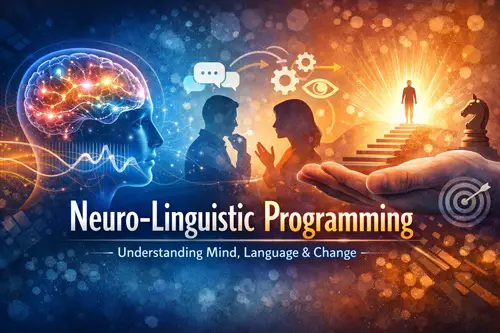 Neuro-Linguistic Programming (NLP) is a broad and controversial set of ideas and practices that emerged in the 1970s at the intersection of psychology, linguistics, and personal development. Advocates describe NLP as a practical methodology for understanding how people think, communicate, and change; critics regard it as a loosely defined self-help system with weak scientific foundations. To assess the nature and value of NLP, it is necessary to distinguish its core concepts, its practical techniques, and its empirical status. Origins and Core AmbitionsNLP was developed in the mid-1970s by Richard Bandler, a mathematics student, and John Grinder, a linguist, at the University of California, Santa Cruz. Their stated aim was not to create a new psychological theory but to model excellence: to identify the patterns of thought and language used by exceptionally effective therapists and communicators and to make those patterns teachable. Early NLP drew heavily on the work of figures such as Fritz Perls (Gestalt therapy), Virginia Satir (family therapy), and Milton Erickson (hypnotherapy). Bandler and Grinder claimed that therapeutic effectiveness could be reverse-engineered by analyzing verbal structure, nonverbal behavior, and subjective experience. From this perspective, NLP presents itself less as a science of the mind and more as a toolbox of techniques derived from observation and imitation. The Meaning of “Neuro,” “Linguistic,” and “Programming”The term Neuro-Linguistic Programming reflects three central assumptions: Neuro: Human experience is mediated by neurological processes. We do not respond directly to reality but to internal representations constructed by the nervous system. Linguistic: Language—verbal and nonverbal—both reflects and shapes these internal representations. Programming: Patterns of thought, emotion, and behavior operate like learned programs and can, in principle, be modified or replaced. These assumptions echo ideas found elsewhere in cognitive psychology, constructivism, and communication theory. What distinguishes NLP is its emphasis on subjective structure—how experience is internally organized—rather than on diagnostic categories or abstract models. Key Concepts and TechniquesSeveral recurring ideas form the backbone of NLP practice: Maps and Territory: A foundational slogan is that “the map is not the territory.” Individuals act based on their internal maps of the world, not on objective reality itself. Change, therefore, involves altering the map. Representational Systems: NLP proposes that people favor sensory modalities (visual, auditory, kinesthetic) in thinking and communication. While often overstated in popular NLP, this idea underlies techniques aimed at improving rapport and communication. Anchoring: Borrowed loosely from classical conditioning, anchoring involves associating a specific stimulus with a particular emotional or mental state, so that the state can later be re-evoked. Reframing: Changing the meaning assigned to an experience in order to alter emotional or behavioral responses. Modeling: Identifying and replicating the cognitive and behavioral patterns of successful individuals. In practice, NLP is less a unified system than a family of methods used in coaching, sales training, therapy, education, and self-development. Claims and PromisesProponents of NLP often claim rapid and wide-ranging benefits: overcoming phobias, improving communication, enhancing performance, resolving trauma, or achieving personal goals. These claims are frequently presented in anecdotal form and framed as practical effectiveness rather than theoretical rigor. It is important to note that NLP literature varies greatly in quality. Some applications are modest and commonsense—focused on attention, language awareness, and goal clarity—while others make extravagant claims that verge on pseudoscience. Scientific Status and CriticismFrom an academic standpoint, NLP faces serious challenges. Controlled studies have generally failed to support strong versions of its claims, particularly those concerning eye movements, representational systems, or rapid therapeutic change. Major psychological associations do not recognize NLP as an evidence-based therapy. Critics argue that NLP suffers from: • Vague or shifting definitions • Lack of falsifiable hypotheses • Reliance on anecdote and testimonial evidence • Commercial incentives that favor marketing over validation As a result, NLP is often cited in textbooks as an example of a psychologically inspired but scientifically unsupported approach. Assessing the Value of NLPDespite these criticisms, NLP continues to be widely used. Its value appears to lie less in its theoretical claims and more in its pragmatic elements: Communication Awareness: NLP encourages close attention to language, framing, and nonverbal cues—skills that are undeniably relevant in interpersonal contexts. Subjective Experience: By focusing on how individuals experience situations internally, NLP aligns with phenomenological and constructivist perspectives. Practical Heuristics: Some techniques function as structured heuristics for reflection, motivation, and behavioral change, even if their proposed mechanisms are overstated. Used cautiously, NLP techniques can function as coaching tools or conversational strategies. Used uncritically or dogmatically, they can foster exaggerated expectations and obscure the limits of personal change. ConclusionNeuro-Linguistic Programming occupies an ambiguous space between psychology, self-help, and commercial training. It is not a scientific theory of mind, nor does it meet the standards of evidence required for clinical psychology. At the same time, it is not mere nonsense: many of its practices draw on familiar psychological principles and can be useful when applied modestly and transparently. For interested readers, the most balanced stance is neither enthusiastic acceptance nor outright dismissal. NLP is best understood as a collection of informal techniques and metaphors about human communication and change—potentially useful as long as its claims are kept proportional to the evidence supporting them.
Comment Form is loading comments...
|