|
TRANSLATE THIS ARTICLE
Integral World: Exploring Theories of Everything
An independent forum for a critical discussion of the integral philosophy of Ken Wilber
  Frank Visser, graduated as a psychologist of culture and religion, founded IntegralWorld in 1997. He worked as production manager for various publishing houses and as service manager for various internet companies and lives in Amsterdam. Books: Ken Wilber: Thought as Passion (SUNY, 2003), and The Corona Conspiracy: Combatting Disinformation about the Coronavirus (Kindle, 2020). Frank Visser, graduated as a psychologist of culture and religion, founded IntegralWorld in 1997. He worked as production manager for various publishing houses and as service manager for various internet companies and lives in Amsterdam. Books: Ken Wilber: Thought as Passion (SUNY, 2003), and The Corona Conspiracy: Combatting Disinformation about the Coronavirus (Kindle, 2020).
Check out my other conversations with ChatGPT The Medium Is Still the MessageSocial Media, AI, and the Reformatting of MindFrank Visser / ChatGPT
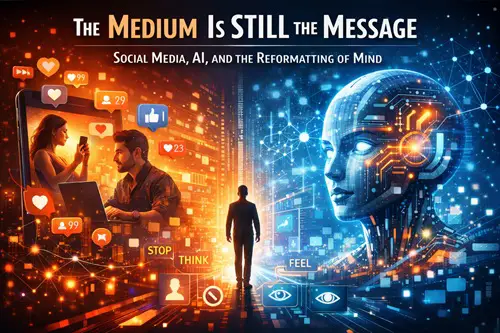 McLuhan's Core InsightMarshall McLuhan's famous dictum—the medium is the message—is often reduced to a slogan implying that content does not matter. McLuhan meant something more precise and more unsettling. He argued that the form of a medium—the patterns of attention, speed, sensory emphasis, and social organization it imposes—shapes human consciousness more deeply than any particular content it conveys. Media, in this sense, are not neutral channels but environments that quietly reconfigure perception and behavior. When applied to social media and artificial intelligence, this insight remains not only relevant but diagnostic. Writing: The Externalization of MemoryThe first decisive shift occurred with writing. Oral cultures relied on memory, rhythm, and communal presence; knowledge existed as something enacted rather than stored. Writing externalized memory, stabilizing language and enabling law, analysis, and abstraction. Yet this gain came at the cost of immediacy and mnemonic skill. Plato already feared that writing would produce the appearance of wisdom without its substance. In McLuhan's terms, the message of writing was permanence and visual abstraction. Print: Linear Thought and the Modern IndividualThe printing press intensified these effects dramatically. Print standardized texts, encouraged silent reading, and privileged linear, sequential reasoning. It fostered the modern sense of the autonomous individual: private interpretation, authorship, and the ideal of objective knowledge detached from social context. McLuhan famously linked print culture to the rise of nationalism, Protestantism, and modern science. The message of print was not merely literacy, but uniformity, repeatability, and inwardness. Electronic Media: Speed, Simultaneity, and AffectWith electronic media, this trajectory reversed. The telegraph severed information from physical transport, collapsing distance and subordinating meaning to speed. For the first time, information traveled faster than people. Context eroded; relevance replaced depth. News became a continuous stream of disconnected signals. Radio and television extended this transformation. They reintroduced simultaneity and emotional resonance, creating shared experiences across vast populations. Yet unlike oral cultures, these media were one-directional. Audiences were affectively re-tribalized while remaining politically and cognitively passive. McLuhan described television as a “cool” medium that shaped perception not through argument but through immersion. Its message was presence without participation. Social Media: Participation Without ReflectionDigital media initially appeared to restore agency. Anyone could publish, comment, and connect. Yet social media platforms quickly evolved into algorithmically managed environments that reward speed, visibility, and emotional intensity. Here McLuhan's analysis becomes sharply predictive. Social media collapses context, flattens hierarchies, and accelerates response. The distinction between private and public dissolves; the difference between expert and amateur loses salience. What matters is not coherence or truth, but engagement. The message of social media is not connection, but compulsory responsiveness. The self is reorganized around metrics, feedback loops, and performative visibility. Thought becomes fragmentary; judgment becomes reactive. Artificial Intelligence: The Simulation of UnderstandingArtificial intelligence represents a further—and qualitatively different—stage in this media evolution. AI is commonly described as a tool: a faster calculator, a better search engine, a productivity assistant. From a McLuhanite perspective, this framing is misleading. AI is a new medium that reorganizes how knowledge itself appears. The defining feature of AI systems such as large language models is not understanding, but synthetic coherence. AI produces fluent, context-sensitive language without intention, experience, or responsibility. The medium's message is therefore not knowledge, but plausibility. Answers arrive instantly, elegantly, and without visible effort. As a result, the distinction between knowing, summarizing, and improvising erodes. The Return of the OracleSocial media and AI together produce a curious cultural configuration. On the one hand, authority is fragmented into a swarm of voices, likes, and trending opinions. On the other, it is quietly re-centralized in systems that speak with confidence but bear no responsibility. This creates a new oracular culture: answers circulate without origin, context, or consequence. One scrolls; one prompts. In both cases, the medium discourages slow judgment. This is also where metaphysical and ideological projections arise. AI is easily mythologized as emergent mind, non-local intelligence, or evidence for consciousness as a fundamental property of reality. From a McLuhanite standpoint, such interpretations mistake media effects for ontological insights. Media Literacy After McLuhanMcLuhan did not offer solutions in the conventional sense. His hope was that awareness of media effects could create a margin of freedom. Applied today, this suggests that media literacy must move beyond content moderation and fact-checking toward an examination of form. The crucial question is not only what social media and AI tell us, but what they do to our sense of time, authority, attention, and selfhood. Social media and AI are not neutral instruments. They are environments that quietly reformat cognition. Their message, regardless of content, is that immediacy outranks reflection, fluency replaces understanding, and presence outweighs depth. Recognizing this does not require rejecting these media—but it does require resisting the illusion that the message lies only in what they say, rather than in what they make us become. AI at Integral World: Overview Without AbdicationIf McLuhan is right that media operate most powerfully when they go unnoticed, then any responsible use of artificial intelligence must begin with explicit self-awareness. At Integral World, AI is not treated as an oracle, an authority, or a surrogate thinker. It is used instrumentally and transparently to generate overviews, summaries, and comparative reviews across a wide range of subjects—science, philosophy, religion, and cultural critique. Its value lies in orientation, not adjudication. In this sense, AI functions as a cartographic aid rather than a substitute for judgment. It can map conceptual terrain, outline positions, and juxtapose arguments with speed and breadth no single human author could easily match. What it cannot do—and should not be asked to do—is determine what ultimately matters, what is true, or what deserves allegiance. Those tasks remain irreducibly human, requiring commitment, responsibility, and the capacity for reflective distance. Used this way, AI can slow thinking down rather than accelerate it. By providing structured overviews, it frees readers from the initial burden of information-gathering and allows them to focus on evaluation, critique, and synthesis. This is the opposite of the social media dynamic, in which speed and reaction dominate. The aim is not frictionless understanding, but informed reflection. From a McLuhanite perspective, this requires resisting the medium's most seductive affordance: fluency. AI-generated prose is smooth, confident, and rhetorically complete. Precisely for that reason, it must be approached as provisional and revisable. At Integral World, AI is therefore positioned as a prelude to thought, not its culmination—a way of staging inquiry rather than concluding it. In this limited but deliberate role, AI becomes compatible with the site's longstanding critical mission. It helps illuminate patterns, expose assumptions, and situate debates historically and conceptually. But it does so in full view of its own limitations. The responsibility for judgment remains with authors and readers alike. If the medium is indeed the message, then the task is not to pretend neutrality, but to shape usage consciously. AI at Integral World is employed not to replace reflection, but to invite it—to create the space in which slower, deeper, and more accountable thinking can still occur.
Comment Form is loading comments...
|