|
TRANSLATE THIS ARTICLE
Integral World: Exploring Theories of Everything
An independent forum for a critical discussion of the integral philosophy of Ken Wilber
  Frank Visser, graduated as a psychologist of culture and religion, founded IntegralWorld in 1997. He worked as production manager for various publishing houses and as service manager for various internet companies and lives in Amsterdam. Books: Ken Wilber: Thought as Passion (SUNY, 2003), and The Corona Conspiracy: Combatting Disinformation about the Coronavirus (Kindle, 2020). Frank Visser, graduated as a psychologist of culture and religion, founded IntegralWorld in 1997. He worked as production manager for various publishing houses and as service manager for various internet companies and lives in Amsterdam. Books: Ken Wilber: Thought as Passion (SUNY, 2003), and The Corona Conspiracy: Combatting Disinformation about the Coronavirus (Kindle, 2020).
Check out my other conversations with ChatGPT Science Under SiegeIdeological Pressures from Left and RightFrank Visser / ChatGPT
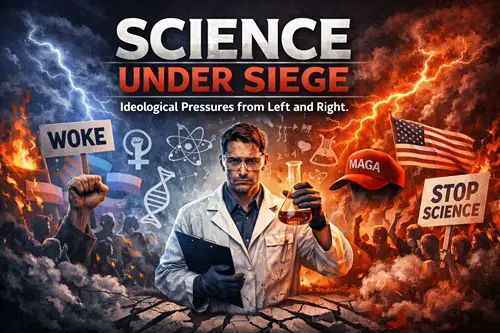 Introduction: The Fragility of Scientific NormsScience depends on norms that are epistemic rather than moral or political: evidence over intention, argument over identity, correction over loyalty. These norms are easily undermined because they are socially enforced rather than legally protected. Today, science is increasingly subordinated to ideological demands from both ends of the political spectrum. On the Left, moral activism reshapes acceptable inquiry from within scientific institutions. On the Right, populist movements reject expertise outright when it conflicts with political identity. The combined effect is an erosion of science as a distinct and trusted mode of knowing. I. Pressure from the Left: Moralization and Internal Policing1. Lawrence Krauss and the New Moral GatekeepingThe case of physicist Lawrence Krauss illustrates how ideological pressures can operate inside scientific culture. Krauss, a prominent cosmologist and outspoken defender of scientific naturalism, became a target not for the quality of his scientific work, but for alleged violations of evolving moral norms around behavior and speech. Regardless of one's assessment of the specific allegations, the broader pattern is instructive: reputational annihilation occurred largely outside formal adjudication and spilled over into his scientific standing, invitations, and institutional affiliations. The lesson many scientists drew was not about ethical conduct—long a legitimate concern—but about risk. Public intellectuals learned that heterodox views combined with personal controversy could render them professionally radioactive. The boundary between moral judgment and scientific credibility blurred. 2. From Accountability to Ideological ComplianceIn this climate, accusations of “harm,” “unsafe speech,” or “toxic presence” increasingly function as substitutes for evidential critique. The Krauss episode sits within a broader pattern in which scientists who resist activist framings—on gender, race, or biology—are treated as moral liabilities rather than intellectual participants. The chilling effect is subtle but pervasive: fewer public debates, fewer risky hypotheses, more strategic silence. 3. Science as Moral PerformanceThe result is a performative moralization of science. Researchers are expected not merely to produce valid results, but to signal alignment with approved values. Disagreement is reframed as ethical deficiency. This undermines the core scientific norm that bad ideas should be refuted by better arguments, not neutralized by social sanction. II. Pressure from the Right: Populist Rejection of Expertise1. Donald Trump and the Politics of DisbeliefIf Krauss exemplifies ideological discipline within science, Donald Trump exemplifies populist assault upon it. Trump's presidency normalized open contempt for scientific expertise, especially when it conflicted with political messaging. Climate science was dismissed as a hoax; epidemiologists were contradicted or sidelined; data collection and reporting were politicized. Trump did not merely disagree with scientists—something entirely legitimate in a democracy—but consistently framed expertise itself as suspect, elitist, or politically motivated. 2. Covid-19: A Case Study in Epistemic BreakdownDuring the Covid-19 pandemic, Trump's public interventions—downplaying risks, promoting unproven treatments, undermining public health agencies—exposed a deeper populist pathology. Scientific uncertainty was exploited to justify denial, while evolving evidence was presented as incompetence or deception. The public was encouraged to trust intuition, loyalty, or charismatic authority over institutional science. 3. Selective SkepticismThis was not principled skepticism but instrumental disbelief. When science aligned with political goals (e.g., economic reopening), it was invoked; when it constrained those goals, it was dismissed. The effect was a radical weakening of public trust in the very idea of expert consensus. III. Converging Pathologies: Different Routes, Same DamageDespite their differences, ideological pressures from Left and Right converge in their consequences: • Truth Becomes Tribal: Scientific claims are accepted or rejected based on political alignment. • Authority Replaced by Loyalty: On the Left, moral virtue; on the Right, identity and allegiance. • Institutions Lose Credibility: Universities and agencies appear ideological rather than epistemic. • Speech Replaces Method: Who speaks matters more than how claims are tested. In both cases, science is no longer allowed to be boringly independent of politics. IV. Consequences• Impoverished Research Culture: Risk aversion replaces curiosity. • Public Confusion: Competing “realities” erode consensus-based policymaking. • Loss of Expertise: Scientists withdraw from public discourse or exit institutions altogether. • Feedback Loop of Distrust: Ideological capture fuels populist backlash, and vice versa. V. Ways Out1. Separate Ethics from EpistemologyEthical standards are necessary, but they must not be allowed to determine the validity of scientific claims. Misconduct should be addressed through due process, not reputational contagion. 2. Defend Institutional NeutralityUniversities and scientific bodies must resist acting as ideological actors. Their legitimacy depends on procedural fairness and viewpoint tolerance. 3. Reassert Scientific LiteracyUncertainty, revision, and disagreement are features of science, not failures. This must be communicated consistently, especially during crises. 4. Resist Charismatic Substitutes for ExpertiseWhether the authority figure is a moral activist or a populist strongman, science must not defer to charisma, outrage, or loyalty. Conclusion: Science Beyond IdeologyThe cases of Lawrence Krauss and Donald Trump reveal two distinct but complementary threats to science: moralized conformity from within and populist rejection from without. Both subordinate evidence to ideology. Defending science today does not mean defending every institution or individual scientist; it means defending the norms that allow knowledge to progress despite human failings. Without those norms, science becomes just another language of power—and loses the very authority that made it worth politicizing in the first place.
Comment Form is loading comments...
|