|
TRANSLATE THIS ARTICLE
Integral World: Exploring Theories of Everything
An independent forum for a critical discussion of the integral philosophy of Ken Wilber
  Frank Visser, graduated as a psychologist of culture and religion, founded IntegralWorld in 1997. He worked as production manager for various publishing houses and as service manager for various internet companies and lives in Amsterdam. Books: Ken Wilber: Thought as Passion (SUNY, 2003), and The Corona Conspiracy: Combatting Disinformation about the Coronavirus (Kindle, 2020). Frank Visser, graduated as a psychologist of culture and religion, founded IntegralWorld in 1997. He worked as production manager for various publishing houses and as service manager for various internet companies and lives in Amsterdam. Books: Ken Wilber: Thought as Passion (SUNY, 2003), and The Corona Conspiracy: Combatting Disinformation about the Coronavirus (Kindle, 2020).
Check out my other conversations with ChatGPT
DEBUNKING ASTROLOGY:
Synchronicity As the Last Defense of Astrology The Mythic Rehabilitation of Astrology The Death Blow to Astrology The Planetary Week: A Fossil of the Mythic Mind Astrology and Synchronicity: Why It Can't Work When Astrology Lost the Stars When Astrology Lost the StarsWhy the Zodiac No Longer Maps a Real WaveFrank Visser / ChatGPT
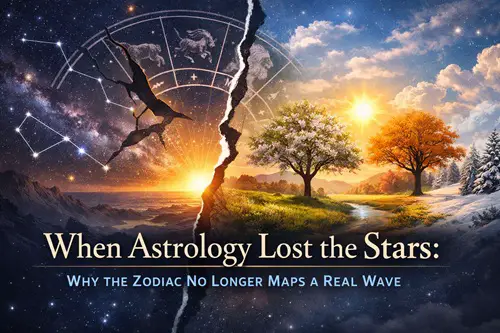 Astrology presents itself as an ancient wisdom that has merely updated its language while preserving its core insights. Yet beneath this appearance of continuity lies a decisive rupture. Modern astrology has rejected the stars that once grounded the zodiac, replacing them with the seasons—while retaining the same symbolic architecture. This substitution is not a harmless reinterpretation. It fundamentally alters the structure, resolution, and informational content of the system. What remains is no longer the same wave. From stellar reference frame to symbolic gridOriginally, the zodiac functioned as a stellar reference frame. The Sun's yearly motion was tracked against a richly differentiated band of constellations along the ecliptic. These constellations were uneven in size, irregular in shape, and embedded in a complex celestial background. Even if their mythic meanings were culturally projected, the underlying signal was high-resolution: a continuous, non-uniform sky that constrained interpretation. That constraint is now gone. Due to the precession of the equinoxes, the zodiac signs no longer align with the constellations bearing their names. Rather than confront this mismatch, Western (tropical) astrology redefined the zodiac as a seasonal system anchored to the equinoxes and solstices. Aries no longer refers to a ram-shaped star pattern, but to the beginning of spring. The stellar anchor was quietly abandoned, while the terminology remained. This was not a refinement. It was a category shift. Seasons are not the zodiacSeasons are real, but they are a coarse-grained signal. They represent a smooth, low-bandwidth annual cycle driven by axial tilt and solar insolation. At most, nature supplies four primary phases: spring, summer, autumn, and winter. Any finer subdivision is secondary, approximate, and region-dependent. The zodiac, by contrast, claims twelve distinct qualitative zones, each with its own psychological and symbolic profile. This fine-grained structure made some sense when tied—however loosely—to a complex stellar background. It makes far less sense when derived from a simple seasonal sine wave. From an information-theoretic perspective, the substitution is devastating. A low-entropy signal cannot support a high-entropy classification without invention. Dividing the year into twelve equal 30-degree segments does not uncover hidden structure in the seasons; it imposes a grid onto a smoother cycle. Meaning is no longer constrained by observation, only by tradition. 4x3 is not the same as 3x4This loss of constraint becomes clearer when we examine astrology's internal arithmetic. Nature gives us a 4x3 structure: four seasons, each with internal variation. Astrology insists on a 3x4 structure: three modalities (cardinal, fixed, mutable) crossed with four elements (fire, earth, air, water). Although both yield twelve, they encode different logics. In the seasonal cycle, the fourfold structure is primary; any tripartite subdivision is derivative and fuzzy. In astrology, the triadic and quartic abstractions are treated as foundational, and the seasons are retrofitted to match them. This inversion matters. Order and hierarchy are not interchangeable. Seasons describe real energy flows in the Earth-Sun system. Modalities and elements do not correspond to independent natural variables; they are conceptual overlays inherited from pre-scientific cosmology. Once the stars are gone, the 3x4 schema floats free of any physical driver. The number twelve persists by cultural inertia, not natural necessity. Meaning without mechanismAstrologers often respond that meaning does not require mechanism—that astrology is symbolic rather than causal. But this defense concedes the core issue. Classical astrology claimed that heaven and Earth formed a single intelligible order. Modern astrology retains the language of cosmic significance while abandoning the ontology that once justified it. The result is a system that keeps the appearance of astronomical grounding while operating entirely as interpretive psychology. The same charts, signs, and authoritative tone remain, but their referents have changed. What was once tied to the sky is now a mythic calendar loosely draped over the year. The Southern Hemisphere problem: where the seasonal argument collapsesEven if one were willing to grant that the zodiac could be reinterpreted as a symbolic expression of the seasons, this defense collapses the moment astrology is considered globally rather than parochially. The seasonal cycle is not universal in its timing. It is phase-inverted between hemispheres. When it is spring in the Northern Hemisphere, it is autumn in the Southern Hemisphere. Summer corresponds to winter; expansion to contraction; growth to decay. If zodiac signs genuinely derived their meanings from seasonal qualities, those meanings would have to reverse across the equator. But they do not. Aries is associated with emergence and initiative in March-April regardless of whether that period corresponds to spring (north) or autumn (south). Capricorn is linked to winter austerity even when it coincides with high summer. The symbolic content of the signs remains fixed while the physical reality they are supposedly grounded in flips by 180 degrees. This is not a technical quibble. It is fatal. A system truly rooted in seasons would require either: • Different sign meanings in different hemispheres, or • A hemispherically neutral natural driver Astrology offers neither. Instead, it quietly universalizes Northern Hemisphere seasonality and presents it as cosmic law. The Earth's actual geometry is ignored in favor of inherited symbolism. This reveals the seasonal rationale for what it is: not a natural foundation, but a post hoc rescue strategy developed within a specific cultural and geographical context, then projected globally. Once applied outside that context, its arbitrariness becomes unmistakable. The Planets in a Disconnected System: Precision Without MeaningEven as astrology has abandoned the stars and repurposed the zodiac as a symbolic seasonal grid, it continues to rely on precise planetary positions in a way that now conflicts with its own seasonal logic. Natal charts, transits, and horoscopes calculate the positions of Mercury, Venus, Mars, Jupiter, and Saturn at a given time and map them onto the tropical zodiac. These positions are treated as meaningful for personality traits, events, or life cycles. Yet this practice is deeply inconsistent. The zodiac signs no longer correspond to constellations, and the seasonal argument is invalid globally. A Mars in tropical Taurus, for example, could occur in Northern Hemisphere spring or Southern Hemisphere autumn, or even during winter depending on the hemisphere. There is no natural or causal foundation for assigning meaning to the planet's position within the symbolic grid. Precision exists, but its connection to reality has been severed. This selective application underscores astrology's hermeneutic, rather than empirical, nature. Planetary positions are mathematically exact but mapped onto an arbitrary and symbolic reference frame. The system appears precise while remaining unmoored from any actual physical or seasonal cycle. In short, astrology's use of planetary positions exemplifies the internal contradiction of the system: it retains the veneer of scientific rigor while floating free of the very astronomical and seasonal realities that were supposed to give it meaning. The result is a system that is, quite literally, a structured narrative with no consistent physical grounding. An indestructible but unconstrained systemBy decoupling meaning from stars, and stars from seasons, astrology becomes unfalsifiable. Any mismatch can be absorbed by reinterpretation. Yet this very flexibility reveals the cost of survival: the zodiac no longer maps a real wave. It projects a Platonic grid onto a simpler cycle and treats the resulting symbolism as discovery rather than invention. The names remain. The meanings persist. But the astronomical and seasonal constraints that once gave the system structure are gone. Astrology still resonates because humans are adept at extracting meaning from narratives. But analytically, the devastation is complete. Once the stars are rejected, the zodiac loses its resolution. Once the seasons are pressed into service, the twelvefold structure becomes arbitrary. And once Northern Hemisphere seasonality is universalized, the last claim to natural grounding collapses. What remains is not astronomy, nor even nature-based symbolism, but a culturally conserved symbolic grid, insulated from empirical reality by reinterpretation. The wave astrology once claimed to map is no longer there.
Comment Form is loading comments...
|
|||||||||||||||||||||||||||||||||||||||||||||||||||