|
TRANSLATE THIS ARTICLE
Integral World: Exploring Theories of Everything
An independent forum for a critical discussion of the integral philosophy of Ken Wilber
  Frank Visser, graduated as a psychologist of culture and religion, founded IntegralWorld in 1997. He worked as production manager for various publishing houses and as service manager for various internet companies and lives in Amsterdam. Books: Ken Wilber: Thought as Passion (SUNY, 2003), and The Corona Conspiracy: Combatting Disinformation about the Coronavirus (Kindle, 2020). Frank Visser, graduated as a psychologist of culture and religion, founded IntegralWorld in 1997. He worked as production manager for various publishing houses and as service manager for various internet companies and lives in Amsterdam. Books: Ken Wilber: Thought as Passion (SUNY, 2003), and The Corona Conspiracy: Combatting Disinformation about the Coronavirus (Kindle, 2020).
Check out my other conversations with ChatGPT Mackinder RevisitedHeartland Geopolitics, Trump, and the Shape of a New World OrderFrank Visser / ChatGPT
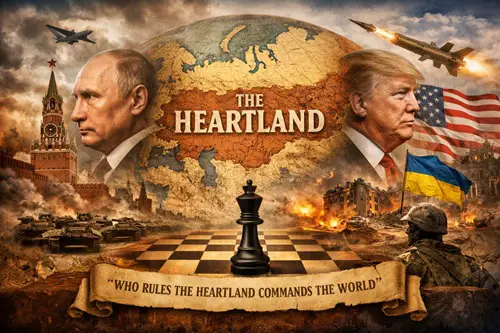 1. Why Mackinder Refuses to Go AwayWhen Halford Mackinder formulated his Heartland theory in 1904, he sought to ground world politics in geography rather than ideology. His famous warning—“Who rules East Europe commands the Heartland; who rules the Heartland commands the World-Island”—was not a prophecy but a structural insight: control of Eurasia's interior confers enduring strategic advantage. More than a century later, in an age of satellites, cyberwarfare, and global finance, Mackinder should have been obsolete. Yet the war in Ukraine, and Donald Trump's apparent willingness to accommodate Russian territorial demands, have returned his framework to the center of geopolitical debate. The persistence of the Heartland raises an uncomfortable question: have we transcended classical geopolitics, or merely forgotten its lessons? 2. Ukraine as the Geopolitical HingeUkraine is often discussed in moral or legal terms—sovereignty, democracy, international law. All are valid. But geopolitically, Ukraine is something more unsettling: a hinge state between Russia and Europe. From a Mackinderian perspective, Ukraine is the western gateway to the Heartland. Zbigniew Brzezinski famously observed that without Ukraine, Russia ceases to be an empire. With Ukraine subordinated, Russia regains strategic depth, buffers NATO, and restores imperial reach lost after 1991. Seen this way, Putin's invasion—however criminal and catastrophic—is not irrational. It is a brutal attempt to resolve a structural vulnerability. Ukraine is not peripheral to Russian strategy; it is central. 3. Trump and the Seduction of Spheres of InfluenceDonald Trump's approach to the Ukraine war appears erratic but follows a consistent underlying intuition: great powers dominate their neighborhoods; smaller states are negotiable; geography trumps norms. This worldview resonates with a pre-1945 logic of spheres of influence. In such a system, peace is achieved not through universal rules but through tacit agreements among strongmen about who controls what. Ukraine, in this framework, becomes a bargaining chip rather than a sovereign actor. At first glance, this looks like hard-nosed realism. In fact, it reflects a deep strategic confusion. 4. The Fatal Error: Spheres of Influence Contradict HegemonySpheres of influence and world hegemony are not complementary strategies; they are opposites. A hegemon seeks to prevent rival consolidation, especially in Eurasia. It maintains open systems, alliance networks, and rule-setting authority precisely to avoid the emergence of closed power blocs. Postwar U.S. grand strategy—shaped explicitly by Mackinder's logic—was never about territorial conquest. It was about preventing any single power from dominating the Heartland. NATO expansion, European integration, and forward defense were containment mechanisms, not ideological indulgences. Trump's willingness to concede Ukraine reverses this logic. It does not preserve American dominance; it abandons it. By legitimizing Russian control over Eastern Europe, the United States would be acquiescing to Heartland consolidation—the very scenario Mackinder warned against. This is not realism. It is strategic abdication. 5. Is a New World Order Inevitable?In one sense, yes. American unipolarity is fading. China's rise, Russia's revanchism, demographic shifts, and internal Western polarization ensure that a post-hegemonic world is emerging. Multipolarity is not a choice; it is a structural condition. But inevitability does not equal desirability. The critical question is not whether a new world order is coming, but what kind of order it will be. There are two possibilities: • Managed multipolarity, in which power diffuses but remains constrained by rules, institutions, and respect for the sovereignty of smaller states. • Spheres-of-influence multipolarity, in which great powers openly dominate their regions and smaller nations exist at sufferance. Trump's approach points decisively toward the second model. This is not a forward-looking adaptation to a changing world, but a regression to 19th-century power politics. 6. Why Ukraine Is the Test CaseUkraine is not merely another nation-state caught between great powers; it is the defining battleground for the emerging structure of international order. Its fate is a litmus test for whether the 21st-century world will be governed by principles or by brute geography. From a strategic standpoint, Ukraine sits at the intersection of multiple imperatives: it is the western gateway to Russia's Heartland, a buffer zone between Moscow and Europe, and a bridge to NATO and EU influence. Its loss to Russian control would dramatically reconfigure the balance of power in Eurasia, signaling that territorial conquest can be rewarded and that spheres of influence are legitimate tools of statecraft. Conversely, a defended Ukraine preserves the credibility of alliances, the deterrent value of international norms, and the strategic integrity of Europe. Normatively, Ukraine represents sovereignty as a principle. Its ability to resist external domination is a signal to smaller and medium powers worldwide that the international system can still protect them. If Ukraine is treated as negotiable, the logic extends inexorably: other vulnerable states—Taiwan, the Baltics, Moldova, and even parts of the Middle East—would be exposed to coercion without expectation of collective defense. The precedent set here is far more consequential than any single battlefield; it is a test of whether international order will tolerate or resist the erosion of state autonomy. Furthermore, the war in Ukraine highlights the interplay of modern and traditional forms of power. Despite cyberwarfare, drones, and economic sanctions, territorial control, supply lines, and manpower still matter. This demonstrates that geography—Mackinder's eternal variable—remains decisive. The conflict thus becomes a proving ground: a demonstration that the Heartland is not an abstract concept, but a real-world determinant shaping the fates of nations. In short, Ukraine is the canary in the coal mine of the new world order. Its treatment reveals whether the emerging multipolarity will be based on shared constraints and rules—or on transactional concessions to the strongest powers. The implications extend far beyond its borders: the future of sovereignty, deterrence, and global order hangs in the balance. 7. Mackinder Reinterpreted, Not ReenactedMackinder diagnosed the dangers of Heartland dominance; he did not prescribe moral surrender to it. To invoke his theory as a justification for Russian expansion—or Western acquiescence—is to misunderstand its purpose. If Mackinder remains relevant, it is as a warning: geography constrains choice, but it does not absolve responsibility. A post-hegemonic world need not be a neo-feudal one. Conclusion: Beyond Hegemony Without CapitulationA new world order may indeed be unavoidable. But Trump's version is not a transition; it is an abdication. The alternative to American primacy is not a world carved into coercive zones of influence, but a more demanding project: plural power under shared constraint. The Heartland still matters—not as destiny, but as a reminder of what is at stake when power is allowed to harden into geography and politics retreats into fatalism. Ukraine, in this sense, is not merely a front line; it is a litmus test for the future of global order, where the principles of sovereignty, restraint, and rule-based multipolarity are either defended or sacrificed.
Comment Form is loading comments...
|