|
TRANSLATE THIS ARTICLE
Integral World: Exploring Theories of Everything
An independent forum for a critical discussion of the integral philosophy of Ken Wilber
  Frank Visser, graduated as a psychologist of culture and religion, founded IntegralWorld in 1997. He worked as production manager for various publishing houses and as service manager for various internet companies and lives in Amsterdam. Books: Ken Wilber: Thought as Passion (SUNY, 2003), and The Corona Conspiracy: Combatting Disinformation about the Coronavirus (Kindle, 2020). Frank Visser, graduated as a psychologist of culture and religion, founded IntegralWorld in 1997. He worked as production manager for various publishing houses and as service manager for various internet companies and lives in Amsterdam. Books: Ken Wilber: Thought as Passion (SUNY, 2003), and The Corona Conspiracy: Combatting Disinformation about the Coronavirus (Kindle, 2020).
Check out my other conversations with ChatGPT Is There Really a “Meaning Crisis” in the West?A Comparison of Wilber, Peterson and VervaekeFrank Visser / ChatGPT
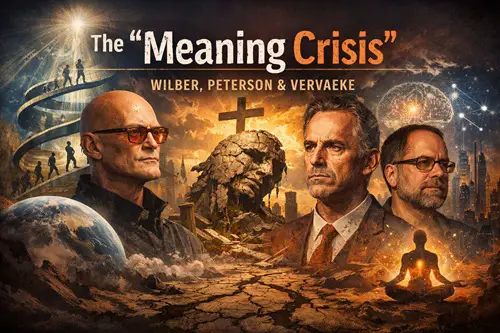 Introduction: A Crisis That Explains EverythingFew phrases circulate as freely in Integral, post-Integral, and metamodern circles as the claim that “the West is in a meaning crisis.” It functions as an all-purpose diagnosis: explaining political polarization, mental health issues, declining religiosity, rising populism, and the alleged spiritual emptiness of modern life. From Jordan Peterson to John Vervaeke, and from Ken Wilber to assorted Integralists, the story is broadly the same: traditional sources of meaning have collapsed, modernity has failed to replace them, and postmodern skepticism has finished the job. But before accepting this diagnosis, it is worth asking a more basic question: is there, in fact, a meaning crisis? Or is this narrative itself a projection—rooted in particular philosophical, spiritual, or generational anxieties? What Integralists Mean by “Meaning Crisis”In Integral discourse, “meaning” is rarely defined in everyday terms. It typically refers to: • A cosmic or metaphysical purpose to existence • A shared civilizational narrative that orders values and identities • A transcendent framework grounding ethics, motivation, and belonging From this perspective, the decline of Christianity, the rise of scientific naturalism, and the fragmentation of grand narratives create an existential vacuum. Human beings, it is argued, need overarching meaning systems; without them, societies drift into nihilism, decadence, or authoritarian regression. Crucially, this framing presupposes that meaning must be unitary, vertical, and ultimately metaphysical. When such meaning disappears, the diagnosis of crisis becomes almost inevitable. The Sociological Reality: Mixed Signals, Not CollapseEmpirically, the Western world does not present a simple picture of existential collapse. On the one hand: • Rates of religious belief and church attendance have declined. • Loneliness, anxiety, and depression are real and documented problems. • Trust in institutions has eroded. On the other hand: • People remain intensely invested in projects of meaning: careers, relationships, creative work, activism, science, sports, and moral causes. • New moral vocabularies—around human rights, identity, ecology, and social justice—have emerged with genuine motivational force. • Many secular societies consistently rank highest in reported life satisfaction. This does not look like a population that has “lost meaning” tout court. It looks more like a pluralization and decentralization of meaning—less inherited, less guaranteed, but not absent. Meaning vs. Metaphysics: A Category ErrorA central problem with the Integral “meaning crisis” thesis is that it quietly conflates meaningfulness with metaphysical depth. People can and do find meaning without believing that: • the universe is evolving toward Spirit, • consciousness is fundamental, • history has a built-in telos. Meaning can arise from participation, commitment, care, and consequence, not from cosmic endorsement. Existentialist philosophy—from Camus to Sartre—already confronted this issue decades ago: the absence of pre-given meaning does not entail the absence of lived meaning. Integralists often treat this existential insight as inadequate or dangerous, precisely because it refuses metaphysical consolation. The Integral Anxiety: Flatland RevisitedKen Wilber famously diagnosed modernity as suffering from “flatland”—the reduction of reality to surfaces, quantities, and mechanisms. The “meaning crisis” narrative functions as a continuation of this critique. But the charge of flatland often rests on a romanticized view of premodern meaning. Traditional societies did not experience meaning as a free, affirming resource; it was often enforced, hierarchical, exclusionary, and cosmologically brittle. Meaning came bundled with dogma, repression, and epistemic closure. What Integralists mourn is not meaning per se, but the loss of a single, authoritative metaphysical story that places humanity at the center of a spiritually animated cosmos. Who Is Really in Crisis?It is worth asking: who is experiencing this alleged crisis most acutely? The “meaning crisis” is disproportionately articulated by: • Intellectuals steeped in philosophy and spirituality • Thinkers dissatisfied with both religion and secular naturalism • Individuals seeking to re-sacralize modernity without returning to dogma For many ordinary people, meaning is not experienced as a philosophical problem. They navigate plural identities, local commitments, and provisional values without demanding cosmic guarantees. The crisis, then, may be less societal than ideological—a crisis felt by those who want modern rationality and premodern metaphysical comfort. Meaning Without MythsNone of this is to deny that modern life poses real existential challenges. Rapid technological change, ecological anxiety, and social fragmentation are genuine pressures. But calling this a “meaning crisis” often smuggles in the assumption that meaning must be: • singular rather than plural, • cosmic rather than local, • given rather than made. Once those assumptions are dropped, the crisis narrative loses much of its force. Modernity has not abolished meaning; it has democratized and destabilized it. That can be disorienting—but it is not nihilism. Three Responses to the Alleged CrisisAlthough Ken Wilber, Jordan Peterson, and John Vervaeke differ markedly in temperament, audience, and intellectual lineage, they converge on a shared diagnosis: modern Western culture has lost access to a deep, binding source of meaning, and this loss is unsustainable. Where they differ is in what they think has been lost and how it must be restored. Ken Wilber: Meaning as Cosmic TeleologyFor Wilber, the meaning crisis is ultimately metaphysical. Modernity, in his view, has amputated the upper reaches of reality—Spirit, Eros, and the intrinsic directionality of evolution—leaving a flattened world of mechanisms and surfaces. Science, when stripped of its contemplative and mystical complements, becomes not merely incomplete but existentially corrosive. Wilber's solution is explicitly teleological: reality itself is evolving toward greater depth, consciousness, and unity. Meaning is restored by situating human life within this grand, vertically stratified cosmos. The crisis, therefore, is not just cultural but ontological: deny Spirit-in-action, and nihilism follows. Critically, this approach presupposes precisely what is in dispute. The absence of cosmic purpose is treated not as a philosophical conclusion but as a psychological deficiency. Meaning must be found in the structure of reality itself; human-scale, provisional meanings are deemed insufficient. The “crisis” thus functions as a rhetorical lever to reintroduce a metaphysical worldview under the guise of existential necessity. Jordan Peterson: Meaning as Mythic OrderPeterson frames the meaning crisis less in metaphysical and more in psychological and mythological terms. For him, the erosion of Judeo-Christian narratives has destabilized the symbolic frameworks that once oriented individuals toward responsibility, sacrifice, and moral seriousness. In their absence, people drift toward nihilism or ideological possession. Unlike Wilber, Peterson does not claim knowledge of cosmic evolution or Spirit. Instead, he treats traditional myths as existential technologies—adaptive narratives shaped by evolutionary and cultural pressures. Meaning is restored by reinhabiting these stories pragmatically, even if their metaphysical truth remains ambiguous. Yet this strategy also reveals a tension. If myths are justified primarily by their psychological utility, then their authority becomes conditional and instrumental. Peterson's solution attempts to preserve the binding force of tradition while suspending belief in its literal truth—a balancing act that satisfies neither secular critics nor religious traditionalists. The “meaning crisis” here reflects anxiety over the loss of moral authority, not demonstrable existential collapse. John Vervaeke: Meaning as Participatory Sense-MakingVervaeke offers the most philosophically sophisticated version of the crisis narrative. Drawing on cognitive science, phenomenology, and ancient philosophy, he argues that modernity has lost forms of participatory knowing—ways of being meaningfully attuned to the world rather than merely representing it. For Vervaeke, meaning is not primarily belief-based but enacted through practices that cultivate relevance, wisdom, and transformation. His proposed remedy is not a return to religion but a re-engineering of spiritual technologies—meditation, dialogical practices, and communities of practice—capable of restoring existential orientation without dogma. Yet even here, the diagnosis may overreach. What Vervaeke describes as a loss of participatory meaning may equally be understood as a shift in cognitive style, not a deficit. Modern societies privilege analytical, procedural, and institutional forms of knowing over immersive, mythic ones. That trade-off brings real costs—but also enormous gains. To label this transition a “crisis” risks pathologizing modern rationality itself. A Shared AssumptionDespite their differences, all three thinkers share a crucial assumption: meaning must be deep, binding, and world-disclosing in order to count. Ordinary, local, self-authored meanings are treated as fragile substitutes for something more fundamental—cosmic purpose, sacred myth, or participatory attunement. Once this assumption is questioned, the crisis narrative weakens. The problem may not be that modern people lack meaning, but that certain intellectual traditions refuse to recognize meaning that is plural, provisional, and non-transcendent. Conclusion: Crisis or Transition?The Western world is not suffering from a deficit of meaning so much as from the end of guaranteed meaning. Integralists interpret this as pathology because their frameworks are oriented toward synthesis, hierarchy, and transcendence. But from another angle, this condition can be seen as a hard-won maturity: a world in which meaning is negotiated rather than imposed, lived rather than revealed, and plural rather than totalizing. If there is a crisis, it may lie less in the absence of meaning than in the refusal to accept that meaning no longer comes prepackaged with metaphysics.
Comment Form is loading comments...
|