|
TRANSLATE THIS ARTICLE
Integral World: Exploring Theories of Everything
An independent forum for a critical discussion of the integral philosophy of Ken Wilber
  Frank Visser, graduated as a psychologist of culture and religion, founded IntegralWorld in 1997. He worked as production manager for various publishing houses and as service manager for various internet companies and lives in Amsterdam. Books: Ken Wilber: Thought as Passion (SUNY, 2003), and The Corona Conspiracy: Combatting Disinformation about the Coronavirus (Kindle, 2020). Frank Visser, graduated as a psychologist of culture and religion, founded IntegralWorld in 1997. He worked as production manager for various publishing houses and as service manager for various internet companies and lives in Amsterdam. Books: Ken Wilber: Thought as Passion (SUNY, 2003), and The Corona Conspiracy: Combatting Disinformation about the Coronavirus (Kindle, 2020).
Check out my other conversations with ChatGPT Turning the TablesPutin, Hitler, and the Abuse of HistoryFrank Visser / ChatGPT
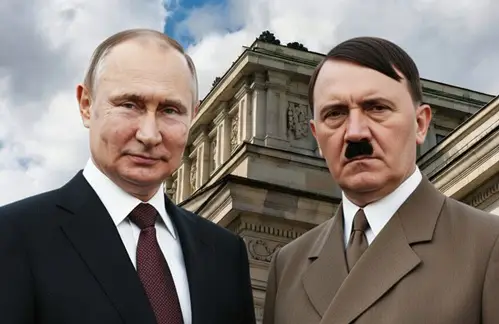 Vladimir Putin routinely frames Russia's war against Ukraine as a continuation of the “Great Patriotic War”: a defensive struggle against fascism, Nazism, and existential threat. Joseph Dillard echoes this framing, presenting Russia as a reluctant actor forced into war by Western provocation and Ukrainian extremism. The analogy is powerful, emotionally resonant, and politically useful. But history cuts both ways. If we take Putin's own premises seriously—national humiliation, economic revival, protection of co-ethnics abroad, failed diplomacy, and encirclement by hostile powers—then the far more instructive comparison is not Stalin versus Hitler, but Putin versus Hitler. This is not a moral equivalence claim, nor a claim of genocidal identity. It is a structural and historical comparison. And structurally, the parallels are disturbing. 1. National Humiliation as Foundational MythHitler's worldview was shaped by the perceived humiliation of Germany after World War I: territorial loss, military restrictions, and national disgrace under the Treaty of Versailles. These grievances became the emotional and ideological fuel of his politics. Putin's core grievance is strikingly similar. The collapse of the Soviet Union—famously described by him as “the greatest geopolitical catastrophe of the 20th century”—functions as a narrative of humiliation, loss, and betrayal. Russia, in this view, was not defeated militarily but cheated out of its rightful status by Western opportunism. In both cases, humiliation is not merely historical memory; it is weaponized into a permanent justification for revisionism. 2. Economic Revival as Proof of DestinyHitler's early successes were inseparable from Germany's economic rebound: massive public works, rearmament, and restored national pride. Economic revival validated his leadership and legitimized increasingly aggressive policies. Putin likewise presided over a period of economic recovery in the 2000s, aided by energy revenues and state consolidation. This recovery was presented as proof that Russia had “stood up from its knees” and reclaimed sovereignty from Western-imposed chaos. In both cases, economic revival became evidence not merely of competence, but of historical destiny—and a mandate for territorial ambition. 3. Protecting “Our People” AbroadOne of Hitler's most effective pretexts for expansion was the protection of ethnic Germans outside Germany: in Austria, the Sudetenland, and beyond. These populations were portrayed as oppressed, endangered, and yearning for reunification. Putin's justification follows the same logic. Russians and Russian-speakers in Crimea, Donbas, and Ukraine at large are framed as victims of persecution, “Nazification,” or cultural erasure. Military intervention is thus recast as humanitarian rescue. The pattern is classic: redefine borders as temporary injustices, redefine minorities as hostages, and redefine aggression as protection. 4. Negotiations Were Tried—and “Failed”Defenders of Putin often insist that diplomacy was exhausted: NATO expansion, the Minsk agreements, Putin's 2021 draft treaties. War, they say, was forced upon Russia. But this argument mirrors precisely the logic used to excuse Hitler's escalation. Negotiations were indeed tried: Munich, bilateral talks, concessions, appeasement. Each failure was then reframed as proof of bad faith by the other side, rather than as evidence of maximalist demands. In both cases, diplomacy was not a genuine effort to coexist but a tactical phase preceding force. 5. Provocation Narratives and VictimhoodHitler portrayed Germany as encircled, provoked, and denied security. The Western powers, the League of Nations, and neighboring states were said to leave Germany no choice but to act. Putin's rhetoric is structurally identical. NATO is the aggressor. Ukraine is a Western proxy. Russia is merely responding. In both narratives, the aggressor claims the status of victim—and thereby immunizes itself against moral scrutiny. 6. “Anti-Fascism” as Ideological InversionPerhaps the most grotesque irony is Putin's invocation of “de-Nazification.” It must be acknowledged, to be precise, that Ukraine does have a far-right and neo-Nazi problem, as do many countries with turbulent post-Soviet histories. Groups such as the Azov movement have existed, and extremist symbolism has occasionally been tolerated or instrumentalized—often exaggerated by Russian propaganda, but not entirely fabricated. However, this reality does not distinguish Ukraine from Russia. Russia itself harbors extensive far-right, ultranationalist, and neo-Nazi networks, many of which have been openly active for decades and, in some cases, absorbed into paramilitary formations fighting in Ukraine. Moreover, Ukraine's far-right parties have consistently performed poorly in national elections, while Russia's political system leaves no comparable space for democratic marginalization or exposure of extremism. Putin's use of “anti-fascism” is therefore not a factual diagnosis but an ideological inversion. Fascism is projected outward so that authoritarian expansion can appear morally righteous. The existence of extremists becomes a pretext for the destruction of an entire state. This is not the legacy of the Great Patriotic War; it is its exploitation. 7. Dehumanization of the EnemyA decisive step toward large-scale violence is the moral downgrading of the enemy. Hitler systematically portrayed Jews, Slavs, and political opponents as Untermenschen—biologically, culturally, and morally inferior. This dehumanization was not merely propaganda; it was the psychological precondition for mass violence and territorial conquest. Putin's rhetoric follows the same functional pattern, even if not the same racial vocabulary. Ukrainians are routinely described as artificial, manipulated, brainwashed, or essentially non-existent as a legitimate people. The Ukrainian state is portrayed as a puppet regime, its leadership as illegitimate, and its citizens as either victims to be “liberated” or extremists to be eliminated. Once a people is stripped of agency, history, or moral standing, violence against them can be framed as correction rather than crime. Dehumanization, in both cases, clears the ethical space in which war becomes not only permissible but necessary. 8. The Dream of a Greater EmpireHitler's ambitions were never limited to border adjustments. His vision of a Greater German Reich—rooted in Lebensraum, racial hierarchy, and historical destiny—required permanent expansion eastward. Empire was not an accidental byproduct of security; it was the goal. Putin's vision is less explicitly racial but no less imperial. His repeated denial of Ukraine's historical legitimacy, his nostalgia for imperial and Soviet greatness, and his insistence on a “Russian world” (Russkiy mir) reveal an aspiration that extends beyond neutral security concerns. Ukraine is not merely a buffer; it is a missing piece of a larger civilizational project. In both cases, empire is justified as restoration rather than conquest. Expansion is framed as reunification, correction, or historical justice. But the underlying logic is the same: sovereignty of neighboring states is conditional, provisional, and ultimately expendable. 9. Is Dillard a Chamberlain?The analogy is uncomfortable—but instructive. Neville Chamberlain was not evil, stupid, or malicious. He believed that understanding grievances, respecting spheres of influence, and avoiding escalation would preserve peace. He mistook revisionist aggression for negotiable insecurity. When Dillard echoes Putin's framing—emphasizing Western provocation, Russian grievance, failed diplomacy, and moral equivalence—he occupies a similar intellectual position. Not as a collaborator, but as an explainer whose framework systematically downplays agency, ideology, and imperial ambition. Chamberlain's failure was not moral weakness; it was analytical misjudgment. He assumed that satisfying grievances would end expansion. History proved otherwise. Conclusion: History as Warning, Not WeaponPutin insists on historical analogy. That is his choice. But history does not obey political preference. If we are to reason historically rather than mythologically, then the lesson of the 1930s is not that Russia is bravely reliving 1941—but that Europe is once again confronting a revisionist power that cloaks expansion in grievance, protection, and failed diplomacy. To ignore that lesson is not realism. It is repetition. And history, when repeated under different banners, is no less destructive.
Widget is loading comments...
|