|
TRANSLATE THIS ARTICLE
Integral World: Exploring Theories of Everything
An independent forum for a critical discussion of the integral philosophy of Ken Wilber
  Frank Visser, graduated as a psychologist of culture and religion, founded IntegralWorld in 1997. He worked as production manager for various publishing houses and as service manager for various internet companies and lives in Amsterdam. Books: Ken Wilber: Thought as Passion (SUNY, 2003), and The Corona Conspiracy: Combatting Disinformation about the Coronavirus (Kindle, 2020). Frank Visser, graduated as a psychologist of culture and religion, founded IntegralWorld in 1997. He worked as production manager for various publishing houses and as service manager for various internet companies and lives in Amsterdam. Books: Ken Wilber: Thought as Passion (SUNY, 2003), and The Corona Conspiracy: Combatting Disinformation about the Coronavirus (Kindle, 2020).
Check out my other conversations with ChatGPT The Martian DelusionWhy Emigrating to Mars Is an Incredibly Dumb IdeaFrank Visser / ChatGPT
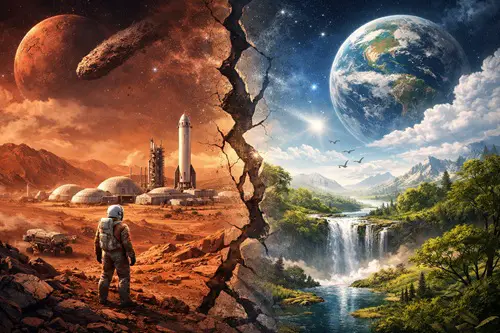 Elon Musk's vision of humanity becoming a “multiplanetary species” by emigrating to Mars has captured the techno-utopian imagination. It is presented as bold, visionary, and necessary—an insurance policy against extinction and a grand next step in human evolution. Yet when examined soberly, the idea of large-scale human emigration to Mars collapses under the weight of physical reality, biological constraints, economic absurdity, and philosophical confusion. Far from being humanity's Plan B, Mars colonization is a spectacularly impractical distraction from the real challenges facing civilization on Earth. 1. Mars Is Lethally Hostile to Human LifeMars is not a slightly inconvenient Earth. It is one of the most hostile environments in the solar system short of Venus. Its surface conditions are fundamentally incompatible with human biology: Atmosphere: Mars' atmosphere is about 1% the density of Earth's and consists mostly of carbon dioxide. Unprotected exposure leads to rapid asphyxiation and decompression. Radiation: Mars lacks a global magnetic field and has a thin atmosphere, exposing inhabitants to chronic cosmic and solar radiation. Long-term exposure dramatically increases cancer risk and causes neurological and reproductive damage. Temperature: Average surface temperature is around -63°C, with extreme fluctuations. Gravity: Mars' gravity is only 38% of Earth's. Long-term low-gravity effects include muscle atrophy, bone loss, cardiovascular deterioration, and potentially irreversible developmental problems for children born there. Every second of human life on Mars would depend on perfectly functioning artificial systems. There is no ecological buffer, no margin for error, and no evolutionary adaptability on relevant timescales. Earth's “hostility” during climate change is trivial compared to Mars' permanent lethality. 2. Closed Systems and the Myth of Self-SufficiencyMusk often speaks of a “self-sustaining” Martian civilization. This is science fiction masquerading as engineering optimism. No fully closed ecological life-support system has ever worked for humans, even on Earth. Experiments like Biosphere 2 failed despite unlimited resupply options, Earth gravity, and abundant sunlight. On Mars: Food production would be energy-intensive, fragile, and nutritionally limited. Industrial supply chains (electronics, medicine, replacement parts) would be impossible to localize at any meaningful level. Any system failure—air, water, power—would be catastrophic and unrecoverable. A Mars colony would remain permanently dependent on Earth for resupply, expertise, and rescue. Calling this “emigration” is misleading; it would be more accurate to call it permanent life support dependency at interplanetary distance. 3. Evolutionary and Reproductive AbsurditiesMars colonization is often framed as a long-term evolutionary step. This betrays a misunderstanding of both evolution and human biology. Human beings evolved in Earth's biosphere over millions of years in tight co-evolution with gravity, microbes, circadian rhythms, atmospheric chemistry, and ecological diversity. Mars offers none of this. The idea that humans could thrive, reproduce healthily, and form a stable society in a radically alien environment is speculative at best and reckless at worst. Children born on Mars might never be able to return to Earth due to gravity differences. A Martian population would be biologically and socially isolated, effectively creating a fragile, dependent offshoot of humanity rather than a robust backup. 4. The “Backup Civilization” FallacyMusk's most compelling rhetorical move is the claim that Mars provides a backup in case Earth suffers a catastrophe. This argument fails on multiple levels. First, any catastrophe capable of destroying Earth's biosphere—asteroid impact, gamma-ray burst, runaway AI, nuclear war—would almost certainly also disrupt the supply chains and political stability required to support a Mars colony. Second, a few thousand people living in sealed habitats on Mars do not constitute a meaningful backup of civilization. Civilization is not just DNA; it is knowledge, infrastructure, culture, agriculture, ecosystems, and billions of interdependent lives. Third, if humanity cannot manage Earth—an extraordinarily forgiving, resource-rich planet—there is no reason to believe it can manage Mars, a planet that actively tries to kill us every moment. 5. Opportunity Cost: Escaping Instead of FixingPerhaps the most damning critique is ethical and economic. The resources required for Mars colonization—trillions of dollars, vast engineering talent, political attention—would be vastly more effective if directed toward: • Climate mitigation and adaptation • Renewable energy infrastructure • Biodiversity preservation • Pandemic preparedness • Nuclear risk reduction • Global poverty and political instability Mars functions psychologically as an escape fantasy: a way to avoid the difficult work of maintaining a complex planetary civilization. It externalizes responsibility rather than confronting it. The fantasy of exit replaces the ethic of stewardship. 6. Techno-Messianism and the Cult of the VisionaryMusk's Mars rhetoric fits a familiar pattern: technological salvationism combined with heroic individualism. The future is framed as something rescued by brilliance rather than governed by institutions, ethics, and collective action. This narrative is emotionally appealing but intellectually shallow. It treats engineering prowess as a substitute for political wisdom and ecological understanding. Worse, it encourages the belief that planetary limits are optional—problems to be bypassed rather than solved. Conclusion: Earth Is the Only Planet That Actually WorksMars is not humanity's future. It is a scientific curiosity, a research destination, and perhaps a site for limited robotic or short-term human exploration. But as a destination for mass emigration or civilizational continuity, it is a fantasy untethered from biological, ecological, and economic reality. Earth is not replaceable. It is not a failed prototype. It is the only known planet that supports complex life, human consciousness, and civilization at scale. The idea that we should abandon it—or hedge our bets by fleeing to a radioactive desert—reveals not visionary foresight but a profound misunderstanding of what makes civilization possible. If we cannot make it here, we will not make it anywhere.
Comment Form is loading comments...
|