|
TRANSLATE THIS ARTICLE
Integral World: Exploring Theories of Everything
An independent forum for a critical discussion of the integral philosophy of Ken Wilber
  Frank Visser, graduated as a psychologist of culture and religion, founded IntegralWorld in 1997. He worked as production manager for various publishing houses and as service manager for various internet companies and lives in Amsterdam. Books: Ken Wilber: Thought as Passion (SUNY, 2003), and The Corona Conspiracy: Combatting Disinformation about the Coronavirus (Kindle, 2020). Frank Visser, graduated as a psychologist of culture and religion, founded IntegralWorld in 1997. He worked as production manager for various publishing houses and as service manager for various internet companies and lives in Amsterdam. Books: Ken Wilber: Thought as Passion (SUNY, 2003), and The Corona Conspiracy: Combatting Disinformation about the Coronavirus (Kindle, 2020).
Check out my other conversations with ChatGPT
ON KOSMIC CREATIVITY
Evolution as Creative Advance When Creativity Becomes Fundamental Kosmic Creativity, Register Integrity, and Modal Fidelity When Modal Pluralism Breaks Its Own Rules Creativity, Cosmos, and Confusion The Trial of Eros: Why It Fails The Cosmic Court Proceedings The Trial of ErosA Philosophical Court TranscriptFrank Visser / ChatGPT
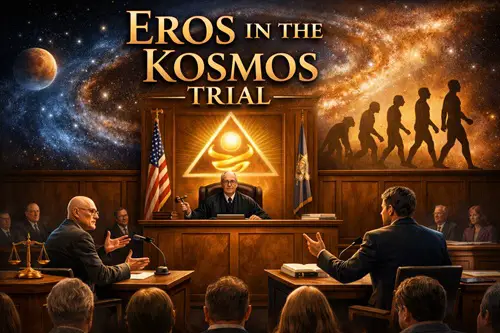 Dramatis Personae• The Court - Charged with adjudicating epistemic legitimacy • Ken Wilber - Defendant, proponent of Eros as Spirit-in-action • Brad Reynolds - Defense witness, advocate of transrational realism • Frank Visser - Plaintiff, critic of metaphysical overreach • The Jury - Informed philosophical reason, attentive to science and phenomenology I. Opening of the CourtCourt: This court convenes to examine a single but far-reaching claim: That evolution is driven, guided, or suffused by an intrinsic cosmic principle—variously called Eros or Spirit-in-action—and that this principle is both real and explanatory. The court recognizes three relevant jurisdictions: • Empirical science • Phenomenology of experience • Metaphysical interpretation The charge is not that this view is meaningless or inspirationally empty, but that it may exceed what evidence and sound epistemology can support. II. Opening Statement for the DefenseKen Wilber Wilber: Evolution is not random chaos punctuated by occasional order. Over nearly fourteen billion years, we see a persistent movement toward greater complexity, differentiation, and integration. Quarks become atoms, atoms become molecules, molecules become cells, cells become organisms, organisms become self-reflective consciousness. Standard evolutionary theory explains how change occurs—through mutation and selection—but it does not explain why evolution repeatedly produces depth, interiority, and increasing consciousness. Through contemplative insight—what I have called the Eye of Spirit—we directly know that reality is grounded in Spirit. This Spirit is not outside the world but expresses itself as the world, through self-transcending holons. Eros is the name for this inherent drive. It is not metaphorical. It is a real force in the universe, as real as gravity, electromagnetism, or the nuclear forces—though operating in a different register. Evolution, properly understood, is Spirit remembering itself in time. III. Cross-Examination of WilberFrank Visser Visser: Mr. Wilber, you repeatedly cite biological complexity—eyes, wings, immune systems—as evidence that evolution requires a deeper explanatory principle. Are you aware that similar arguments were made by proponents of Intelligent Design? Wilber: Yes, but my position is not Intelligent Design. I do not posit an external designer intervening from outside nature. Visser: Agreed. You posit an internal designer instead. But the logical structure remains the same: where evolutionary explanations feel unsatisfying, you insert purposive agency. Why is this not a metaphysical gap-filler? Wilber: Because Spirit is not inferred from gaps. It is directly known. Visser: We will return to that claim. One more question: evolutionary biology explains complexity through cumulative selection. Do you deny this? Wilber: No. I deny that it explains creativity, novelty, and directionality. Visser: But dissatisfaction with an explanation does not license ontological inflation. Science does not require a cosmic drive to explain complexity—only time, variation, and selection. Your Eros is not required by the data. IV. Defense WitnessBrad Reynolds Reynolds: The prosecution misunderstands the nature of the claim. Spirit is not a scientific hypothesis competing with evolutionary theory. It is a transrational reality directly apprehended through contemplative realization. To accuse Wilber of metaphysical speculation is to impose scientific criteria on spiritual knowledge. This is scientism. Those who have directly realized Spirit know that reality is fundamentally conscious and purposive. Evolution is one of Spirit's modes of self-expression. Furthermore, if spiritual realization is genuine, then Spirit must have causal efficacy. Otherwise, how could post-material insight be communicated through speech and action? V. Cross-Examination of ReynoldsVisser: You say Spirit is directly known. What exactly is known? Reynolds: Nondual awareness. Unity with the Ground of Being. Visser: Is what is directly known labeled “Spirit” before or after interpretation? Reynolds: Spirit is self-evident in realization. Visser: Yet Buddhists experience emptiness, Advaitins experience Brahman, Christians experience God. These are incompatible ontologies. Are they all literally true? Reynolds: They are different perspectives on the same ultimate reality. Visser: Or they are different interpretations of similar experiences. How do you distinguish the two? Reynolds: The depth of realization confers certainty. Visser: Certainty is psychological, not epistemic. Feeling certain does not establish ontological truth. VI. Plaintiff's Clarifying TestimonyFrank Visser Visser: This case turns on a crucial confusion. What is directly known in spiritual experience is experience—not metaphysics. Experiences of unity, boundary dissolution, and nonduality are real as experiences. But calling them “Spirit,” “Eros,” or “Ground of Being” is an interpretive act, shaped by culture, doctrine, and expectation. There is no uninterpreted experience of Spirit. Experiences do not announce their ontological meaning. Therefore, Spirit is not directly known; it is inferred. If Spirit is an interpretation of experience, it has no special epistemic privilege. And if it lacks such privilege, it cannot ground claims about evolution or cosmology. This is not scientism. It is epistemic hygiene. VII. Jury DeliberationJury Foreperson: We acknowledge that novel causal dynamics in evolution are possible. Science remains open to empirical surprise. However, no such dynamics have been observed. Wilber's Eros is asserted, not discovered. We further find that spiritual experience does not justify ontological conclusions without interpretive mediation. The transrational defense collapses once experience is distinguished from meaning. We also note an existential motive: Eros guarantees that evolution is meaningful, progressive, and safe. This may be comforting—but comfort is not evidence. VIII. Final VerdictCourt: On the charge that Eros exists as a real causal force in evolution: Not proven. On the claim that Spirit is directly known as an ontological reality: Not established. On the allegation of scientism against the plaintiff: Dismissed. On the charge of epistemological overreach: Sustained. The court affirms: • Spiritual experiences are real. • Their metaphysical interpretations are contestable. • Their projection into cosmology is unjustified. The universe may yet surprise us. But it has not testified on behalf of Eros. Court adjourned.
Widget is loading comments...
|