|
TRANSLATE THIS ARTICLE
Integral World: Exploring Theories of Everything
An independent forum for a critical discussion of the integral philosophy of Ken Wilber
  Frank Visser, graduated as a psychologist of culture and religion, founded IntegralWorld in 1997. He worked as production manager for various publishing houses and as service manager for various internet companies and lives in Amsterdam. Books: Ken Wilber: Thought as Passion (SUNY, 2003), and The Corona Conspiracy: Combatting Disinformation about the Coronavirus (Kindle, 2020). Frank Visser, graduated as a psychologist of culture and religion, founded IntegralWorld in 1997. He worked as production manager for various publishing houses and as service manager for various internet companies and lives in Amsterdam. Books: Ken Wilber: Thought as Passion (SUNY, 2003), and The Corona Conspiracy: Combatting Disinformation about the Coronavirus (Kindle, 2020).
Check out my other conversations with ChatGPT The Myth of the Sacred "Why"Why the How/Why Distinction FailsFrank Visser / ChatGPT
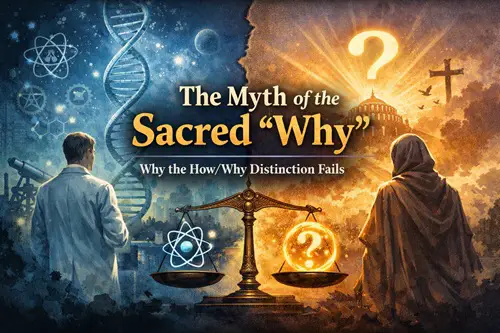 A familiar apologetic strategy in religious and spiritual discourse claims that science and religion occupy complementary domains. Science, we are told, answers how questions—mechanisms, causes, processes—while religion uniquely addresses why questions—meaning, purpose, and ultimate significance. This rhetorical division is meant to disarm scientific criticism by relocating religion beyond empirical scrutiny. Yet the distinction collapses upon inspection. Not only is it conceptually confused, it also functions as a refuge for superstition, dogmatism, and metaphysical overreach. The Ambiguity of "Why"The core problem lies in the equivocation built into the word why. In ordinary and scientific usage, why questions ask for explanations: Why does water boil at 100°C? Why did the bridge collapse? Why do species go extinct? These are causal questions, and science answers them routinely—often by translating "why" into "by what mechanisms and under what conditions." Religious and spiritual discourse, however, quietly redefines why to mean for what purpose or with what intention. This shift is rarely acknowledged. Instead, it is smuggled in as though it were an extension of explanation rather than a metaphysical leap. Once why is reinterpreted as cosmic purpose, the question ceases to be explanatory and becomes speculative—or worse, mythopoetic. Purpose Is Not an ExplanationPurpose-based answers are not explanations unless there is independent evidence of an agent capable of having purposes. When religion claims that the universe exists "for a reason," it implicitly assumes a purposive mind behind nature. But this assumption is precisely what is under dispute. To invoke divine intention as an answer to why is to assume the conclusion in advance. In science, purposes are admissible only within restricted domains—namely, biology and psychology—and even there they are carefully constrained. Natural selection explains why traits persist without invoking foresight or cosmic intention. The "purpose" of the heart is not to fulfill a divine plan but to pump blood because organisms with functioning hearts survived. Outside such domains, teleology becomes metaphysics dressed up as explanation. The Slide into SuperstitionOnce why questions are severed from causal accountability, they become an open invitation to unfalsifiable narratives. Why did this disaster happen? Why was this child born disabled? Why did this war erupt? Religious answers typically invoke divine will, karmic law, or spiritual necessity—none of which can be tested, corrected, or constrained by evidence. Historically, such answers have justified everything from natural disasters as punishment to social hierarchies as divinely ordained. When why questions are answered without methodological discipline, they do not yield meaning; they yield rationalizations. This is the soil in which superstition and fundamentalism flourish. Meaning Is Not a Cosmic PropertyDefenders of the how/why split often retreat to a softer claim: religion does not explain events but provides meaning. Yet meaning is not something embedded in the universe waiting to be discovered. It is something humans create—through culture, narrative, values, and relationships. To confuse existential meaning with cosmic purpose is a category error. The fact that humans seek meaning does not imply that the universe was designed to supply it. Science does not fail to answer why life matters; it correctly refuses to treat that question as a property of the cosmos rather than a human concern. Science Does Answer "Why"—Just Not the Ones Religion PrefersIronically, science answers many why questions far more successfully than religion ever has. Why do planets orbit stars? Why do diseases spread? Why do beliefs propagate? Why do humans invent gods? These are all legitimate why questions, and they receive increasingly robust answers from physics, biology, psychology, and anthropology. What religion insists on preserving is not why as such, but a narrow class of ultimate why questions whose answers are immune to revision. These are not explanatory questions but doctrinal placeholders—designed to stop inquiry rather than advance it. The Intellectual Cost of the How/Why FirewallBy insisting that religion owns the why, religious discourse exempts itself from standards of evidence while still making claims about reality. This firewall allows metaphysical assertions to masquerade as insight, while criticism is dismissed as scientism or reductionism. The result is not a peaceful coexistence of domains but an asymmetrical truce: science must justify itself constantly, while religion declares its conclusions untouchable. This is not complementarity; it is epistemic privilege. Ken Wilber and the Spiritualization of "Why"Ken Wilber's Integral Theory exemplifies a sophisticated version of the same how/why maneuver. While presenting himself as a synthesizer who honors modern science, Wilber repeatedly reassigns explanatory authority when scientific accounts fail to support his metaphysical commitments. Science, in his framework, is granted jurisdiction over how evolution proceeds, but denied competence to address why it does so—at which point Wilber introduces Spirit, Eros, or a self-transcending Kosmos as the deeper answer. This strategy allows Wilber to affirm evolutionary biology in form while quietly subverting it in substance. Natural selection may describe the mechanisms of change, but it is said to be incomplete without a prior drive toward complexity, depth, or self-realization. The moment science refuses to endorse such a directional impulse, Wilber relocates the issue into a transrational register, beyond empirical adjudication. The result is a metaphysical supplement that explains nothing while claiming explanatory depth. Crucially, Wilber treats this "why" as a discovery rather than an interpretation. Eros is not offered as a poetic metaphor or existential stance, but as a real feature of the Kosmos—albeit one allegedly invisible to scientific methods. This places Wilber squarely within the tradition of teleological metaphysics he claims to transcend. The fact that such claims are insulated from falsification is not regarded as a weakness, but as evidence that they operate at a higher level of knowing. Here the how/why distinction functions as an intellectual escape hatch. Whenever empirical science reaches a non-teleological conclusion—random mutation, contingent history, blind processes—Wilber declares that science has overstepped its domain. Yet when spiritual metaphysics makes claims about evolution, cosmology, or consciousness, it is exempted from the same evidential demands. This is not integration; it is asymmetrical jurisdiction. Moreover, Wilber's appeal to transrational insight does not resolve the problem—it merely redescribes it. To claim that Spirit or Eros is "directly known" does not establish its objective existence; it establishes only that certain experiences are interpreted in metaphysical terms. The move from experience to ontology is precisely what science refuses to make without independent corroboration. By framing this refusal as reductionism, Wilber repeats the classic apologetic tactic: redefining epistemic restraint as spiritual blindness. In this sense, Wilber's Integral Theory does not escape the superstition/fundamentalism trap—it intellectualizes it. The cosmic why is preserved at all costs, even if doing so requires positing invisible forces that conveniently align with spiritual intuition but never constrain it. The language is more polished than traditional theology, but the structure of the argument is the same. Conclusion: When "Why" Becomes a Metaphysical RefugeThe enduring appeal of the science/how versus religion/why distinction lies in its promise of harmony without accountability. Yet, as we have seen, this division does not clarify the limits of knowledge so much as it redraws them to protect preferred conclusions. Whether in traditional religion or in Ken Wilber's Integral metaphysics, the sacred why functions as a metaphysical refuge—invoked precisely where causal explanation ends and speculative meaning begins. By rebranding teleology as transrational insight, Wilber does not overcome the problem; he refines it. The universe is once again endowed with intention, direction, and purpose, not because evidence demands it, but because spiritual intuition insists upon it. Genuine intellectual humility, however, lies in resisting the temptation to inflate human longings into cosmic properties. When why questions outrun evidence, the honest response is not metaphysical supplementation but disciplined restraint. Retiring the sacred why does not impoverish our understanding of the world; it liberates inquiry from the need to smuggle meaning into nature under the guise of explanation.
Widget is loading comments...
|