|
TRANSLATE THIS ARTICLE
Integral World: Exploring Theories of Everything
An independent forum for a critical discussion of the integral philosophy of Ken Wilber
  Frank Visser, graduated as a psychologist of culture and religion, founded IntegralWorld in 1997. He worked as production manager for various publishing houses and as service manager for various internet companies and lives in Amsterdam. Books: Ken Wilber: Thought as Passion (SUNY, 2003), and The Corona Conspiracy: Combatting Disinformation about the Coronavirus (Kindle, 2020). Frank Visser, graduated as a psychologist of culture and religion, founded IntegralWorld in 1997. He worked as production manager for various publishing houses and as service manager for various internet companies and lives in Amsterdam. Books: Ken Wilber: Thought as Passion (SUNY, 2003), and The Corona Conspiracy: Combatting Disinformation about the Coronavirus (Kindle, 2020).
Check out my other conversations with ChatGPT
ON KOSMIC CREATIVITY
Evolution as Creative Advance When Creativity Becomes Fundamental Kosmic Creativity, Register Integrity, and Modal Fidelity When Modal Pluralism Breaks Its Own Rules Creativity, Cosmos, and Confusion The Trial of Eros: Why It Fails The Cosmic Court Proceedings The Trial of ErosWhy Wilber's Spirit-in-Evolution FailsFrank Visser / ChatGPT
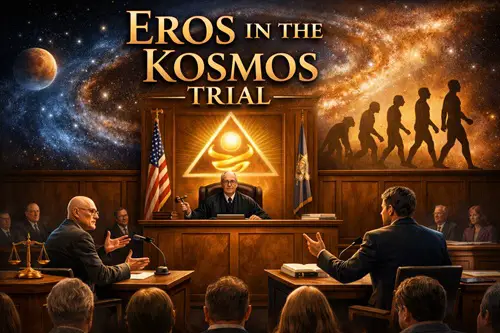 IntroductionKen Wilber has long maintained that evolution is not merely a blind, mechanical process, but the outward expression of an intrinsic drive in the universe—Eros, or Spirit-in-action. In his most explicit formulations, Wilber describes Eros as an actual force, comparable in reality to gravity or electromagnetism, operating from within the Kosmos to generate increasing complexity, consciousness, and integration. This claim has been repeatedly criticized as unscientific, metaphysical, and indistinguishable in structure from Intelligent Design. In response, Wilber and defenders such as Brad Reynolds insist that these critiques miss the point. Eros, they argue, is not a scientific hypothesis but a transrational truth, directly known through contemplative realization. To reject it is said to betray scientism and reductionism. This essay examines that defense at its strongest—and explains why it ultimately fails, not only scientifically, but epistemologically and philosophically. Wilber's Strongest Case for ErosWilber's position can be reconstructed charitably as follows: 1. Evolution displays a long-term trend toward greater complexity, depth, and consciousness. 2. Standard evolutionary theory explains mechanisms (variation, selection) but not the directionality or creativity of the process. 3. Interior spiritual realization reveals a deeper truth: reality is grounded in Spirit, which expresses itself through self-transcending holons. 4. Therefore, evolution can be legitimately interpreted as Spirit—or Eros—unfolding in time. This view is not presented merely as poetry or metaphor. Wilber explicitly claims ontological realism: Eros is inherent in the universe and operates as a genuine causal principle. The First Failure: Evolutionary ExplanationThe first and most familiar problem is that Wilber repeatedly invokes biological features—eyes, wings, immune systems, neural complexity—as phenomena that supposedly cannot be explained by orthodox evolutionary theory without invoking Spirit. This move mirrors, almost point for point, the historical arguments of Intelligent Design: • appeal to complexity • appeal to improbability • appeal to explanatory insufficiency • insertion of a purposive principle As in the ID cases, the flaw lies not in pointing out gaps in scientific knowledge, but in smuggling metaphysical conclusions into those gaps. Evolutionary theory does not require an intrinsic cosmic drive to account for complexity, only cumulative selection acting over vast timescales. Wilber's dissatisfaction with this explanation is philosophical, not scientific. At this level alone, Eros fails as a scientific claim. The Second Failure: Violating Epistemological PluralismWilber's deeper problem, however, is internal. His own framework insists on epistemological pluralism: different domains of reality require different modes of knowing. • Science investigates exterior phenomena. • Introspection investigates interior experience. • Contemplation investigates spiritual states. Yet Wilber repeatedly violates this principle by allowing interior spiritual insight to legislate exterior cosmology. The Eye of Spirit is asked to explain evolutionary history, biological innovation, and cosmic development—domains that properly belong to the sciences. When challenged, Wilber's defenders respond that this is not a category error, because Spirit is directly known. This brings us to the decisive issue. The Final Problem: Spirit Is Not “Directly Known”The strongest defense of Eros rests on a single claim: that Spirit is directly known in transrational realization, and therefore does not require empirical justification. But this claim collapses under scrutiny. What is directly known in mystical or contemplative states is experience, not metaphysics. Such experiences may include: • nonduality • boundary dissolution • unity consciousness • loss of subject-object distinction Calling these experiences “Spirit,” “Eros,” “Ground of Being,” or “Absolute Consciousness” is already an interpretive act. It draws on cultural, philosophical, and religious frameworks. There is no such thing as an uninterpreted experience of Spirit. This is not a skeptical dismissal of spirituality. It is a phenomenological fact: experiences do not announce their own ontological meaning. The same type of experience has been interpreted across history as Brahman, God, emptiness, the One, Buddha-nature, or Logos—mutually incompatible metaphysical claims arising from structurally similar states. Thus, even within the interior domain, Spirit is not given as a fact but inferred as a meaning. Transrational Does Not Mean Epistemically PrivilegedLabeling this interpretation “transrational” does not rescue it. Transrational experiences may transcend discursive thought, but the interpretation of those experiences does not transcend rational evaluation. A belief does not gain ontological authority because it feels self-validating, profound, or revelatory. Those qualities describe phenomenology, not reality. Once this is acknowledged, the entire edifice collapses: • If Spirit is an interpretation of experience, it has no automatic claim to ontological truth. • If it lacks ontological certainty interiorly, it cannot ground claims about evolution exteriorly. • Eros becomes a metaphysical narrative, not an explanatory principle. Why Wilber Cannot Let Go of ErosAt this point, the persistence of Eros demands explanation. Why does Wilber repeatedly overreach? The answer is existential rather than evidential. Without Eros: • evolution is contingent, not purposeful • complexity has no guaranteed trajectory • consciousness is emergent, not destined • the universe offers no built-in meaning Eros functions as a religious guarantee—a promise that reality is ultimately on our side. This is a prerational need, not a transrational insight. ConclusionWilber's vision of evolution as Spirit-in-action is imaginative, inspiring, and existentially reassuring. But it fails on every level where it claims ontological authority. • As science, it is unsupported. • As epistemology, it violates its own principles. • As phenomenology, it confuses experience with interpretation. • As metaphysics, it asserts more than it can justify. The sober conclusion is unavoidable: • There is no evidence for Eros as a force in evolution. • There is no guarantee that Spirit is an ontological reality rather than a symbolic interpretation. • There is experience—and the meanings we project onto it. That recognition does not impoverish spirituality. It rescues it from metaphysical inflation. And it restores intellectual honesty to Integral thought.
Widget is loading comments...
|