|
TRANSLATE THIS ARTICLE
Integral World: Exploring Theories of Everything
An independent forum for a critical discussion of the integral philosophy of Ken Wilber
  Frank Visser, graduated as a psychologist of culture and religion, founded IntegralWorld in 1997. He worked as production manager for various publishing houses and as service manager for various internet companies and lives in Amsterdam. Books: Ken Wilber: Thought as Passion (SUNY, 2003), and The Corona Conspiracy: Combatting Disinformation about the Coronavirus (Kindle, 2020). Frank Visser, graduated as a psychologist of culture and religion, founded IntegralWorld in 1997. He worked as production manager for various publishing houses and as service manager for various internet companies and lives in Amsterdam. Books: Ken Wilber: Thought as Passion (SUNY, 2003), and The Corona Conspiracy: Combatting Disinformation about the Coronavirus (Kindle, 2020).
Check out my other conversations with ChatGPT The Wilber-Combs Lattice RevisitedStates, Stages, and the Limits of Integral MappingFrank Visser / ChatGPT
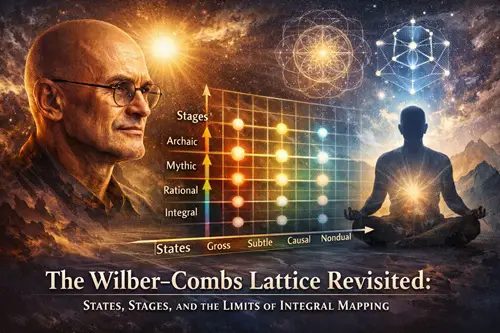 I. Introduction: The Promise of the LatticeThe Wilber-Combs Lattice (WCL) represents one of Ken Wilber's more technically ambitious contributions to integral theory. Introduced in the mid-20s, most prominently in Integral Spirituality, the lattice was designed to resolve a persistent confusion in both spiritual discourse and developmental psychology: the conflation of states of consciousness with stages of development. Wilber's basic insight was sound. Human beings can undergo powerful altered or mystical experiences without necessarily having developed the cognitive, moral, or psychological structures associated with later developmental stages. Conversely, advanced developmental capacities do not guarantee access to contemplative or transpersonal states. The lattice aimed to clarify this by plotting states (gross, subtle, causal, nondual) along one axis and stages (archaic through integral) along another, allowing any experience to be described as a state-at-a-stage. Conceptually elegant, the lattice promised to discipline both spiritual inflation and reductionist skepticism. The question is whether it succeeds. II. Uptake and Influence: A Limited ReachDespite its prominence within Wilber's own work, the Wilber-Combs Lattice has had limited uptake outside integral and transpersonal subcultures. In mainstream developmental psychology, the model is rarely cited. This is not accidental. Contemporary developmental research focuses on empirically operationalized constructs—identity formation, moral reasoning, executive function—while states of consciousness remain methodologically elusive and theoretically marginal. The lattice straddles two domains that psychology typically keeps distinct. Within contemplative studies and transpersonal psychology, the lattice is better known but functions largely as a heuristic device, not as a research framework. It appears in integrative essays and practitioner-oriented discussions, but rarely structures experimental design or longitudinal study. In integral circles, by contrast, the lattice has acquired near-canonical status. Yet here its use is often rhetorical rather than analytical—invoked to classify spiritual claims or to defend assertions of realization, rather than to critically examine them. Ironically, the very audience most committed to the lattice tends to use it least rigorously. III. The Core Claim: States and Stages as Orthogonal DimensionsAt the heart of the lattice lies a strong theoretical claim: states and stages are largely independent variables. This independence is reinforced by one of Wilber's most frequently repeated maxims: Any state can be reached from any stage. This claim is intended to prevent elitism and to emphasize the universality of spiritual potential. But as a psychological assertion, it is deeply problematic. IV. “Any State from Any Stage”: Why the Maxim Fails1. Developmental Capacity Is Not OptionalDevelopmental psychology has consistently shown that experience is constrained by cognitive, emotional, and metacognitive capacities. While rudimentary altered states—absorption, trance, emotional rapture—may indeed be widely accessible, more refined contemplative states presuppose capacities that are themselves developmental achievements: sustained attention, emotional regulation, reflexive self-awareness, and symbolic integration. To claim that a subject at an early or mythic stage can access the same nondual or causal states as a post-conventional subject empties the notion of “state” of any meaningful structure. At best, it reduces states to undifferentiated phenomenological events; at worst, it confuses pre-reflective fusion with post-reflective integration. 2. Phenomenology Is Stage-Constituted, Not Stage-NeutralEven when similar language is used—“unity,” “emptiness,” “God-realization”—the phenomenological organization and interpretation of such experiences varies dramatically by stage. A mythic-stage experience of unity is embedded in narrative and authority; a rational-stage experience is psychologized or naturalized; a post-conventional experience is reflexively contextualized and often deconstructed. The lattice tends to treat states as if they were raw experiential givens merely colored by stage. In reality, the stage helps constitute the experience itself. This undermines the claim of clean orthogonality between the two axes. 3. Access Versus Stability and IntegrationWilber's maxim also conflates momentary access with developmental stabilization. Many states can be briefly accessed through meditation, psychedelics, ritual, or crisis. But the ability to stabilize, integrate, and embody such states over time is strongly stage-dependent. This distinction is crucial. Without it, the lattice tacitly legitimizes claims of realization based on episodic experiences, while sidelining the slow work of psychological development. In practice, this has often enabled the very spiritual bypassing the lattice was meant to counteract. 4. A Back Door to Spiritual InflationParadoxically, the claim that “any state can be reached from any stage” has functioned, in integral culture, as a defensive shield against critique. Developmental objections can be dismissed on the grounds that “states transcend stages,” even when behavioral, ethical, or cognitive evidence suggests otherwise. Rather than disciplining spiritual claims, the lattice—combined with this maxim—has often insulated them. V. Structural Problems in the Lattice ItselfBeyond the problematic maxim, the lattice suffers from deeper conceptual weaknesses. 1. Category Confusion States and stages belong to different ontological categories: transient experiential modes versus relatively stable meaning-making structures. Mapping them as equivalent dimensions suggests a commensurability that has never been demonstrated. 2. Implicit Teleology Despite Wilber's protests, the lattice retains a developmental telos culminating in “integral” or “nondual” realization. This reintroduces hierarchy under the guise of inclusivity, a move increasingly at odds with contemporary developmental systems theory. 3. Lack of Operational Definitions Neither the states nor the stages in the lattice are specified with sufficient operational clarity to support empirical testing. This leaves the model vulnerable to interpretive drift and ideological use. 4. Cultural Narrowness The lattice universalizes a Western developmental sequence while selectively incorporating non-Western contemplative states. Alternative cultural models of maturity and consciousness are assimilated rather than allowed to challenge the framework. VI. Toward a More Defensible ReformulationIf the Wilber-Combs Lattice is to be rehabilitated rather than abandoned, several refinements are necessary: Weaken the independence claim: States and stages should be treated as interacting variables, not orthogonal absolutes. Replace the maxim with a more defensible formulation: Elementary altered states may be widely accessible, but their depth, stability, interpretation, and integration are strongly stage-dependent. Ground the model empirically, using validated developmental assessments and standardized phenomenological reporting. Abandon teleological framing in favor of non-linear, context-sensitive developmental dynamics. VII. ConclusionThe Wilber-Combs Lattice captures an important truth: experience alone does not equal development. That insight remains valuable. But the lattice overreaches when it claims that states float freely of developmental constraints. The maxim that “any state can be reached from any stage” is less an empirical finding than a normative gesture—one that weakens the model precisely where rigor is most needed. Rather than clarifying the relationship between development and spirituality, the lattice has too often blurred it. A rehabilitated model would preserve the distinction between states and stages while acknowledging that consciousness is not accessed from nowhere. Experience is always structured, interpreted, and integrated—or not—by development.
Comment Form is loading comments...
|