|
TRANSLATE THIS ARTICLE
Integral World: Exploring Theories of Everything
An independent forum for a critical discussion of the integral philosophy of Ken Wilber
  Frank Visser, graduated as a psychologist of culture and religion, founded IntegralWorld in 1997. He worked as production manager for various publishing houses and as service manager for various internet companies and lives in Amsterdam. Books: Ken Wilber: Thought as Passion (SUNY, 2003), and The Corona Conspiracy: Combatting Disinformation about the Coronavirus (Kindle, 2020). Frank Visser, graduated as a psychologist of culture and religion, founded IntegralWorld in 1997. He worked as production manager for various publishing houses and as service manager for various internet companies and lives in Amsterdam. Books: Ken Wilber: Thought as Passion (SUNY, 2003), and The Corona Conspiracy: Combatting Disinformation about the Coronavirus (Kindle, 2020).
Check out my other conversations with ChatGPT Mysticism in a Lab CoatBrad Reynolds' Metaphysical Appropriation of PhysicsFrank Visser / ChatGPT
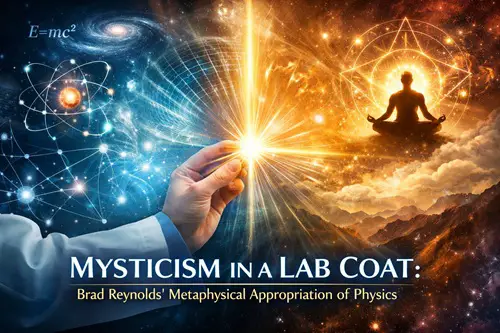 Introduction: The Promise and the ProblemBrad Reynolds' trilogy on Matter, Light, and Conscious Light presents itself as a bold exercise in “Integral Vision,” promising a synthesis of science and spirituality in which modern physics is said to converge with ancient mystical insight. According to Reynolds, contemporary physics—especially quantum theory and cosmology—has effectively outgrown materialism and now points toward a spiritually grounded universe, best understood as Light, Spirit, or Consciousness-in-action. This ambition is familiar within the integral milieu. The idea that science, properly understood, ultimately confirms the perennial wisdom traditions has long been one of integral theory's motivating hopes. The difficulty is equally familiar: this confirmation is asserted rather than demonstrated, achieved through metaphorical slippage, epistemological conflation, and selective readings of physics that function rhetorically rather than analytically. The question is not whether mysticism is meaningful, but whether it can legitimately claim ontological authority over physical reality—and whether physics can be enlisted in that claim without being distorted in the process. The Core Move: From Physics to SpiritAcross the three essays, Reynolds relies on a recurring argumentative pattern. He begins with genuine scientific insights—matter as energy, the quantum vacuum, the centrality of light in cosmology—and emphasizes their counterintuitive or paradoxical nature. These paradoxes are then treated as indications that physical explanation has reached its limits, at which point mystical interpretation steps in to supply the deeper truth. The conclusion follows that science itself is pointing beyond materialism toward Spirit. What is missing in this progression is an actual inference. Physics certainly undermines naïve materialism; matter is not solid substance but a complex interplay of fields, energies, probabilities, and symmetries. Yet abandoning naïve materialism does not entail embracing mystical idealism. Reynolds treats this transition as self-evident, but it is precisely here that argument is required and where none is offered. The gap between the claim that matter is not what we once thought and the claim that matter is Spirit is bridged by analogy, not by logical necessity or empirical warrant. Light as Metaphor, Not OntologyLight occupies a privileged position in Reynolds' metaphysical vision. Scientifically, light is indispensable: photons mediate electromagnetic interactions, structure atomic behavior, enable perception, and carry information across cosmic distances. Spiritually, light has long functioned as a powerful metaphor for consciousness, divinity, and revelation. Reynolds' mistake is not in noticing this convergence of symbolism, but in collapsing metaphor into ontology. When physics describes light as fundamental, it is not making claims about consciousness, intention, or divine purpose. These are additional metaphysical commitments that require independent justification. Reynolds treats the symbolic resonance between physical light and spiritual light as if it constituted evidence of their identity. Yet symbolic overlap does not license ontological conclusions. The result is a category confusion in which poetic meaning is mistaken for explanatory power, and metaphor is promoted to metaphysics. Quantum Vacuum ≠ Mystical VoidA similar equivocation appears in Reynolds' treatment of the quantum vacuum or zero-point field. He presents this scientific concept as a modern rediscovery of the mystical Void, suggesting a deep convergence between physics and contemplative insight. However, the resemblance dissolves upon closer inspection. The quantum vacuum is a mathematically defined and empirically constrained construct within physical theory. It possesses no awareness, intention, or spiritual significance. The mystical Void, by contrast, is experiential, soteriological, and typically described as conscious or divine. That both are sometimes described as “nothing” is linguistically interesting but philosophically trivial. Reynolds treats a shared word as a shared essence, substituting semantic coincidence for conceptual rigor. Physics does not secretly reintroduce Spirit into the universe; rather, Spirit is imported into physics by metaphysical fiat and then celebrated as scientific confirmation. The Privileging of Mystical EpistemologyBeneath these interpretive maneuvers lies a deeper assumption: the epistemic supremacy of mystical experience. Reynolds presumes that the Eye of Spirit grants privileged access to the ultimate nature of reality, while science merely measures external appearances. This hierarchy is never defended; it is simply assumed. Mystical experience is treated not as one human mode of meaning-making but as a form of ontological disclosure. This asymmetry renders the entire framework unfalsifiable. When science appears to support mystical conclusions, it is welcomed as confirmation. When it does not, it is dismissed as incomplete or reductionist. No conceivable scientific finding could challenge the metaphysical conclusion, because mystical insight always occupies the highest epistemic court of appeal. What is presented as integration thus becomes insulation from critique. Integral theory, if it is to retain philosophical credibility, cannot function as a mechanism for spiritual veto power. Circularity Disguised as IntegrationReynolds frequently invokes “Integral Vision” as though it were an independent standard by which views can be assessed. In practice, however, Integral Vision is defined so that it must culminate in mystical metaphysics. Those who do not arrive at Spirit-Light simply have not seen integrally. The reasoning is circular: integral vision includes mystical insight; mystical insight reveals Spirit as ultimate; therefore, integral vision reveals Spirit as ultimate. Nothing is demonstrated, only restated in increasingly exalted terms. Physics as Rhetorical OrnamentOne of the most revealing features of Reynolds' essays is that physics never performs genuine explanatory work. Scientific concepts serve primarily as illustrations and sources of prestige. There is no sustained engagement with competing interpretations of quantum theory, with the philosophy of science, or with the methodological limits of scientific inference. Physics is neither challenged nor transformed by mysticism; it is aestheticized. Science becomes a supporting character in a story whose metaphysical ending was decided in advance. Conclusion: The Cost of Spiritual OverreachReynolds' mystical metaphysics is not problematic because it is spiritual, but because it mistakes spirituality for explanation, metaphor for mechanism, and experience for evidence. By claiming physics as an ally without respecting its epistemic autonomy, the project ultimately weakens both science and spirituality. The universe revealed by physics is already astonishing: self-organizing, contingent, vast, and indifferent to human narratives. To insist that it must secretly be Spirit-Light is not an act of integration but an act of metaphysical reassurance. An integral philosophy worthy of the name would resist this temptation. It would allow science to speak in its own voice, mysticism in another, and accept that meaning does not require cosmic intention, nor wonder divine authorship. In Reynolds' work, mysticism wears the language of physics like a lab coat—but beneath it, the metaphysical commitments remain untouched, untested, and ultimately unearned.
Comment Form is loading comments...
|