|
TRANSLATE THIS ARTICLE
Integral World: Exploring Theories of Everything
An independent forum for a critical discussion of the integral philosophy of Ken Wilber
  Frank Visser, graduated as a psychologist of culture and religion, founded IntegralWorld in 1997. He worked as production manager for various publishing houses and as service manager for various internet companies and lives in Amsterdam. Books: Ken Wilber: Thought as Passion (SUNY, 2003), and The Corona Conspiracy: Combatting Disinformation about the Coronavirus (Kindle, 2020). Frank Visser, graduated as a psychologist of culture and religion, founded IntegralWorld in 1997. He worked as production manager for various publishing houses and as service manager for various internet companies and lives in Amsterdam. Books: Ken Wilber: Thought as Passion (SUNY, 2003), and The Corona Conspiracy: Combatting Disinformation about the Coronavirus (Kindle, 2020).
Check out my other conversations with ChatGPT
ON KOSMIC CREATIVITY
Evolution as Creative Advance When Creativity Becomes Fundamental Kosmic Creativity, Register Integrity, and Modal Fidelity When Modal Pluralism Breaks Its Own Rules Creativity, Cosmos, and Confusion The Trial of Eros: Why It Fails The Cosmic Court Proceedings When Modal Pluralism Breaks Its Own RulesA Response to Bruce Alderman on Wilber's ErosFrank Visser / ChatGPT
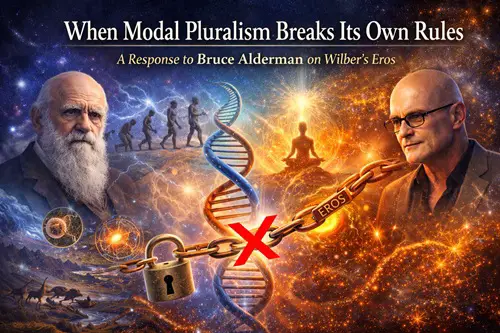 Below is a response essay to Bruce Alderman, that accepts plural modalities in principle while arguing that Wilber has systematically violated his own epistemic framework through the deployment of Eros as a quasi-causal factor in evolutionary science. The charge of crypto-creationism is stated carefully, argued structurally, and grounded in Wilber's own schemes. Introduction: A Serious Contribution Worth Taking SeriouslyBefore turning to points of disagreement, it is important to acknowledge the value of Bruce Alderman's contribution. Alderman is not a casual commentator on Integral Theory. He is one of its most philosophically literate and methodologically self-aware interlocutors, deeply familiar with both Wilber's corpus and the wider intellectual traditions—Whitehead, Habermas, Latour—from which he draws. His essay is not an exercise in apologetics, nor a reflexive defense of Wilber at all costs. On the contrary, it is an unusually careful attempt to diagnose why debates around Eros, evolution, and explanation have proven so resistant to resolution. By shifting attention from the truth or falsity of particular claims to the problem of how different kinds of claims are made, Alderman raises the level of the conversation. I share much of this diagnosis. I fully agree that different modalities of knowing disclose different aspects of reality, and that scientific, philosophical, and contemplative perspectives cannot be collapsed into one another without distortion. Wilber's original framework of the “three eyes” and multiple validity criteria remains, in principle, a valuable safeguard against reductionism. It is precisely because Alderman takes these distinctions seriously—and because of his standing within the integral field—that his argument deserves a direct and equally serious response. What follows is not a rejection of modal pluralism, nor a defense of scientism, but a challenge to what I see as a persistent blind spot: the repeated violation of Wilber's own epistemic rules at the point where metaphysics intrudes into evolutionary explanation. In short, Alderman helps clarify the problem. I contend that he does not go far enough in assigning responsibility for it. The problem is that Wilber himself has repeatedly violated these very distinctions—and not accidentally, rhetorically, or marginally, but systematically and strategically. Nowhere is this more evident than in his treatment of Eros in relation to evolutionary science. The Issue Is Not Modality—It Is TransgressionAlderman frames the dispute as a problem of register confusion: critics allegedly mistake spiritual discourse for scientific explanation. This framing lets Wilber off too easily. The core objection is not that Wilber speaks spiritually about the universe. It is that he repeatedly introduces Eros—described at various points as “a real force,” “a drive,” or “Spirit-in-action”—into the explanatory space of evolutionary biology, while simultaneously shielding it from scientific accountability. That is not a misunderstanding by critics. It is what Wilber actually does. Wilber's Own Epistemic RulesWilber has been exceptionally clear—when it suits him—that: • Science concerns third-person, empirical, intersubjectively testable phenomena • Spiritual insight concerns first-person contemplative disclosure • Each domain has its own methods and cannot trespass without confusion This is precisely why Wilber has so often accused others of “category errors.” Yet when it comes to evolution, Wilber routinely abandons this discipline. Eros Enters the Laboratory—IllicitlyWilber does not merely say that evolution can be contemplated spiritually. He repeatedly points to specific empirical problems in evolutionary biology—eyes, wings, the immune system, the origin of life, the Cambrian explosion—and presents them as evidence that standard evolutionary mechanisms are insufficient in principle. Only then does Eros appear. Eros is not introduced as a poetic gloss or existential interpretation, but as what explains what science allegedly cannot. It is explicitly contrasted with chance variation and natural selection, which are portrayed as blind, flatland, and ultimately inadequate. This move places Eros squarely within the arena of scientific explanation, regardless of how defenders later wish to reclassify it. Why the “Interpretive” Defense FailsAlderman suggests that Eros should be read as non-causal, non-competitive, and interpretive. That reading may be philosophically charitable—but it is textually and rhetorically unstable. Wilber does not merely interpret evolutionary outcomes as meaningful after the fact. He repeatedly claims that without Eros: • novelty cannot arise • complexity cannot be explained • direction cannot be accounted for These are explanatory claims. Once such claims are made, retreating into spiritual immunity is not clarification; it is evasion. Not a Slip, but a PatternThis is not a single unfortunate metaphor, nor a moment of rhetorical excess. It is a recurring argumentative structure: • Identify unresolved scientific problems • Present them as principled failures of evolutionary theory • Introduce Eros as the deeper explanatory factor • Deflect criticism by invoking spiritual epistemology That pattern has been repeated for decades. Calling it “cross-modal speech” understates the case. It is cross-modal privilege. Crypto-Creationism, Not Classical CreationismWilber is not a biblical creationist. He does not posit a designer intervening from outside nature. But structurally, his position mirrors creationist logic in a subtler form: • Scientific gaps are treated as metaphysical openings • Direction is smuggled into nature without evidential warrant • A non-empirical principle is granted explanatory priority • Science is allowed to operate, but never to close the case This is creationism without a creator—teleology without a designer, but with the same epistemic asymmetry. Linguistic Sophistication Won't Save Us (or Wilber)One reason Wilber's violations are so often overlooked is his extraordinary linguistic sophistication. Few contemporary thinkers are as verbally agile. He moves effortlessly between science, philosophy, mysticism, psychology, and poetry, often within a single paragraph. This fluency creates an aura of depth that can make boundary violations hard to detect. But linguistic elegance is not epistemic discipline. A concept does not become legitimate merely because it is wrapped in nuanced qualifiers, shifting metaphors, or carefully hedged prose. Nor does invoking “multiple registers,” “different lenses,” or “nondual perspectives” retroactively absolve a claim that has already been positioned as explanatory. Wilber's language often performs a double function: it appears precise while remaining strategically elastic. Terms like Eros, Spirit-in-action, or self-organizing drive slide between meanings—sometimes causal, sometimes metaphorical, sometimes contemplative—without ever settling long enough to be pinned down. When pressed, they dissolve into interpretation. When unchallenged, they function as explanation. This is not accidental. It is rhetorically effective. The problem is that no amount of semantic refinement can compensate for a category violation. If Eros is introduced to explain empirical phenomena that evolutionary theory allegedly cannot, then it enters the arena of scientific explanation, regardless of how carefully it is later re-described. At that point, poetic nuance becomes irrelevant; evidential standards apply. Appeals to “both/and” thinking do not help here. Integration is not achieved by allowing concepts to mean different things at different moments without accountability. True pluralism requires constraint, not just inclusivity. In this sense, Alderman's emphasis on register integrity, while philosophically sound, underestimates the power of rhetoric itself. The problem is not merely that readers misunderstand Wilber. It is that Wilber's prose actively enables misunderstanding—by design. No amount of linguistic sophistication can rescue a framework that repeatedly violates its own epistemic rules. Precision of language is not a substitute for precision of claims. And eloquence cannot redeem an argument that depends on crossing boundaries it claims to respect. If integral theory is to move forward, it will not be by ever finer verbal distinctions, but by the harder task of renouncing explanatory privileges it has not earned. Why This MattersAlderman's appeal to register integrity explains why the debate persists, but it does not resolve it. The issue is not mutual misunderstanding. It is rule-breaking by the architect of the rules himself. Wilber built a sophisticated framework to keep science and spirituality from contaminating one another. Then, precisely at the most contested point—evolution—he violated it. And when called out, the violation is rebranded as interpretation. ConclusionI fully accept plural modalities of knowing. I reject scientism as much as spiritual reductionism. But pluralism only works if its boundaries are respected. Wilber's use of Eros does not respect them. It is not an innocent metaphor, not a harmless spiritual gloss, and not a misunderstanding by critics. It is a sustained attempt to elevate a metaphysical principle into explanatory authority over evolutionary science—while denying critics the right to evaluate it as such. That is why the charge of crypto-creationism persists. Not because critics are confused about modalities—but because Wilber has crossed them. Addendum: Why AI Is Precisely the Right Tool for This JobBruce Alderman has expressed skepticism about the use of AI in philosophical and textual analysis, worried that it may flatten nuance, exaggerate patterns, or substitute statistical correlation for understanding. In many contexts, this caution is justified. AI is no substitute for philosophical judgment, historical scholarship, or close reading. But in this case, AI is not a liability. It is an asset. The criticism of Wilber developed here does not hinge on subtle interpretive nuance or hidden meanings. It concerns surface-level rhetorical behavior: the indiscriminate mixing of scientific, metaphysical, and evocative language within the same explanatory space. That behavior is not obscure. It is repetitive, patterned, and linguistically detectable. This makes it ideally suited to AI-assisted analysis. Pattern Detection, Not Philosophical AuthorityAI is particularly good at identifying: • recurrent phrases • shifts in register • semantic slippage • the proximity of empirical claims to metaphysical assertions In other words, AI excels at derp text analysis: exposing where language becomes sloppy, promiscuous, or strategically ambiguous—not by interpretation, but by pattern recognition. Wilber's videos and writings provide a textbook case. Within minutes of analysis, AI can reliably flag: • where evolutionary problems are framed as empirical failures • where spiritual concepts are immediately introduced as explanatory supplements • where causal language (“drives,” “forces,” “pushes”) is later re-described as metaphor • where scientific authority is invoked rhetorically and then disavowed defensively This is not deep metaphysics. It is linguistic behavior. Why This Matters for the Eros DebateAlderman's account leans heavily on charitable reinterpretation: Wilber should be read as speaking interpretively, symbolically, or spiritually. AI analysis helps demonstrate why critics remain unconvinced. Because Wilber does not consistently speak that way. Instead, his discourse oscillates—often within the same passage—between: • empirical inadequacy claims • metaphysical supplementation • poetic elevation • epistemic retreat AI does not invent this pattern. It merely makes it visible. AI as a Check on Rhetorical ImmunizationOne of the most persistent defenses of Wilber is that critics “take him too literally.” AI analysis neutralizes this defense by showing that literal, explanatory language is doing real work before being rhetorically dissolved. AI does not accuse. It does not interpret motives. It simply shows recurrence, proximity, and usage. In that sense, it functions as a counterweight to linguistic charisma. It strips away the spell cast by eloquence and forces attention back to how claims are actually constructed. Not Replacing Judgment—Supporting ItNone of this means AI replaces philosophical evaluation. Humans still decide: • whether a pattern is problematic • whether a concept is legitimate • whether a move is justified But AI helps answer a prior question that Alderman's analysis largely assumes rather than demonstrates: Is the alleged register confusion really there—or is it merely in the eye of the critic? In Wilber's case, the answer is unambiguous. ConclusionAlderman is right to warn against naive reliance on AI for philosophical truth. But he underestimates its value as a diagnostic instrument—especially when the issue at hand is not subtle metaphysics, but repeated rhetorical boundary violations. When a thinker's language oscillates systematically between science and spirituality while claiming immunity from both critiques, AI-assisted derp text analysis is not a threat to understanding. It is a form of accountability. And in the case of Wilber's Eros, it confirms what critics have been saying all along: the problem is not misunderstanding. The problem is right there in the words.
Widget is loading comments...
|