|
TRANSLATE THIS ARTICLE
Integral World: Exploring Theories of Everything
An independent forum for a critical discussion of the integral philosophy of Ken Wilber
  Frank Visser, graduated as a psychologist of culture and religion, founded IntegralWorld in 1997. He worked as production manager for various publishing houses and as service manager for various internet companies and lives in Amsterdam. Books: Ken Wilber: Thought as Passion (SUNY, 2003), and The Corona Conspiracy: Combatting Disinformation about the Coronavirus (Kindle, 2020). Frank Visser, graduated as a psychologist of culture and religion, founded IntegralWorld in 1997. He worked as production manager for various publishing houses and as service manager for various internet companies and lives in Amsterdam. Books: Ken Wilber: Thought as Passion (SUNY, 2003), and The Corona Conspiracy: Combatting Disinformation about the Coronavirus (Kindle, 2020).
Check out my other conversations with ChatGPT Selective LegalismRussia, China, and the Instrumental Use of International LawFrank Visser / ChatGPT
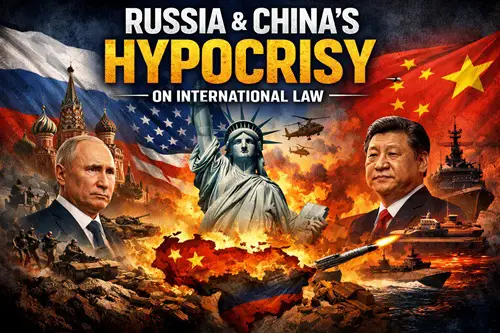 When Russia and China condemn a U.S. military action against Venezuela as a violation of international law, the charge carries an immediate air of moral gravity. Principles such as state sovereignty, non-intervention, and respect for territorial integrity are indeed cornerstones of the post-1945 international order. Yet the credibility of such condemnations depends not merely on rhetorical invocation but on consistent adherence. On that measure, both Moscow and Beijing stand on precarious ground. Their objections are less a defense of international law as a universal norm than an exercise in selective legalism—invoking rules when they constrain rivals, disregarding them when they obstruct their own strategic ambitions. International Law as a Strategic InstrumentInternational law was designed to restrain power, not to sanctify it. However, in practice it often functions as a vocabulary of legitimacy rather than a binding constraint. Great powers, in particular, tend to adopt an instrumental relationship to legal norms: rules are emphasized when advantageous and relativized when inconvenient. Russia and China exemplify this pattern with remarkable consistency. Their condemnation of U.S. intervention in Venezuela rests on familiar legal claims: the prohibition of unilateral military action, respect for national sovereignty, and the illegitimacy of regime change imposed from outside. Each of these principles is sound in the abstract. The difficulty arises when those same principles are systematically violated by the accusers themselves. Russia: Sovereignty as a Conditional PrincipleRussia's posture toward international law has undergone a marked transformation since the end of the Cold War. While formally committed to the UN Charter, Moscow has repeatedly violated the territorial integrity of neighboring states when it suited its geopolitical objectives. The annexation of Crimea in 2014 represents a paradigmatic breach of international law: the use of military force to alter borders, justified post hoc through a contested referendum conducted under occupation. This act directly contravened the very norm Russia now claims to defend in Venezuela. The subsequent full-scale invasion of Ukraine in 2022 went further still, openly rejecting the prohibition on aggressive war and attempting to extinguish the sovereignty of a UN member state. Russia has attempted to rationalize these actions through appeals to historical entitlement, ethnic protection, or Western hypocrisy. Yet such arguments underscore the core problem: sovereignty, for Moscow, is not an inviolable principle but a revocable privilege—respected only insofar as it aligns with Russian security and imperial interests. Against this background, Russia's denunciation of U.S. actions in Venezuela appears less a defense of law than a tactical maneuver aimed at opposing American influence while preserving freedom of action for itself. China: Non-Intervention with Chinese CharacteristicsChina presents itself as the guardian of non-intervention, especially in contrast to Western liberal interventionism. Beijing frequently emphasizes respect for sovereignty, particularly when defending authoritarian regimes against external pressure. This stance resonates strongly in the Global South and forms a key pillar of China's diplomatic messaging. Yet China's actual conduct reveals a far more conditional commitment. In the South China Sea, Beijing has ignored international arbitration rulings, constructed artificial islands, and militarized contested waters in defiance of established maritime law. Its treatment of Hong Kong—effectively dismantling the “one country, two systems” framework guaranteed by international agreement—represents another clear violation of binding commitments. Moreover, China's posture toward Taiwan directly contradicts its professed respect for peaceful coexistence. While invoking sovereignty to shield itself from criticism, Beijing simultaneously threatens the use of force to absorb a self-governing polity, signaling that territorial integrity matters most when it is China's own. Thus, when China condemns U.S. intervention in Venezuela, it does so not from principled consistency but from strategic alignment: opposing American power projection while reinforcing a global norm against interference that conveniently protects its own internal and regional ambitions. Venezuela as a Proxy BattlefieldVenezuela occupies a symbolic role in this geopolitical theater. For Russia and China, support for Caracas serves multiple purposes: resisting U.S. dominance in the Western Hemisphere, protecting economic and strategic investments, and reinforcing a narrative of Western overreach. International law becomes a rhetorical shield, not a constraint. This does not absolve the United States of its own contradictions. U.S. interventions have frequently stretched or violated international law, often justified by moral or security imperatives rather than legal authorization. But pointing out American hypocrisy does not erase Russian or Chinese hypocrisy; it merely multiplies it. The Erosion of Normative AuthorityThe deeper consequence of such selective adherence is the erosion of international law itself. When major powers treat legal norms as optional and contingent, the system devolves into a contest of narratives rather than a framework of restraint. Smaller states, meanwhile, are left exposed, learning that sovereignty is protected only when geopolitically convenient. Russia and China's condemnation of U.S. actions in Venezuela thus rings hollow—not because the principles invoked are wrong, but because the invokers have repeatedly demonstrated their willingness to violate those same principles elsewhere. International law cannot survive as a menu from which great powers choose selectively. Either it binds all, or it constrains none. Hypocrisy as a Structural Feature of Global PoliticsAt a deeper level, the hypocrisy on display should not be understood as a moral anomaly but as a structural feature of global politics. International relations have never been governed primarily by consistent ethical principles; they are governed by power, interest, and strategic narrative management. International law functions less as a neutral referee than as a shared language through which states justify actions already decided on other grounds. From this perspective, Russia, China, and the United States are not outliers but exemplars. Each invokes sovereignty, human rights, or legal norms when doing so constrains adversaries, and each relativizes or bypasses those same norms when they obstruct national objectives. The hypocrisy lies not in violating international law—an unfortunately common practice—but in presenting such violations as principled exceptions while framing identical behavior by rivals as existential threats to the global order. This does not mean international law is meaningless. On the contrary, its persistent invocation testifies to its residual normative power. States feel compelled to justify themselves in legal terms precisely because naked power still lacks legitimacy. Yet this also means that hypocrisy is built into the system: if law were genuinely binding on great powers, it would constrain them equally; since it does not, it becomes an instrument of persuasion rather than restraint. Seen in this light, the Russian and Chinese condemnation of U.S. actions in Venezuela is not shocking but predictable. It reflects not a sudden concern for legal purity, but the routine choreography of great-power politics—where norms are weaponized rhetorically, violations are normalized selectively, and moral outrage is calibrated to strategic convenience. In such a world, consistency is the exception; hypocrisy is the rule. Conclusion: Hypocrisy as the Price of a Rules-Based RhetoricThe condemnation by Russia and China of U.S. intervention in Venezuela is indeed hypocritical—but not in a way that should surprise anyone familiar with the realities of global politics. Their selective invocation of sovereignty and international law mirrors a broader pattern shared by all major powers, including the United States itself. What distinguishes Russia and China is not the presence of hypocrisy, but the brazenness with which legal principles are treated as disposable when they obstruct core strategic interests. This does not render international law irrelevant, nor does it reduce all legal claims to mere cynicism. Rather, it exposes the uneasy role international law plays in a world still governed by power politics. Legal norms survive not because they are consistently obeyed, but because they remain indispensable as a language of legitimacy. Even habitual violators feel compelled to speak in its terms. In this sense, hypocrisy is not a deviation from the international order; it is one of its operating conditions. The real danger lies not in exposing this hypocrisy, but in allowing it to erode what little normative constraint remains. When every violation is justified as exceptional and every rival's action is framed as uniquely illegitimate, the distinction between law and power collapses entirely. The lesson, then, is not that international law is a sham, but that its authority is fragile and unevenly enforced. In a system where might still shapes right, hypocrisy becomes the toll states pay for invoking a rules-based order they are unwilling—or unable—to fully uphold.
Comment Form is loading comments...
|