|
TRANSLATE THIS ARTICLE
Integral World: Exploring Theories of Everything
An independent forum for a critical discussion of the integral philosophy of Ken Wilber
  Frank Visser, graduated as a psychologist of culture and religion, founded IntegralWorld in 1997. He worked as production manager for various publishing houses and as service manager for various internet companies and lives in Amsterdam. Books: Ken Wilber: Thought as Passion (SUNY, 2003), and The Corona Conspiracy: Combatting Disinformation about the Coronavirus (Kindle, 2020). Frank Visser, graduated as a psychologist of culture and religion, founded IntegralWorld in 1997. He worked as production manager for various publishing houses and as service manager for various internet companies and lives in Amsterdam. Books: Ken Wilber: Thought as Passion (SUNY, 2003), and The Corona Conspiracy: Combatting Disinformation about the Coronavirus (Kindle, 2020).
Check out my other conversations with ChatGPT The Elephant in the RoomWilber's Strategic SilenceFrank Visser / ChatGPT
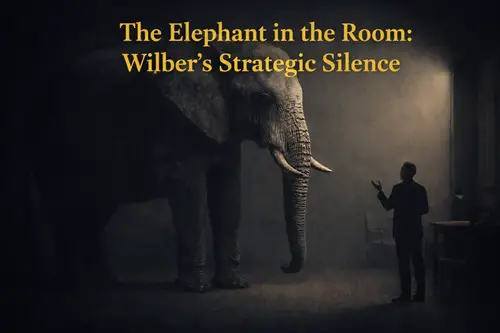 For more than two decades, Ken Wilber has been the object of sustained, detailed, and technically informed criticism—particularly from Frank Visser, but also from philosophers, scientists, and former allies within the Integral milieu. And yet Wilber himself has almost never responded directly, publicly, or substantively to these critiques. This silence is not a footnote. It is a central fact that shapes how the entire controversy must be interpreted. 1. Silence as a Strategic Choice, Not an OversightWilber is not unaware of his critics. He has acknowledged them obliquely, occasionally dismissively, and sometimes by proxy through defenders. He is also demonstrably capable of polemical engagement when he chooses—as seen in his extended attacks on “flatland,” postmodernism, or materialism. His silence, therefore, is selective. That selectivity demands explanation. The most charitable interpretation is that Wilber no longer considers these debates productive or spiritually useful. The less charitable—but more plausible—interpretation is that direct engagement would require concessions that undermine his system's authority. 2. Why Wilber Cannot Easily RespondA serious response to critics like Visser would force Wilber to do at least one of the following: Clarify whether concepts like Eros are metaphorical, ontological, or explanatory. Specify how spiritual insight translates into claims about evolution or cosmology. Accept that many earlier scientific claims were overstated or simply wrong. Abandon the pretense of being “post-metaphysical.” Submit Integral Theory to the same standards of revision he demands of science. Each of these moves would weaken Integral Theory's aura of comprehensive synthesis. Silence preserves ambiguity—and ambiguity preserves authority. 3. Delegation to Defenders: A Telling PatternInstead of responding himself, Wilber has allowed or encouraged a cadre of defenders to engage critics. This outsourcing has several advantages: Defenders can invoke the Eye of Spirit without Wilber having to formalize it. Tone can escalate without reputational cost. Critics can be dismissed as spiritually immature rather than intellectually wrong. No definitive position ever needs to be stated. The result is a perpetual debate without adjudication. 4. Silence as Epistemic AsymmetryWilber continues to make grand claims—about evolution, consciousness, culture, and Kosmos—while declining to answer those who examine the evidentiary basis of those claims. This creates a profound asymmetry: Critics must justify every assertion. Wilber's assertions are insulated by status, charisma, and spiritual framing. Defenders treat critique as hostility rather than inquiry. In any other intellectual domain, this would be considered evasive. 5. The Cost of Silence to Integral TheoryWilber's refusal to engage has had predictable consequences: Integral Theory has become inward-facing, sustained primarily by adherents. Its scientific credibility has eroded outside its own ecosystem. Critics are portrayed as obsessives rather than interlocutors. The theory has ceased to evolve in response to external knowledge. What remains is not a living research program but a protected worldview. 6. The Irony: Silence Undermines the Integral IdealIntegral Theory claims to transcend partial perspectives by integrating them. Yet Wilber's silence toward his most sustained critic violates that very principle. If critique from evolutionary biology, philosophy of science, and epistemology is excluded, then “integration” becomes selective assimilation. The silence thus exposes a contradiction between Integral Theory's self-image and its actual practice. Conclusion: Silence Speaks LoudlyWilber's decades-long silence is not spiritual transcendence. It is not pedagogical restraint. It is not benign neglect. It is a strategic refusal to submit metaphysical claims to sustained public scrutiny. Once this is acknowledged, the burden of explanation shifts decisively. The question is no longer why critics persist, but why the architect of a purported “theory of everything” declines to defend it. In debates of this kind, silence is not neutrality. It is an answer.
Widget is loading comments...
|