|
TRANSLATE THIS ARTICLE
Integral World: Exploring Theories of Everything
An independent forum for a critical discussion of the integral philosophy of Ken Wilber
  Frank Visser, graduated as a psychologist of culture and religion, founded IntegralWorld in 1997. He worked as production manager for various publishing houses and as service manager for various internet companies and lives in Amsterdam. Books: Ken Wilber: Thought as Passion (SUNY, 2003), and The Corona Conspiracy: Combatting Disinformation about the Coronavirus (Kindle, 2020). Frank Visser, graduated as a psychologist of culture and religion, founded IntegralWorld in 1997. He worked as production manager for various publishing houses and as service manager for various internet companies and lives in Amsterdam. Books: Ken Wilber: Thought as Passion (SUNY, 2003), and The Corona Conspiracy: Combatting Disinformation about the Coronavirus (Kindle, 2020).
Check out my other conversations with ChatGPT Joel Morrison and Ken WilberNonduality Without Teleology?Frank Visser / ChatGPT
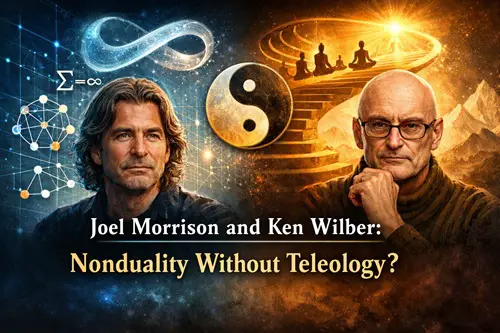 IntroductionBoth Joel Morrison and Ken Wilber present themselves as critics of modern fragmentation. Each rejects Cartesian dualism, scientistic reductionism, and the privileging of discursive reason over other modes of cognition. Both invoke nonduality as a corrective to what they see as a deeply distorted modern worldview. Yet beyond this shared dissatisfaction, their philosophical trajectories diverge in a decisive way. Morrison's project remains largely epistemological, focused on how cognition actually operates at the interface of perception and concept. Wilber's, by contrast, evolves into a full-blown metaphysical narrative—one that smuggles teleology, hierarchy, and spiritual directionality back into the very domains he claims to have naturalized. This essay argues that Morrison, whatever his limitations, largely avoids the metaphysical inflation that has plagued Wilber's Integral Theory. The difference is not one of temperament or rhetorical style, but of philosophical restraint. Interface Philosophy vs. Developmental Metaphysics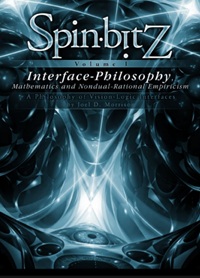
Joel Morrison's philosophy—most fully expressed in SpinbitZ—is best understood as an interface philosophy. His central concern is not what reality ultimately is, but how human cognition apprehends structure, relation, and continuity. He insists that abstract reasoning is inseparable from visual and perceptual cognition, and that diagrams and spatial representations are not mere pedagogical aids but epistemically significant tools. This emphasis places Morrison closer to traditions in embodied cognition and philosophy of perception than to speculative metaphysics. Even when he draws on mathematics or invokes holarchical structures, these are treated as seen relations, not as engines driving cosmic evolution. Ken Wilber's trajectory is fundamentally different. What begins as a framework for organizing perspectives—quadrants, levels, lines—gradually hardens into a metaphysical story about reality itself. Development becomes not merely descriptive but directional. Stages become ontologically privileged. Evolution acquires an inner drive—Eros—that functions as a quasi-theological principle. The contrast is stark: Morrison investigates the conditions of intelligibility; Wilber advances a worldview. Nonduality: Epistemic Insight or Ontological Engine?Both thinkers appeal to nonduality, but they deploy it in radically different ways. For Morrison, nonduality functions primarily as an epistemic insight. It names the co-arising of perception and concept, the inseparability of seeing and thinking, and the artificiality of rigid subject-object divisions. It does not imply a cosmic purpose, a spiritual gradient, or a privileged endpoint of realization. Nonduality here is descriptive, structural, and methodologically modest. Wilber's nonduality, despite repeated disclaimers, performs a very different role. It operates as a metaphysical horizon toward which development “tends.” It legitimizes hierarchical valuations of consciousness and culture. It retroactively spiritualizes biological and cultural evolution. Eros, whatever its poetic framing, does explanatory work indistinguishable from older metaphysical teleologies. This is where the charge of “closet creationism” gains its force. Wilber does not posit an external designer, but he does posit an immanent drive that explains why complexity, consciousness, and spirituality reliably increase. The explanatory structure remains intact; only the theological vocabulary has been modernized. Morrison does not make this move. Mathematics and Structure: Illustration or Explanation?Morrison's use of mathematics is cautious. Mathematical structures are treated as visualizable relations that aid cognition. They help us see patterns, constraints, and symmetries, but they do not explain why reality exists or where it is going. Mathematics remains a tool of representation, not a metaphysical foundation. Wilber's engagement with mathematics and complexity theory is more problematic. Scientific concepts are frequently enlisted as retrospective confirmations of spiritual claims. Complexity becomes evidence of Eros. Emergence becomes a secularized miracle. The sciences are said to “agree” with Integral Theory, even when their practitioners explicitly do not. This rhetorical strategy has been a persistent source of resistance from scientists—and not because they misunderstand metaphor, but because they recognize metaphysical overreach. Holarchy: Neutral Structure or Value Ladder?The concept of holarchy crystallizes the difference between the two thinkers. Morrison's holarchies are structurally neutral. They describe how systems can be simultaneously parts and wholes, scalable without implying moral or spiritual superiority. A holarchy here is a descriptive feature of organization, not a ladder of value. Wilber's holarchies, by contrast, are normatively charged. Despite repeated assurances that “higher” does not mean “better,” the evaluative load never fully disappears. Higher stages are more inclusive, more conscious, more real. The ladder remains, even when its rungs are rhetorically softened. This is not an accidental misunderstanding by critics; it is built into the architecture of Wilber's system. Strengths and Limits of Morrison's ProjectMorrison's philosophy is not without serious weaknesses. It lacks the argumentative discipline expected in academic philosophy. Its reliance on visual intuition sometimes substitutes for explicit argument. Its idiosyncratic terminology can obscure rather than clarify. And its publication outside peer-reviewed venues limits critical engagement. Yet these are methodological shortcomings, not metaphysical ones. Morrison's work does not require us to accept hidden cosmic drives, spiritualized evolution, or ontologically privileged stages of reality. It remains compatible with a broadly naturalistic worldview. Wilber's does not. Conclusion: Nonduality Without Metaphysical InflationFrom the standpoint of philosophical economy, the difference between Morrison and Wilber is decisive. Morrison multiplies representations; Wilber multiplies ontological commitments. Morrison explores how we think; Wilber tells us how reality must be. Whatever one thinks of Morrison's eccentricities, his restraint is instructive. He demonstrates that one can critique modern dualism, emphasize nonduality, and take cognition seriously without re-introducing teleology through the back door. In an intellectual climate where spiritualized explanations too easily masquerade as integration, that restraint matters. Afterword: Why This Comparison MattersThe contrast between Joel Morrison and Ken Wilber is not merely a matter of intellectual temperament or stylistic preference. It illuminates a deeper fault line running through contemporary attempts to “integrate” science, philosophy, and spirituality. That fault line concerns the temptation to convert epistemic insight into ontological assertion. Morrison's work, whatever its eccentricities, remains largely on the epistemic side of that divide. His emphasis on visual cognition, interfaces, and structural relations reflects a concern with how meaning appears rather than with why the cosmos exists. In that sense, his philosophy is exploratory rather than justificatory. It asks how humans navigate complexity without presuming that complexity itself is animated by a hidden purpose. Wilber's Integral Theory crosses that line. What begins as a framework for organizing perspectives becomes a story about reality's inner direction. Nonduality ceases to be a corrective to dualistic thinking and becomes instead a metaphysical horizon that evolution is said to approach. The moment Eros is introduced as a universal explanatory principle, the project ceases to be integrative in a methodological sense and becomes theological in all but name. This distinction matters because it speaks to a recurring pattern in intellectual history. Whenever modern science dismantles older metaphysical certainties, there is a counter-movement to re-enchant the world—often by redescribing spiritual intuitions in contemporary jargon. Complexity replaces providence; emergence replaces miracle; nonduality replaces God. The vocabulary changes, but the explanatory function remains. Your long-standing critique of Wilber has consistently targeted this maneuver. The problem is not metaphor, myth, or spiritual experience as such. It is the elevation of those experiences into explanatory frameworks that claim to complete science rather than merely coexist with it. Morrison, by contrast, does not claim completion. He offers tools, not ultimates. Seen this way, the comparison is instructive even for readers who find Morrison's work opaque or underdeveloped. It demonstrates that one can resist modern fragmentation without reinstating teleology, and that nonduality need not be conscripted into a grand evolutionary narrative. Philosophical restraint, in this context, is not a weakness but a virtue. If Integral Theory is to have a future beyond its current insular audience, it will have to confront this issue directly. Integration cannot mean metaphysical inflation by other means. It must begin with a clear distinction between how we know, how we describe, and what we claim to exist. Morrison's work, for all its limitations, reminds us that this distinction is still available—and still worth defending.
Comment Form is loading comments...
|