|
TRANSLATE THIS ARTICLE
Integral World: Exploring Theories of Everything
An independent forum for a critical discussion of the integral philosophy of Ken Wilber
  Frank Visser, graduated as a psychologist of culture and religion, founded IntegralWorld in 1997. He worked as production manager for various publishing houses and as service manager for various internet companies and lives in Amsterdam. Books: Ken Wilber: Thought as Passion (SUNY, 2003), and The Corona Conspiracy: Combatting Disinformation about the Coronavirus (Kindle, 2020). Frank Visser, graduated as a psychologist of culture and religion, founded IntegralWorld in 1997. He worked as production manager for various publishing houses and as service manager for various internet companies and lives in Amsterdam. Books: Ken Wilber: Thought as Passion (SUNY, 2003), and The Corona Conspiracy: Combatting Disinformation about the Coronavirus (Kindle, 2020).
Check out my other conversations with ChatGPT Intelligent Design's Missing Dimension: ImplementationFrank Visser / ChatGPT
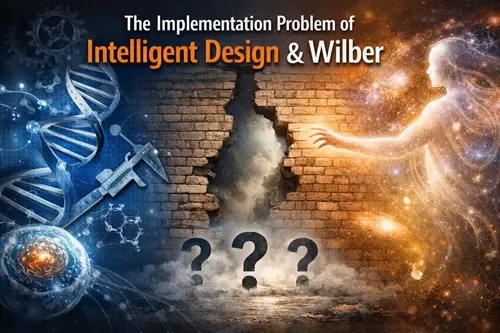 Debates over Intelligent Design (ID) typically focus on origins: whether complex biological structures can arise through undirected evolutionary processes or whether they point to an intelligent cause. Proponents emphasize “irreducible complexity,” “specified information,” or improbabilities allegedly beyond the reach of natural selection. Critics respond by showing how evolutionary mechanisms—mutation, selection, drift, and constraint—can account for these phenomena without invoking a designer. Yet both sides often overlook a deeper and more damaging omission in the ID framework. Even if one grants, for the sake of argument, that biological life exhibits hallmarks of design, Intelligent Design remains radically incomplete because it never explains how design is implemented. The problem is not merely that ID lacks empirical support; it lacks a coherent model of causation. Design Without a MechanismIn every domain where design is uncontroversial—engineering, architecture, software—design is inseparable from implementation. A blueprint does nothing unless translated into materials through concrete processes: manufacturing steps, assembly lines, testing procedures, and iterative revisions. Design is not a magical inscription of intent onto matter; it is a mediated, stepwise transformation governed by physical constraints. Intelligent Design, by contrast, stops at the declaration that something was “designed” and treats that conclusion as explanatory. The designer's intentions are asserted, but the causal chain by which those intentions become DNA sequences, protein folds, or developmental pathways is left entirely unspecified. This omission is not a minor gap to be filled later; it is the core of scientific explanation. The Biological Constraint ProblemBiology is not clay awaiting sculpting by an external hand. Organisms develop through tightly regulated processes: gene expression, epigenetic modulation, embryological patterning, and ecological interaction. Any act of “design” would have to operate within these systems or else override them in detectable ways. If the designer intervenes at the genetic level, how are nucleotide sequences altered? Through what physical process? If intervention occurs during development, how are signaling pathways modified without disrupting the organism? If new forms are introduced wholesale, where are the discontinuities in the fossil record, biogeography, or population genetics? ID offers no answers because answering them would require specifying mechanisms that either resemble known biological processes (in which case evolution suffices) or violate them (in which case empirical evidence should be overwhelming). The silence on implementation is therefore strategic but fatal. The Mirage of “Front-Loaded” DesignSome ID proponents attempt to evade the implementation problem by appealing to “front-loading”: the idea that all future biological complexity was encoded in the initial conditions of life or the universe. But this move merely displaces the problem rather than solving it. Front-loading presupposes an astronomically precise encoding of future contingencies—environmental changes, mass extinctions, genetic drift, and stochastic mutation—into early genomes. This does not eliminate implementation; it multiplies it beyond plausibility. Moreover, it renders design empirically indistinguishable from naturalistic evolution, while simultaneously demanding a level of foresight so extreme that it undermines the very intuition ID was meant to preserve. Implementation Versus InvocationEvolutionary theory, whatever its open questions, excels precisely where ID falters. It does not merely say that complexity arose; it specifies how complexity accumulates through incremental, testable processes constrained by physics, chemistry, and ecology. Mutations occur. Selection filters. Developmental systems bias outcomes. Population structures shape trajectories. ID, by contrast, invokes intelligence as a terminal explanation. It substitutes agency for analysis, intention for interaction, and mystery for mechanism. In doing so, it abandons the explanatory norms that make science cumulative and corrigible. Theological Intuition, Scientific FailureAt its core, Intelligent Design reflects a theological intuition: that life's complexity feels purposeful rather than accidental. But translating that intuition into a scientific framework requires more than pointing to improbability. It requires a theory of implementation—of how intelligence acts upon matter in space and time. Until ID confronts this missing dimension, it remains not an alternative to evolutionary biology, but a commentary running alongside it: metaphysically suggestive, rhetorically confident, and scientifically inert. In the end, the decisive question is not whether life looks designed, but whether design—absent a mechanism of implementation—explains anything at all. Ken Wilber and the Same Brick WallKen Wilber's integral philosophy is often presented as a sophisticated alternative to Intelligent Design, precisely because it avoids talk of an external “designer.” Instead, Wilber invokes Eros, Spirit-in-action, or an intrinsic evolutionary drive toward greater depth, complexity, and consciousness. On the surface, this looks like a decisive advance over ID's crude appeals to intervention. In reality, it collides with the same brick wall: implementation. Wilber is explicit that evolution is not merely a blind, mechanical process. Natural selection, he argues, may explain the survival of forms, but not their arrival. To account for the creative advance of evolution, he posits a formative, purposive principle operating from within the cosmos itself. Yet this move merely internalizes the designer without solving the causal problem. How, exactly, does Eros act? At what level does it operate—genes, cells, organisms, ecosystems? Does it bias mutation rates, steer developmental pathways, shape selection pressures, or suspend them? Does it operate continuously or episodically? Does it leave measurable signatures distinguishable from known biological mechanisms? On these questions, Wilber is as silent as Intelligent Design theorists. This silence is not accidental. Any attempt to specify implementation would immediately expose Wilber to the same dilemma faced by ID. If Eros works through known mechanisms, then it adds no explanatory value beyond standard evolutionary biology. If it works by bypassing or overriding those mechanisms, then it predicts detectable deviations from evolutionary theory—deviations that have never been observed. Wilber frequently appeals to complexity theory, self-organization, and emergence as if these concepts smuggle purpose into nature. But self-organization explains pattern formation under constraints; it does not supply foresight, direction, or values. Emergence describes outcomes, not agencies. Invoking these terms without detailing causal pathways amounts to rhetorical elevation, not explanation. In this sense, Wilber's evolutionary mysticism functions as a high-level metaphysical gloss layered atop Darwinian processes, not a competing account of how evolution actually works. Like Intelligent Design, it gestures toward intelligence or purpose while refusing to cash out that gesture in mechanistic terms. The result is a theory that is immune to falsification precisely because it never descends into the realm where falsification is possible. Wilber has often accused “flatland” science of reducing reality to surfaces and quantities. But in evolutionary biology, it is precisely attention to surfaces—genes, organisms, environments, interactions—that delivers explanatory power. By contrast, Wilber's depth metaphysics hovers above the causal chain, influencing everything in principle while explaining nothing in detail. Thus, despite their cultural and philosophical distance, Intelligent Design and Integral Theory converge on the same failure point. Both insist that evolution is guided by something more than blind processes. Both recoil from specifying how that guidance is implemented. And both ultimately rely on invocation rather than explanation. The brick wall remains unmoved: without a theory of implementation, appeals to design, Eros, or Spirit are not deeper explanations of evolution—they are evasions of it.
Widget is loading comments...
|