|
TRANSLATE THIS ARTICLE
Integral World: Exploring Theories of Everything
An independent forum for a critical discussion of the integral philosophy of Ken Wilber
  Frank Visser, graduated as a psychologist of culture and religion, founded IntegralWorld in 1997. He worked as production manager for various publishing houses and as service manager for various internet companies and lives in Amsterdam. Books: Ken Wilber: Thought as Passion (SUNY, 2003), and The Corona Conspiracy: Combatting Disinformation about the Coronavirus (Kindle, 2020). Frank Visser, graduated as a psychologist of culture and religion, founded IntegralWorld in 1997. He worked as production manager for various publishing houses and as service manager for various internet companies and lives in Amsterdam. Books: Ken Wilber: Thought as Passion (SUNY, 2003), and The Corona Conspiracy: Combatting Disinformation about the Coronavirus (Kindle, 2020).
Check out my other conversations with ChatGPT Power and Morality in International RelationsAn Enduring TensionFrank Visser / ChatGPT
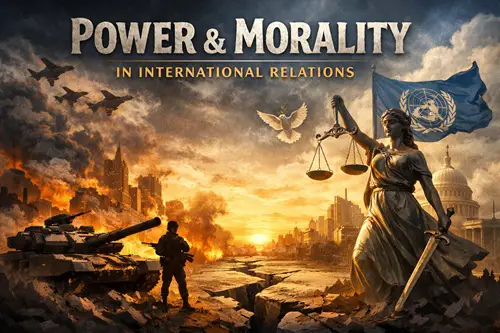 International relations are marked by a persistent and often uncomfortable tension between power and morality. States routinely invoke moral principles—justice, sovereignty, human rights, self-determination—yet their behavior is frequently driven by strategic interests, security imperatives, and the pursuit of influence. This gap between moral rhetoric and political practice is not merely hypocrisy; it reflects a structural dilemma at the heart of international politics. Power enables action, but morality seeks to constrain it. Understanding their uneasy coexistence is essential for grasping both the limits and possibilities of global order. The Realist Challenge: Power as the Final ArbiterClassical and structural realism begin from a sobering premise: the international system is anarchic. There is no world government capable of enforcing moral norms in the way domestic law constrains individual behavior. In this environment, states prioritize survival, security, and relative power. From Thucydides' Melian Dialogue to modern balance-of-power theory, realism insists that moral considerations are subordinate to necessity. As the Athenians bluntly observed, “the strong do what they can and the weak suffer what they must.” From this perspective, moral language is often epiphenomenal—useful for mobilizing domestic support or legitimizing policy, but rarely decisive. Humanitarian interventions, sanctions regimes, or appeals to international law are interpreted less as ethical commitments than as instruments of statecraft. Realism does not deny morality outright; it questions its causal force when vital interests are at stake. Liberal and Constructivist Responses: Norms with TeethLiberal and constructivist theories resist the realist reduction of morality to mere window dressing. They argue that norms, institutions, and shared values can shape state behavior in meaningful ways. International law, multilateral organizations, and human rights regimes create expectations and reputational costs that even powerful states cannot entirely ignore. Over time, norms may become internalized, influencing how states define their interests rather than merely constraining them from the outside. Examples include the stigmatization of territorial conquest, the decline of formal colonialism, and the widespread—if inconsistently applied—acceptance of human rights discourse. From this angle, morality is not powerless; it operates indirectly, gradually, and unevenly. The problem is not that moral norms are irrelevant, but that they are fragile and dependent on political support. Selective Morality and the Problem of HypocrisyThe most corrosive feature of the power-morality relationship is selective application. States often enforce moral principles when doing so aligns with their interests and disregard them when it does not. This selectivity breeds cynicism and undermines the credibility of moral claims. When international law is invoked against rivals but ignored by allies—or when humanitarian concern suddenly emerges in strategically valuable regions—morality begins to look indistinguishable from propaganda. Yet hypocrisy, while ethically troubling, may also signal the residual force of moral norms. As some theorists have noted, the very need to justify actions in moral terms suggests that power alone is not sufficient. Even the most powerful states seek legitimacy. The problem is not that morality is invoked insincerely, but that it lacks consistent enforcement mechanisms in a system dominated by unequal power. Tragic Choices and Moral LimitsInternational politics often presents tragic dilemmas rather than clear moral choices. Pursuing peace may require tolerating injustice; defending sovereignty may perpetuate suffering; intervention may save lives while violating international norms. In such cases, moral purity is unattainable. States must choose among imperfect options under conditions of uncertainty and risk. This tragic dimension cautions against both moral absolutism and moral nihilism. The former ignores the constraints of power and unintended consequences; the latter collapses ethics into mere interest. A more sober moral stance recognizes limits—accepting that some wrongs cannot be fully avoided, only mitigated. Conclusion: Moral Aspiration under Conditions of PowerThe tension between power and morality in international relations is not a problem to be solved once and for all, but a condition to be managed. Power without morality descends into domination; morality without power risks irrelevance. International politics unfolds in the space between these poles, where ethical aspiration confronts strategic necessity. The challenge, then, is not to eliminate power from global affairs—an impossible task—but to embed it within norms, institutions, and practices that restrain its worst excesses. Progress, where it occurs, is incremental and reversible. Yet the persistent appeal to moral language, however compromised, suggests that power alone has never been enough—and perhaps never will be. Addendum: The Ukraine War: Power, Morality, and Competing NarrativesThe war in Ukraine illustrates with unusual clarity the tension between power and morality in international relations. On the moral plane, Russia's invasion represents a flagrant violation of international law, Ukrainian sovereignty, and the post-World War II norm against territorial conquest. These principles are neither obscure nor contested: if they are to mean anything, they must apply precisely in cases such as this. From this perspective, moral judgment appears straightforward. Yet the geopolitical context complicates the picture. Russia frames its actions in the language of security, historical grievance, and strategic necessity, pointing to NATO expansion and perceived encirclement as provocations. While such arguments do not morally justify the invasion, they help explain it. Here the realist distinction between explanation and justification becomes crucial. To understand why Russia acted as it did is not to excuse the action, but to acknowledge that power calculations and security fears can override normative restraints when core interests are perceived to be at stake. Western responses further expose the selective application of morality. Support for Ukraine is framed in terms of defending democracy, sovereignty, and a rules-based international order. At the same time, critics point to inconsistencies: comparable violations elsewhere have elicited weaker responses, and Western powers themselves have a mixed record when it comes to respecting international law. These inconsistencies do not negate the moral case for supporting Ukraine, but they do weaken claims to universal principle and reinforce suspicions that morality often follows power rather than guiding it. The Ukraine war also highlights the tragic structure of moral choice in international politics. Supplying arms to Ukraine may be necessary to deter aggression and uphold norms, yet it prolongs a war that inflicts immense human suffering. Pursuing negotiations may save lives but risks rewarding aggression and undermining deterrence. Each option carries moral costs that cannot be fully reconciled. There is no outcome in which power and morality align perfectly. In this sense, Ukraine is not an anomaly but a revealing case. It shows how moral principles remain indispensable as standards of judgment, even when they fail as constraints on behavior. The war underscores both the necessity of moral language in condemning aggression and its insufficiency in preventing it. Power determines what is done; morality shapes how actions are justified, contested, and remembered. The uneasy coexistence of the two is not a flaw of the international system so much as its defining condition.
Comment Form is loading comments...
|