|
TRANSLATE THIS ARTICLE
Integral World: Exploring Theories of Everything
An independent forum for a critical discussion of the integral philosophy of Ken Wilber
  Frank Visser, graduated as a psychologist of culture and religion, founded IntegralWorld in 1997. He worked as production manager for various publishing houses and as service manager for various internet companies and lives in Amsterdam. Books: Ken Wilber: Thought as Passion (SUNY, 2003), and The Corona Conspiracy: Combatting Disinformation about the Coronavirus (Kindle, 2020). Frank Visser, graduated as a psychologist of culture and religion, founded IntegralWorld in 1997. He worked as production manager for various publishing houses and as service manager for various internet companies and lives in Amsterdam. Books: Ken Wilber: Thought as Passion (SUNY, 2003), and The Corona Conspiracy: Combatting Disinformation about the Coronavirus (Kindle, 2020).
Check out my other conversations with ChatGPT Evolution Seen Through the Stages of DevelopmentA perspectival analysis using Integral Theory's color spectrumFrank Visser / ChatGPT
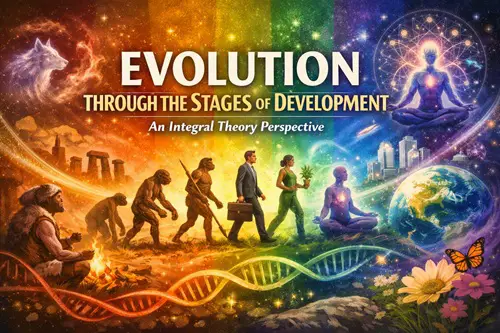 Introduction: Evolution as Object and as InterpretationEvolution, as a scientific theory, describes population-level change through variation, inheritance, and differential reproductive success. That account, however, is not encountered by human beings in a cognitive vacuum. Every culture, and every individual, interprets evolution through a developmental lens shaped by values, identity, and meaning-making capacity. Integral Theory usefully emphasizes this interpretive dimension: evolution does not change as we develop, but our understanding of it does. Problems arise, however, when these changing interpretations are treated as progressively deeper truths about evolution itself, rather than as increasingly complex perspectives on it. What follows is a stage-by-stage account of how evolution typically appears from each major developmental worldview, using the standard color nomenclature. Beige: Survival and Implicit NaturalismAt the Beige stage, there is no explicit theory of evolution. Life is experienced as immediate survival within a hostile or indifferent environment. Change over time is registered only pragmatically—animals migrate, seasons shift, food sources disappear. From this level, evolution is not an object of reflection. Nature happens. There is no distinction between biological process and lived necessity. Evolution here is invisible, not denied. Purple: Ancestral and Animistic EvolutionPurple consciousness interprets nature through myth, ancestry, and spirit-infused continuity. Change over time is explained through the actions of ancestors, totems, or nature spirits. Evolution appears as: • Sacred lineage (“we come from the Bear clan”) • Cyclical regeneration rather than linear transformation • A living cosmos in which species and humans are kin From this perspective, Darwinian evolution feels cold, desacralizing, and alien. Yet interestingly, Purple already intuits connectedness—just not via mechanisms. Evolution is mythically personalized. Red: Power, Dominance, and Natural StruggleRed consciousness emphasizes strength, conquest, and assertion. Nature is a battleground; life advances through force. Evolution is often implicitly understood as: • Survival of the strongest • Predation as proof of superiority • Growth through domination This stage resonates selectively with popularized (and often distorted) versions of Darwinism. Competition is embraced; cooperation is ignored. Evolution becomes a justification for power, not an explanatory framework. Blue: Order, Creation, and Fixed DesignBlue seeks certainty, authority, and moral order. Evolution is troubling here because it undermines fixed categories and divine design. Typical Blue interpretations include: • Creationism or Intelligent Design • A young Earth or separately created species • Suspicion of randomness and contingency When evolution is accepted at all, it is often reframed as: • A pre-scripted unfolding of God's plan • Change within limits, not open-ended transformation • Evolution is morally regulated or rejected outright. Orange: Scientific Naturalism and MechanismOrange is the first stage to fully accept evolution on its own terms. It emphasizes: • Empirical evidence • Methodological naturalism • Causal explanation without metaphysics From Orange, evolution appears as: • A blind, undirected process • Driven by mutation, selection, drift, and speciation • Lacking inherent purpose or direction This view is powerful, austere, and highly successful—but existentially thin. Meaning is bracketed out, not denied, but rendered irrelevant. Evolution is factually understood, but not existentially integrated. Green: Interconnection, Context, and CareGreen reacts against Orange reductionism by emphasizing: • Ecological embeddedness • Cooperation and symbiosis • Ethical responsibility toward life Evolution is reinterpreted as: • A web of mutual dependencies • Co-evolution rather than mere competition • A process with moral implications (care for biodiversity, sustainability) Green often critiques “selfish gene” narratives, sometimes overcorrecting by soft-pedaling selection pressures. Evolution becomes relational and value-laden, though sometimes at the expense of explanatory rigor. Teal (Integral): Evolution as Multidimensional ProcessTeal seeks to integrate all prior perspectives. Evolution is now viewed as: • Operating across quadrants (biological, cultural, experiential, systemic) • Involving mechanisms, meanings, and developmental patterns • Expressed differently at matter, life, mind, and culture levels At its best, Integral Theory here makes a crucial move: Evolution is not just biological change, but the context in which consciousness, culture, and values emerge. At its worst, however, Teal drifts into: • Teleological language (“Spirit-in-action”) • Implied directionality toward higher consciousness • Retroactive metaphysics layered onto empirical science This is where critics argue that Integral Theory crosses a line: from interpretation of evolution to reinterpretation of evolution itself as purposive. Evolution becomes cosmically meaningful, but at the risk of overreach. Turquoise (Speculative): Cosmic Evolution and SpiritTurquoise represents a largely aspirational stage in Integral discourse. Evolution here is framed as: • A universal process of awakening • Matter → life → mind → soul → Spirit • A self-recognizing cosmos This view is explicitly metaphysical. Evolution is no longer merely interpreted—it is redefined as a sacred ascent. From a scientific standpoint, this adds nothing explanatory. From a spiritual standpoint, it adds narrative coherence and existential reassurance. Evolution becomes a spiritual story, not a scientific one. Conclusion: Perspective Matters—But So Do BoundariesIntegral Theory is at its strongest when it clarifies how different developmental stages interpret evolution. It is weakest when it implies that later interpretations reveal deeper truths about evolution's actual causal structure. A disciplined Integral approach would say: • Evolution itself is best described by evolutionary biology (Orange). • Human meaning-making around evolution develops through stages (Beige → Turquoise). • Spiritual interpretations are optional overlays, not scientific upgrades. Seen this way, Integral Theory becomes a meta-framework for understanding our responses to evolution, not a competing theory of evolution itself. That distinction makes all the difference. Are Orange and Green Being Privileged?A predictable objection to the foregoing analysis is that it appears to privilege the Orange (scientific-naturalist) and, to a lesser extent, Green (contextual-ecological) perspectives, while treating Teal and Turquoise more critically. From within Integral discourse itself, that can look like a regression to “flatland” or a failure to honor higher-order stages. This objection deserves a careful response. First, there is an unavoidable asymmetry of domains. Evolution, strictly speaking, is a biological theory operating in the Lower-Right quadrant: populations, genes, environments, and measurable change over time. Orange thinking is not privileged because it is “higher,” but because it is fit-for-purpose with respect to that domain. Methodological naturalism is not a worldview preference; it is a constraint built into the explanatory success of evolutionary biology. Second, Green's contribution is acknowledged not as a superior explanatory framework, but as a corrective lens. Green rightly expands attention to ecological systems, cooperation, symbiosis, and ethical implications. However, when Green challenges core evolutionary mechanisms (selection, drift, constraint) on moral or ideological grounds, it weakens explanation rather than deepens it. Its value is contextual and normative, not causal. Third—and this is the crucial Integral point—the critique of Teal and Turquoise is not a rejection of later-stage perspectives as perspectives. It is a rejection of a specific move: the conversion of developmental interpretation into ontological claim. When Integral Theory suggests that later stages disclose evolution as inherently purposive, Spirit-driven, or teleologically ascending, it exceeds what developmental pluralism itself can justify. In other words, the issue is not which stage is higher, but which questions each stage is competent to answer. A genuinely Integral stance would therefore say: • Orange provides the most reliable account of how evolution works. • Green enriches our understanding of how evolution is embedded and valued. • Teal clarifies how multiple interpretations arise and interact. • Turquoise articulates existential or spiritual meanings that some individuals may find compelling. What it would not say—without leaving Integral epistemic humility behind—is that later stages reveal deeper truths about evolution's causal structure that earlier stages somehow missed. Thus, Orange and Green are not privileged as worldviews, but as epistemically appropriate tools for a specific explanatory task. To deny that distinction is not Integral—it is category confusion. Seen this way, the essay does not flatten the developmental spectrum. It reinscribes a boundary that Integral Theory itself, at its best moments, insists upon: transcend and include—but do not conflate.
Comment Form is loading comments...
|