|
TRANSLATE THIS ARTICLE
Integral World: Exploring Theories of Everything
An independent forum for a critical discussion of the integral philosophy of Ken Wilber
  Frank Visser, graduated as a psychologist of culture and religion, founded IntegralWorld in 1997. He worked as production manager for various publishing houses and as service manager for various internet companies and lives in Amsterdam. Books: Ken Wilber: Thought as Passion (SUNY, 2003), and The Corona Conspiracy: Combatting Disinformation about the Coronavirus (Kindle, 2020). Frank Visser, graduated as a psychologist of culture and religion, founded IntegralWorld in 1997. He worked as production manager for various publishing houses and as service manager for various internet companies and lives in Amsterdam. Books: Ken Wilber: Thought as Passion (SUNY, 2003), and The Corona Conspiracy: Combatting Disinformation about the Coronavirus (Kindle, 2020).
Check out my other conversations with ChatGPT What Counts as a Good Explanation?Metaphysics, Eros, and the Limits of Scientific LegitimacyFrank Visser / ChatGPT
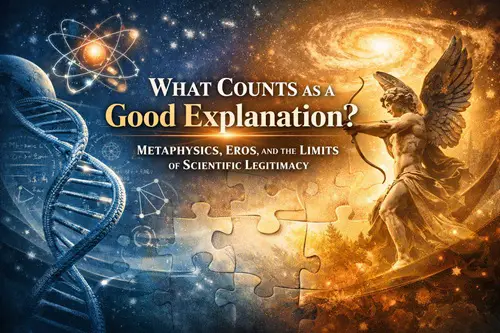 In Finding Radical Wholeness (2024), Ken Wilber reiterates one of the most contentious claims of his long career: that Eros is a real force in the universe, “as real as the four fundamental forces of physics.” Taken literally, this formulation is indefensible. Wilber does not mean a fifth physical interaction alongside gravity, electromagnetism, and the strong and weak nuclear forces. Rather, he gestures toward a metaphysical principle—an intrinsic drive toward complexity, depth, or self-transcendence—that he believes has real causal efficacy. Even if one charitably reconstructs Wilber's claim in this metaphysical sense, a deeper problem remains. Such a concept cannot be offered as a superior explanation for biological phenomena, as Wilber has repeatedly attempted to do. The issue here is not merely scientific disagreement but a failure to respect what counts as a legitimate explanation within the philosophy of science. To see why, we must clarify what scientific explanations are, how they function, and where metaphysical narratives exceed their jurisdiction. Explanation in Science: Constraints, Not WorldviewsIn the philosophy of science, explanations are not judged by how meaningful, inspiring, or spiritually satisfying they are. They are judged by methodological constraints that have emerged historically as science separated itself from metaphysics, theology, and speculative cosmology. At a minimum, a good scientific explanation must satisfy the following criteria: Empirical grounding The explanans must connect to observable, measurable, or experimentally testable phenomena, either directly or indirectly. Causal specificity It must specify how the proposed cause produces the effect, not merely that it does. Explanatory constraint The explanation must rule out alternatives and make itself vulnerable to falsification or revision. Integration with existing theory It must cohere with, or responsibly challenge, well-established bodies of knowledge. Predictive or unifying power Ideally, it should generate testable predictions or unify disparate observations under a common mechanism. These criteria do not reflect “scientistic prejudice.” They are the price of admission for participating in scientific explanation rather than metaphysical storytelling. Metaphysical Forces and the Category ErrorWilber's appeal to Eros as a “real force” collapses an important distinction: ontological commitment is not the same as explanatory adequacy. One may consistently believe that reality is fundamentally spiritual, teleological, or value-laden. Such beliefs belong to metaphysics. But metaphysical commitments do not automatically function as explanations within empirical sciences. To treat them as such is a category error. When physicists speak of forces, they refer to mathematically formalized interactions with precisely defined properties, measurable effects, and quantifiable constraints. To say that Eros is “as real” as these forces while exempting it from their methodological requirements is rhetorical inflation, not conceptual clarification. If Eros is:
then it cannot do explanatory work in biology—no matter how meaningful it may be at a metaphysical or spiritual level. The Problem of Pseudo-ExplanationIn philosophy of science, explanations that merely rename a phenomenon without illuminating its causal structure are called pseudo-explanations. Saying that evolution produces increasing complexity because of Eros is not explanatory unless Eros itself is independently specified and constrained. Otherwise, it functions as a verbal placeholder—an attractive label standing in for ignorance or dissatisfaction with existing accounts. This problem was already identified by Darwin's critics in the 19th century, who appealed to vital forces or élan vital to explain life. Those concepts failed not because they were metaphysically impossible, but because they did no explanatory work once molecular biology, genetics, and thermodynamics advanced. Eros, in Wilber's usage, risks repeating this historical error: reviving a vitalist impulse while ignoring why science abandoned it. Why “Transcending Physicalism” Is Not EnoughWilber often frames his position as going beyond “flatland physicalism.” But rejecting physicalism does not automatically license explanatory freedom. A non-physical ontology must still confront the following questions if it wishes to explain biological phenomena:
Without answers, the appeal to Eros becomes unfalsifiable and therefore explanatorily inert. It explains everything and nothing at once. This is precisely why science resists teleological explanations—not out of metaphysical dogmatism, but because unconstrained purpose-talk short-circuits inquiry rather than advancing it. Structural, Not Incidental, FailureIt is tempting to treat Wilber's claims about Eros as careless phrasing or rhetorical excess. But the problem is structural. His framework consistently conflates metaphysical meaning with scientific explanation, treating the former as a corrective to the latter rather than as a separate domain. This is why critics—yourself included—are right to insist that the issue is not isolated errors or outdated references, but a recurring violation of explanatory boundaries. Wilber does not merely supplement evolutionary theory with metaphysical reflection; he repeatedly presents metaphysical concepts as if they resolve scientific problems that biology has already addressed. Conclusion: Respecting Explanatory DomainsA good explanation in science is modest, constrained, and accountable to evidence. A good metaphysical narrative may be expansive, integrative, and existentially resonant. Confusing the two undermines both. Eros may function as a symbolic or spiritual interpretation of evolution. It may express a human longing to see meaning in cosmic history. But it cannot be offered as a superior explanation for biological phenomena without abandoning the very standards that make explanation possible. The irony is that Wilber's ambition to “honor science” while transcending it ends up doing neither. By treating metaphysical assertions as explanatory substitutes, he weakens the credibility of his spiritual vision and misrepresents the nature of scientific understanding. If there is a lesson from the philosophy of science, it is this: explanation is not about depth of feeling or metaphysical scope, but about disciplined restraint. Where restraint is lost, explanation dissolves into proclamation.
Widget is loading comments...
|