|
TRANSLATE THIS ARTICLE
Integral World: Exploring Theories of Everything
An independent forum for a critical discussion of the integral philosophy of Ken Wilber
  Frank Visser, graduated as a psychologist of culture and religion, founded IntegralWorld in 1997. He worked as production manager for various publishing houses and as service manager for various internet companies and lives in Amsterdam. Books: Ken Wilber: Thought as Passion (SUNY, 2003), and The Corona Conspiracy: Combatting Disinformation about the Coronavirus (Kindle, 2020). Frank Visser, graduated as a psychologist of culture and religion, founded IntegralWorld in 1997. He worked as production manager for various publishing houses and as service manager for various internet companies and lives in Amsterdam. Books: Ken Wilber: Thought as Passion (SUNY, 2003), and The Corona Conspiracy: Combatting Disinformation about the Coronavirus (Kindle, 2020).
Check out my other conversations with ChatGPT Colors, Types, and Scientific CredibilitySurrounded by Idiots Compared with Spiral Dynamics and Wilber's Integral ModelFrank Visser / ChatGPT
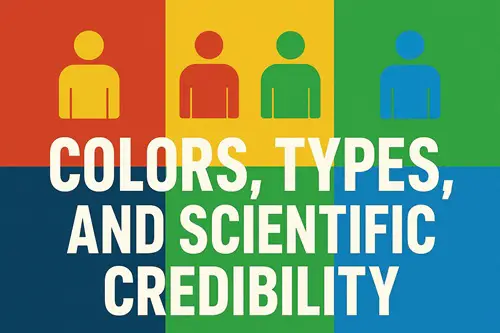 The popular success of Thomas Erikson's Surrounded by Idiots, being translated into 55 languages and selling 1.5 million copies worldwide, has made its four-color typology—Red, Yellow, Green, Blue—almost ubiquitous in corporate training, management workshops, and self-help culture. At first glance, this chromatic taxonomy appears to resonate with other color-based frameworks such as Spiral Dynamics and Ken Wilber's Integral Theory, both of which also deploy colors to describe patterns of human psychology and culture. This superficial similarity invites comparison. From a scientific perspective, however, the similarities are largely cosmetic, while the differences—particularly regarding empirical grounding, theoretical ambition, and explanatory scope—are decisive. 1. Surrounded by Idiots: A Simplified Behavioral TypologyErikson's model is essentially a rebranding of the classic DISC personality framework, itself derived from William Moulton Marston's 1928 work Emotions of Normal People. The four colors correspond to behavioral tendencies:
From a scientific standpoint, the strengths and weaknesses of this model are clear: Strengths
Weaknesses
Crucially, Erikson does not claim scientific depth. His framework is presented as a heuristic—a communication tool rather than a theory of mind, development, or reality. When criticized, it fails by over-simplicity, not by metaphysical excess.[1] 2. Spiral Dynamics: Developmental Psychology with Cultural AmbitionsSpiral Dynamics, developed by Clare Graves and later popularized by Don Beck and Christopher Cowan, also uses colors, but in a fundamentally different way. Its colors (Beige through Turquoise) represent value systems or worldviews that allegedly emerge in response to life conditions, both individually and culturally. From a scientific perspective: Positive aspects
Scientific problems
Nevertheless, Spiral Dynamics remains, at least in intention, a developmental model. It does not claim that colors represent timeless personality types, but rather contingent adaptations. Its scientific weakness lies in underdetermined evidence and overgeneralization—not in conflating psychology with cosmology. 3. Wilber's Integral Theory: Color as Metaphysical CodingKen Wilber incorporates Spiral Dynamics into a far more ambitious architecture. In his AQAL framework, colors (borrowed directly from Spiral Dynamics) are embedded within a system that claims to integrate psychology, biology, culture, spirituality, and cosmology. From a scientific standpoint, this is where problems multiply:
Unlike Erikson, Wilber does not present his colors as mere heuristics. Unlike Spiral Dynamics, he does not limit them to psychological or cultural development. Instead, colors become indicators of ontological depth, subtly transforming a descriptive schema into a quasi-evolutionary metaphysics. This move places Integral Theory outside the boundaries of science proper. 4. Why Color Systems Are So Appealing—and So MisleadingThe shared use of color across these frameworks is not accidental. Color coding:
But from a scientific perspective, color is a rhetorical device, not an evidential one. It creates an illusion of coherence and comparability where none may exist. That Surrounded by Idiots and Integral Theory can both speak in colors while operating at radically different epistemic levels is precisely the problem. The danger is not that Erikson's model is simplistic; it openly is. The danger lies in more ambitious systems that borrow the same visual language while making claims that far exceed their empirical warrant. 5. Scientific Verdict: Modesty MattersJudged by scientific standards, the paradoxical conclusion is this:
If one must choose among color-coded frameworks, science favors limited, operational tools over grand integrative narratives. Erikson's colors fail as personality science but succeed as pragmatic metaphors. Wilber's colors, by contrast, succeed rhetorically while failing to respect the boundary between empirical inquiry and metaphysical speculation. In science, explanatory restraint is a virtue. In this light, the most “serious” flaw is not simplicity—but overreach dressed up in the reassuring glow of the color spectrum.
NOTES[1] These four types are usually presented as four quadrants, displaying two dimensions: task vs. people oriented, and outgoing vs. reserved personalities. With a little fantasy we could match these with Wilber's four quadrants:
Comment Form is loading comments...
|