|
TRANSLATE THIS ARTICLE
Integral World: Exploring Theories of Everything
An independent forum for a critical discussion of the integral philosophy of Ken Wilber
  Frank Visser, graduated as a psychologist of culture and religion, founded IntegralWorld in 1997. He worked as production manager for various publishing houses and as service manager for various internet companies and lives in Amsterdam. Books: Ken Wilber: Thought as Passion (SUNY, 2003), and The Corona Conspiracy: Combatting Disinformation about the Coronavirus (Kindle, 2020). Frank Visser, graduated as a psychologist of culture and religion, founded IntegralWorld in 1997. He worked as production manager for various publishing houses and as service manager for various internet companies and lives in Amsterdam. Books: Ken Wilber: Thought as Passion (SUNY, 2003), and The Corona Conspiracy: Combatting Disinformation about the Coronavirus (Kindle, 2020).
Check out my other conversations with ChatGPT Maidan 2014: Coup or Revolution?Frank Visser / ChatGPT
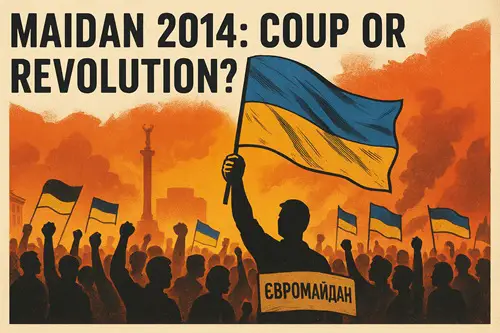 The 2014 Maidan events in Ukraine—commonly referred to as the Euromaidan or Revolution of Dignity—remain among the most contested political upheavals of the early 21st century. At stake is not merely historical interpretation, but geopolitical legitimacy: Was the overthrow of President Viktor Yanukovych the result of a popular democratic revolution, or did it constitute an unconstitutional coup d'état, enabled or orchestrated by external actors? The answer depends on how one defines revolution and coup, how one evaluates legality versus legitimacy, and how one weighs internal agency against foreign influence. This essay argues that Maidan was neither a textbook coup nor a pristine democratic revolution, but a hybrid political rupture: a mass popular uprising that culminated in an unconstitutional transfer of power under extraordinary conditions. 1. Background: A State Between East and WestUkraine in 2013 was a deeply divided country—regionally, linguistically, economically, and geopolitically. Since independence in 1991, it had oscillated between pro-Western and pro-Russian orientations without resolving its underlying structural weaknesses: endemic corruption, oligarchic capture of the state, weak rule of law, and economic stagnation. Viktor Yanukovych, elected president in 2010 in elections widely regarded as free and fair, embodied this ambivalence. While initially signaling openness to European integration, he abruptly suspended preparations for an Association Agreement with the European Union in November 2013, opting instead for closer ties with Russia. This reversal—widely perceived as opaque, corrupt, and externally pressured—triggered mass protests in Kyiv's Maidan Nezalezhnosti (Independence Square). 2. The Case for “Revolution”2.1 Mass Participation and Popular MobilizationThe strongest argument for calling Maidan a revolution lies in its scale and spontaneity. Over several months, hundreds of thousands of Ukrainians participated in protests across Kyiv and other cities. The movement was not confined to a single party or elite faction; it included students, civil society groups, middle-class professionals, nationalists, liberals, and ordinary citizens frustrated with corruption and authoritarian drift. The protests expanded from a narrow pro-EU demonstration into a broader revolt against kleptocracy, police brutality, and the concentration of power in the presidency. 2.2 State Violence and Loss of LegitimacyA decisive turning point came with the violent crackdown on protesters, especially in January-February 2014, culminating in the killing of over 100 demonstrators. These events profoundly eroded Yanukovych's moral authority. In revolutionary theory, legitimacy does not rest solely on formal legality but on the consent of the governed. Once the state employs lethal violence against peaceful protest on a mass scale, its claim to democratic legitimacy weakens dramatically. 2.3 Collapse of the RegimeRevolutions often succeed not because protesters seize power directly, but because the ruling regime collapses internally. In February 2014, Yanukovych lost support from key elites, security forces, and members of his own party. His flight from Kyiv created a power vacuum. Parliament (the Verkhovna Rada) acted under extraordinary pressure to stabilize the situation. From this perspective, Maidan resembles other “people-powered” uprisings in which mass protest triggers elite defections and regime breakdown—more 1989 Eastern Europe than a military putsch. 3. The Case for “Coup”3.1 Constitutional IrregularitiesThe most substantial argument for labeling Maidan a coup concerns procedure. Yanukovych was removed from office without following the Ukrainian constitution's impeachment process, which required a constitutional court review and a supermajority vote. Parliament declared that Yanukovych had “withdrawn from fulfilling his duties,” a formulation that had no clear constitutional basis. From a strictly legal standpoint, this was an unconstitutional change of power. 3.2 Role of Armed GroupsWhile the Maidan movement was largely peaceful, organized and sometimes armed nationalist groups played a visible role, particularly in the later stages. Their presence complicates the narrative of a purely civic uprising and provided ammunition for critics who portray Maidan as coerced rather than consensual. However, it is important to note that these groups did not seize state institutions independently, nor did they form a junta or ruling council—key features of classic coups. 3.3 Western InvolvementWestern political support for the Maidan movement—rhetorical, diplomatic, and financial—was unmistakable. High-profile visits by U.S. and EU officials, open encouragement of protest demands, and post-Maidan assistance have led critics (especially in Russia) to frame events as a Western-backed regime change. Yet foreign support, even decisive support, does not by itself define a coup. Coups are typically elite-driven, covert, and executed by insiders within the state apparatus. Maidan was publicly visible, prolonged, and driven by mass mobilization. 4. Coup vs. Revolution: A False Dichotomy?Political theory suggests that “coup” and “revolution” are ideal types rather than mutually exclusive categories.
Maidan exhibits features of both:
Crucially, the decisive act was not a secret seizure of power by conspirators, but the collapse of presidential authority followed by parliamentary improvisation under extreme conditions. 5. Aftermath and Historical JudgmentSubsequent events—the annexation of Crimea by Russia, the war in Donbas, and later the full-scale Russian invasion in 2022—have profoundly shaped how Maidan is remembered. For Ukrainians, it has increasingly become a foundational moment of national self-assertion. For Russia, it remains framed as an illegitimate Western-backed coup justifying intervention. Historical judgment, however, should resist retrospective moralization. The legitimacy of Maidan does not derive from its geopolitical consequences but from the conditions under which it arose: a corrupt, violent, and increasingly authoritarian regime confronted by sustained popular resistance. ConclusionThe Maidan uprising of 2014 was not a classical coup, nor was it a constitutionally pristine revolution. It was a popular revolt that culminated in an unconstitutional but politically intelligible transfer of power, triggered by state violence and elite defection. To call it merely a coup is to ignore the agency of millions of Ukrainians. To call it a flawless democratic revolution is to overlook its legal and procedural fractures. Maidan should therefore be understood as a revolutionary rupture under conditions of state failure—messy, contingent, and deeply consequential, both for Ukraine and for the geopolitical order that followed.
Comment Form is loading comments...
|