|
TRANSLATE THIS ARTICLE
Integral World: Exploring Theories of Everything
An independent forum for a critical discussion of the integral philosophy of Ken Wilber
  Frank Visser, graduated as a psychologist of culture and religion, founded IntegralWorld in 1997. He worked as production manager for various publishing houses and as service manager for various internet companies and lives in Amsterdam. Books: Ken Wilber: Thought as Passion (SUNY, 2003), and The Corona Conspiracy: Combatting Disinformation about the Coronavirus (Kindle, 2020). Frank Visser, graduated as a psychologist of culture and religion, founded IntegralWorld in 1997. He worked as production manager for various publishing houses and as service manager for various internet companies and lives in Amsterdam. Books: Ken Wilber: Thought as Passion (SUNY, 2003), and The Corona Conspiracy: Combatting Disinformation about the Coronavirus (Kindle, 2020).
Check out my other conversations with ChatGPT Why I Keep Returning to Wilber and EvolutionFrank Visser / ChatGPT
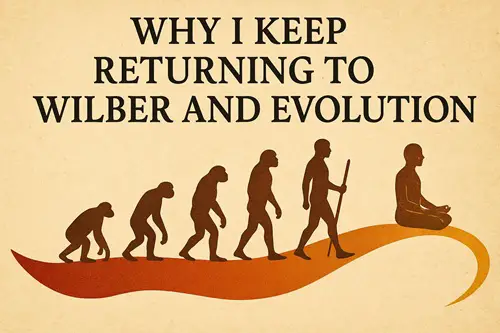 Readers occasionally remark that a disproportionate number of my essays circle back to Ken Wilber and evolutionary theory. The concern is understandable. Repetition can signal fixation, diminishing returns, or even counter-productivity. If an argument has been made once, why not move on? The short answer is that the argument has not yet been met. Wilber places evolution at the very center of his Integral Theory. Evolution is not a peripheral metaphor or illustrative analogy; it is the backbone of his cosmology. Concepts such as Eros, self-transcendence, depth, and developmental hierarchy are repeatedly presented as having grounding in evolutionary processes themselves. This makes Wilber's engagement with evolutionary theory a decisive test case for the credibility of Integral Theory as a whole. Yet this is precisely where a persistent asymmetry appears. Wilber makes strong claims about evolution—claims that go beyond psychology, phenomenology, or spiritual hermeneutics and enter the domain of empirical science. At the same time, when these claims are examined against mainstream evolutionary biology, they are either left undefended, reframed as “metaphysical,” or shifted into a domain allegedly immune to scientific critique. The result is a moving target: evolution is invoked when it supports the Integral narrative, and reclassified when it does not. This pattern creates a structural problem rather than a personal disagreement. In intellectual discourse, repetition is usually unnecessary once positions have been clarified and counterarguments acknowledged. But repetition becomes unavoidable when core claims continue to be restated without addressing prior critiques. Wilber has revised his language over the decades, but the underlying assertion—that evolution is driven by an intrinsic Eros or telos toward greater depth—remains intact. What has not followed is a sustained engagement with evolutionary biology as it is actually practiced. Nor has Wilber publicly confronted detailed critiques of his evolutionary claims, despite their availability for many years. This absence matters. Integral Theory presents itself as a “theory of everything,” or at least as a framework capable of integrating science and spirituality without distortion. When a central scientific domain is treated selectively, the promise of integration collapses into rhetorical synthesis. At that point, critique is not redundancy; it is due diligence. Some readers suggest that continuing to press this point gives Wilber undue attention, or keeps a dead debate artificially alive. I see it differently. As long as Integral Theory continues to influence readers, students, and practitioners—often with claims about evolution that sound scientific but are not accountable to science—the issue remains live. Silence would imply either resolution or concession. Neither has occurred. There is also a broader principle at stake. Intellectual cultures often develop immune responses to criticism, especially when charismatic figures are involved. Over time, unresolved problems are normalized, and critics are reclassified as “reductionists,” “flatlanders,” or simply tiresome. Repetition, in such contexts, is not stubbornness but resistance to amnesia. If Wilber were to directly address these critiques—by clarifying which of his evolutionary claims are empirical, which are metaphysical, and how they relate to contemporary evolutionary biology—the need for repetition would largely evaporate. Debate would move forward. Positions could converge, diverge, or be abandoned. But that requires engagement. Until then, the recurrence of these essays reflects not a lack of new material, but the persistence of an unresolved problem at the heart of Integral Theory. Evolution remains the keystone of Wilber's system. As long as that keystone is conceptually unstable, returning to it is not counter-productive—it is unavoidable. Ultimately, the question is not whether I write “too much” about Wilber and evolution, but whether the issue itself has been resolved. Repetition becomes counter-productive only when it circles a settled matter. In this case, it does not.
As long as evolutionary claims remain central to Integral Theory, yet insulated from evolutionary science, the tension persists—and so must the critique. Readers are, of course, free to disengage; intellectual inquiry is not a moral obligation. But for those who care about the integrity of synthesis between science and spirituality, returning to this unresolved fault line is neither obsession nor provocation. It is simply what responsible criticism looks like when silence would imply closure that has not, in fact, been earned.
Comment Form is loading comments...
|