|
TRANSLATE THIS ARTICLE
Integral World: Exploring Theories of Everything
An independent forum for a critical discussion of the integral philosophy of Ken Wilber
  Frank Visser, graduated as a psychologist of culture and religion, founded IntegralWorld in 1997. He worked as production manager for various publishing houses and as service manager for various internet companies and lives in Amsterdam. Books: Ken Wilber: Thought as Passion (SUNY, 2003), and The Corona Conspiracy: Combatting Disinformation about the Coronavirus (Kindle, 2020). Frank Visser, graduated as a psychologist of culture and religion, founded IntegralWorld in 1997. He worked as production manager for various publishing houses and as service manager for various internet companies and lives in Amsterdam. Books: Ken Wilber: Thought as Passion (SUNY, 2003), and The Corona Conspiracy: Combatting Disinformation about the Coronavirus (Kindle, 2020).
Check out my other conversations with ChatGPT The Impossibility of Detecting Intelligent Extraterrestrial LifeInsights from Brian GreeneFrank Visser / Grok
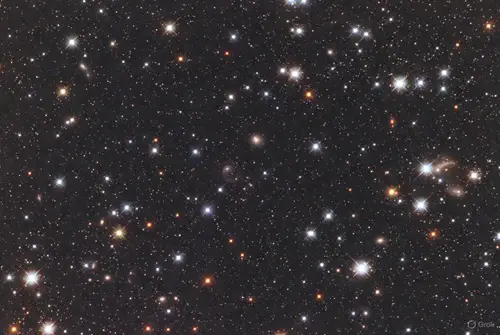 In his recent YouTube talk titled "Why It's IMPOSSIBLE to Find Intelligent Life Out There," physicist Brian Greene addresses one of the most enduring mysteries in science: the apparent absence of intelligent alien civilizations despite the vastness of the universe. Uploaded in December 2025, the video draws on decades of search efforts, including over 60 years of initiatives like SETI (Search for Extraterrestrial Intelligence), which have yielded no verified signals or evidence of extraterrestrial technology. Greene frames this silence not as proof that we are alone, but as a profound challenge that may render detection practically impossible, even if intelligent life exists elsewhere. Greene begins by invoking the famous Fermi Paradox—named after physicist Enrico Fermi's casual query, "Where is everybody?"—which highlights the contradiction between the high statistical probability of life emerging in a universe with billions of habitable planets and the total lack of contact or observable signs. The universe is ancient (13.8 billion years old), immense (with trillions of galaxies), and teeming with the chemical building blocks of life. Yet, after exhaustive searches for radio signals, optical lasers, or other technosignatures, humanity has found nothing conclusive. Central to Greene's argument is the role of vast cosmic distances and the finite speed of light. Even if advanced civilizations are broadcasting signals or building megastructures, the light-speed limit means that information from distant stars takes years, centuries, or millennia to reach us. The observable universe is about 93 billion light-years across, but most of it is far beyond practical communication range. A signal from a civilization 1,000 light-years away would have left its source a millennium ago; by now, that civilization might have risen, peaked, and collapsed. Greene emphasizes that technological civilizations may be fleeting on cosmic timescales—perhaps lasting only thousands or millions of years before self-destruction, migration, or evolution into forms that no longer use detectable technologies. Another key point Greene explores is the rarity of intelligent life. While simple microbial life might be common (as suggested by the rapid emergence of life on Earth), the leap to complex, tool-using, communicating intelligence could be extraordinarily improbable. Drawing from evolutionary biology, he notes the contingent steps on Earth: from single-celled organisms to multicellularity, to brains capable of abstract thought and technology. These transitions might represent "great filters"—barriers that few, if any, planetary biospheres overcome. If intelligence is a rare fluke, the galaxy could be dotted with life but devoid of peers capable of interstellar signaling. Greene also considers more speculative resolutions, such as the possibility that advanced civilizations transcend electromagnetic communication altogether, using quantum methods, neutrinos, or gravitational waves that current human technology cannot detect. Or perhaps they intentionally remain silent (the "zoo hypothesis"), observing us without interfering, or they have colonized the galaxy in ways that are invisible to us. However, he cautions against over-relying on such explanations, favoring evidence-based reasoning grounded in physics. Ultimately, Greene's talk is sobering yet inspiring. The "impossibility" in the title refers not to the non-existence of aliens, but to the practical barriers—distance, time, rarity, and technological mismatches—that may forever isolate civilizations in the cosmos. This cosmic loneliness underscores the preciousness of human intelligence and consciousness. As Greene often reflects in his broader work, understanding our place in an apparently empty universe compels us to find meaning within ourselves, through science, art, and connection. Rather than despair, the silence of the stars invites deeper curiosity about the laws of nature and our brief, brilliant moment in the cosmic story. Greene's eloquent synthesis of cosmology, biology, and philosophy leaves viewers with a profound appreciation for the challenges of the search, reminding us that even if intelligent life is out there, the universe's scale may ensure we never shake hands across the void.
Why It's IMPOSSIBLE to Find Intelligent Life Out There | Brian Greene
Comment Form is loading comments...
|