|
TRANSLATE THIS ARTICLE
Integral World: Exploring Theories of Everything
An independent forum for a critical discussion of the integral philosophy of Ken Wilber
  Frank Visser, graduated as a psychologist of culture and religion, founded IntegralWorld in 1997. He worked as production manager for various publishing houses and as service manager for various internet companies and lives in Amsterdam. Books: Ken Wilber: Thought as Passion (SUNY, 2003), and The Corona Conspiracy: Combatting Disinformation about the Coronavirus (Kindle, 2020). Frank Visser, graduated as a psychologist of culture and religion, founded IntegralWorld in 1997. He worked as production manager for various publishing houses and as service manager for various internet companies and lives in Amsterdam. Books: Ken Wilber: Thought as Passion (SUNY, 2003), and The Corona Conspiracy: Combatting Disinformation about the Coronavirus (Kindle, 2020).
Check out my other conversations with ChatGPT
EVOLUTION AND INTEGRAL THEORY:
The Symposium That Never Happened A Post-Conference Critical Synthesis Evolution as the Fault Line of Integral TheoryA Post-Conference Critical SynthesisFrank Visser / ChatGPT
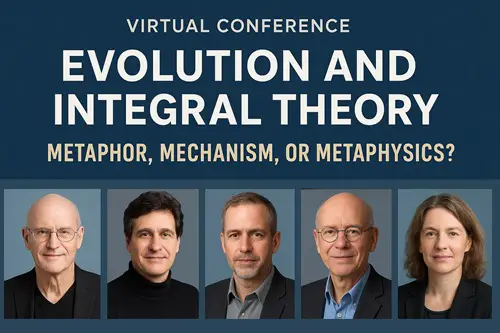 Evolution is not merely one topic among many in Ken Wilber's Integral Theory; it is its structural backbone. Integral Theory presupposes a universe that develops, that reliably moves from simplicity to complexity, from matter to life to mind to spirit. Without evolution understood as a broadly directional process, Integral Theory loses its coherence as a grand synthesis. Yet precisely here—at the point where metaphysical aspiration meets empirical science—serious doubts arise about Wilber's command of evolutionary biology. This essay examines evolution as the critical fault line of Integral Theory: the point at which its philosophical ambitions collide with the methodological constraints of science. Evolution as Narrative, Not MechanismWilber's account of evolution is primarily narrative rather than mechanistic. Across his major works—Up from Eden, Sex, Ecology, Spirituality, A Brief History of Everything—evolution is presented as a story of increasing depth, interiority, and consciousness. Matter gives rise to life, life to mind, mind to soul, soul to Spirit. This sequence is not merely descriptive but valorized; it is treated as the universe revealing its own latent potentials. What is largely absent from this account is sustained engagement with evolutionary mechanisms. Natural selection, genetic drift, constraint, historical contingency, and extinction play at best a supporting role. Instead, Wilber introduces Eros: a putative drive toward self-transcendence, complexity, and interior depth. While Wilber often insists that Eros is not a “force” in the crude physical sense, it nonetheless functions as an explanatory principle. It is invoked to account for why evolution allegedly moves in a preferred direction at all. This is the first point of tension. Evolutionary biology explains how populations change over time under specific conditions; it does not require, and does not posit, a cosmic impulse toward higher forms. Wilber's evolutionary story therefore operates at a different level from biological explanation, even when it borrows scientific language. The Rhetorical Use of ScienceIntegral Theory frequently appeals to complexity theory, self-organization, dissipative structures, and emergence to support its evolutionary vision. Names such as Prigogine and Kauffman are cited as evidence that science itself is rediscovering purpose, direction, or proto-teleology in nature. Yet these appeals are often rhetorical rather than technical. Self-organization in physics and chemistry does not imply long-term evolutionary directionality, let alone spiritual ascent. Emergence does not guarantee progress; it merely describes the appearance of new properties under specific conditions. Complexity theory explains pattern formation, not cosmic intention. The problem is not that Wilber references these fields, but that he consistently stretches their implications beyond what their practitioners claim. Scientific caution is replaced by metaphysical enthusiasm, while the authority of science is retained as a legitimizing backdrop. When critics object, the response is often that Wilber is “only speaking philosophically”—a retreat that raises the question of why scientific validation was invoked in the first place. Directionality Without Design?A central ambiguity in Integral Theory is its stance on teleology. Wilber denies endorsing intelligent design or creationism, yet he insists that evolution displays a persistent trajectory toward greater depth and consciousness. This “directionality without a director” is presented as self-evident, sometimes even obvious. However, evolutionary biology offers a far more ambivalent picture. While local increases in complexity occur, they are accompanied by massive extinction, long periods of stasis, and rampant simplification. Bacteria remain the dominant life forms on Earth. Intelligence is rare, fragile, and contingent. There is no biological law driving evolution toward higher consciousness; there is only differential reproduction in changing environments. Integral Theory responds by shifting the evidential burden: directionality is said to be visible when viewed “from 30,000 feet” or across cosmic timescales. But this move substitutes aesthetic pattern recognition for scientific explanation. Trends become values; descriptions quietly become prescriptions. The Retreat to MetaphorWhen pressed on these issues, Integral defenders often insist that Eros is merely a metaphor, a poetic way of naming creativity or novelty. Yet Integral Theory simultaneously treats Eros as ontologically significant, as something woven into the fabric of reality. This oscillation—between metaphor when challenged and mechanism when convenient—is a defining feature of Wilber's engagement with science. The result is a conceptual no-man's-land. If Eros is metaphorical, it explains nothing and cannot ground Integral Theory's evolutionary claims. If it is real, it demands empirical justification that science does not provide. Integral Theory wants the inspirational power of metaphysics and the authority of science without fully submitting to the constraints of either. Evolution After IntegralNone of this implies that evolution lacks philosophical significance, nor that science exhausts all possible interpretations of the cosmos. But it does imply that any theory claiming to integrate science must respect its limits. Evolutionary biology is not incomplete because it lacks Spirit; it is methodologically restricted because it studies natural processes. Integral Theory's great ambition—to unify matter, life, mind, and meaning—falters when it treats evolution as a spiritual allegory rather than a hard-won scientific framework. Its evolutionary narrative is compelling, even seductive, but it remains largely insulated from empirical correction. If Integral Theory is to mature intellectually, it must choose: either relinquish its quasi-scientific claims about evolution and stand openly as a metaphysical worldview, or submit its evolutionary assertions to the same critical scrutiny it demands of other disciplines. Until then, evolution will remain not the foundation of Integral Theory, but its most revealing fault line.
Comment Form is loading comments...
|