|
TRANSLATE THIS ARTICLE
Integral World: Exploring Theories of Everything
An independent forum for a critical discussion of the integral philosophy of Ken Wilber
  Frank Visser, graduated as a psychologist of culture and religion, founded IntegralWorld in 1997. He worked as production manager for various publishing houses and as service manager for various internet companies and lives in Amsterdam. Books: Ken Wilber: Thought as Passion (SUNY, 2003), and The Corona Conspiracy: Combatting Disinformation about the Coronavirus (Kindle, 2020). Frank Visser, graduated as a psychologist of culture and religion, founded IntegralWorld in 1997. He worked as production manager for various publishing houses and as service manager for various internet companies and lives in Amsterdam. Books: Ken Wilber: Thought as Passion (SUNY, 2003), and The Corona Conspiracy: Combatting Disinformation about the Coronavirus (Kindle, 2020).
Check out my other conversations with ChatGPT Children of the Night in a Dark UniverseHow Light and Darkness Shape Human Biology and PsychologyFrank Visser / ChatGPT
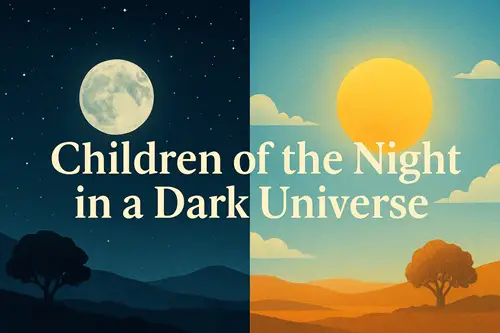 From a cosmic perspective, light is a rarity. The universe is overwhelmingly dark, punctuated only by islands of stellar illumination separated by vast, light-less expanses. Even on Earth, daylight is a brief daily interval, carved out by planetary rotation, while darkness reigns before and after. Yet human civilization has inverted this cosmic ratio. We live by day, work under artificial illumination, and increasingly push the night aside as a mere inconvenience. This reversal obscures a deeper evolutionary truth: biologically and psychologically, we are not merely creatures of light, but descendants of darkness. Light as a Biological SignalLight is not merely a visual phenomenon; it is a biological instruction. The human retina contains specialized photoreceptors— intrinsically photosensitive retinal ganglion cells (ipRGCs) —that do not contribute to vision at all. Instead, they project directly to the suprachiasmatic nucleus (SCN) of the hypothalamus, the brain's master circadian clock. Through this pathway, light entrains our internal rhythms to the 24-hour cycle of Earth's rotation. Daylight suppresses the secretion of melatonin, increases cortisol in the early morning, and promotes alertness, metabolic activity, and cognitive performance. In evolutionary terms, light synchronizes foraging, hunting, and social coordination. It tells the organism: now is the time to act. Modern chronobiology has made clear that exposure to morning light is one of the strongest regulators of circadian stability. Yet this regulatory role of light is relatively recent in evolutionary time. For hundreds of millions of years, life existed without eyes, guided instead by chemical and thermal gradients, and later by crude light-sensing mechanisms that merely distinguished day from night. Light, biologically speaking, began as a timing cue, not a habitat. Darkness as the Ancestral ConditionDarkness, by contrast, is the default state of the universe and the deep past of life. Early mammals evolved under the ecological shadow of dinosaurs, becoming predominantly nocturnal to avoid predation. This nocturnality shaped mammalian sensory systems: heightened olfaction, sensitive hearing, and neural architectures attuned to low-light conditions rather than sharp visual acuity. Even today, human vision betrays this ancestry. Compared to diurnal predators like eagles or hawks, human eyesight is mediocre in bright light. Our pupils dilate widely, our retinas contain a high density of rod cells suited for low-light sensitivity, and our visual system prioritizes contrast and motion detection—features advantageous at dusk or night. Physiologically, darkness triggers the release of melatonin, lowers body temperature, and shifts metabolism toward repair rather than expenditure. Growth hormone secretion peaks during deep sleep, immune processes are upregulated, and neural plasticity—especially memory consolidation—accelerates. Darkness is not merely the absence of light; it is an active biological state, one optimized for restoration. Psychological Effects of LightPsychologically, light is associated with clarity, orientation, and agency. Bright environments increase confidence, reduce ambiguity, and promote outward-focused cognition. Numerous studies show that illumination levels affect moral reasoning, risk-taking, and even honesty: people behave more transparently under brighter conditions. Light structures narrative and meaning. It is no accident that across cultures light symbolizes knowledge, revelation, and truth. Psychologically, illumination allows the mind to stabilize its models of the world. Boundaries become visible; objects are differentiated; threats are easier to assess. Light supports the ego's preference for control, predictability, and mastery. Yet excessive or poorly timed light—particularly artificial light at night—disrupts these same systems. Chronic exposure to blue-rich light suppresses melatonin, fragments sleep, and is associated with mood disorders, metabolic dysfunction, and impaired cognitive performance. In psychological terms, perpetual light creates a state of low-grade vigilance without recovery. Psychological Effects of DarknessDarkness, conversely, destabilizes perception and invites inwardness. In the absence of visual certainty, the brain amplifies imagination, memory, and emotion. This is why darkness has long been associated with fear, but also with creativity, introspection, and the sacred. Sensory deprivation experiments and dark-retreat traditions alike demonstrate that reduced light shifts cognition away from external problem-solving toward associative, symbolic, and dream-like modes. From an evolutionary standpoint, fear of the dark is not irrational; it is an inherited risk-assessment bias. Predators, uncertainty, and social vulnerability historically increased after sunset. But alongside fear came storytelling, bonding, and ritual. Nighttime cognition is slower, less analytical, but more integrative. It favors meaning over measurement. Sleep itself—the deepest embrace of darkness—is a state in which the self loosens its grip. Conscious control fades, and the brain engages in processes that cannot be voluntarily accessed: emotional recalibration, memory pruning, and unconscious integration. Psychologically, darkness is the condition for renewal. Modern Imbalance: Living Against the NightTechnological civilization has decisively tipped the balance toward light. Artificial illumination extends the day indefinitely, eroding the natural contrast between day and night. The result is a biologically confused organism: circadian rhythms drift, sleep becomes shallow, and psychological restlessness increases. We are, in effect, attempting to live as purely diurnal beings in a universe that never was. This is not merely a medical problem but a psychological one. Constant illumination mirrors constant productivity, constant visibility, and constant self-presentation. Darkness—both literal and metaphorical—has become suspect, equated with inactivity or danger, rather than recognized as a necessary phase of the human cycle. Conclusion: Relearning the Value of DarknessLight enables action, coordination, and clarity. Darkness enables repair, reflection, and depth. Biologically and psychologically, humans are adapted to the rhythm between the two, not to the dominance of either. While daylight may structure our social lives, darkness shaped our nervous systems and still governs our inner worlds. In a universe where darkness is the rule and light the exception, our task is not to banish the night, but to reclaim it. To sleep deeply, to dim the lights, and to allow periods of obscurity—literal and mental—is not a regression, but an evolutionary fidelity. We remain, despite all our illumination, children of the night living briefly by the day.
Comment Form is loading comments...
|