|
TRANSLATE THIS ARTICLE
Integral World: Exploring Theories of Everything
An independent forum for a critical discussion of the integral philosophy of Ken Wilber
  Frank Visser, graduated as a psychologist of culture and religion, founded IntegralWorld in 1997. He worked as production manager for various publishing houses and as service manager for various internet companies and lives in Amsterdam. Books: Ken Wilber: Thought as Passion (SUNY, 2003), and The Corona Conspiracy: Combatting Disinformation about the Coronavirus (Kindle, 2020). Frank Visser, graduated as a psychologist of culture and religion, founded IntegralWorld in 1997. He worked as production manager for various publishing houses and as service manager for various internet companies and lives in Amsterdam. Books: Ken Wilber: Thought as Passion (SUNY, 2003), and The Corona Conspiracy: Combatting Disinformation about the Coronavirus (Kindle, 2020).
Check out my other conversations with ChatGPT
EVOLUTION AND INTEGRAL THEORY:
The Symposium That Never Happened A Post-Conference Critical Synthesis Evolution and Integral TheoryMetaphor, Mechanism, or Metaphysics?The Symposium That Never HappenedFrank Visser / ChatGPT
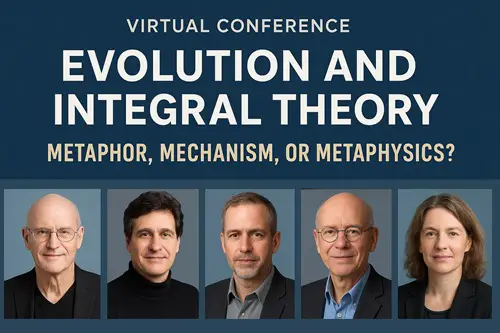 NOTE: Of course, this conference did not happen, nor will it ever, given the current integral landscape. Hence a virtual conference. LIST OF PARTICIPANTS
Moderator: Welcome. This conference addresses a single question: Is Ken Wilber's use of evolution scientifically responsible, philosophically legitimate, or metaphysically indulgent? We begin with clarification, not critique. SESSION I - What Ken Wilber Claims About EvolutionModerator: Ken, are you making empirical claims about biological evolution? Ken Wilber: No. I am not doing biology. I am doing meta-theory. I accept the findings of evolutionary science, but I argue that they describe only the exterior dimensions of reality. Evolution also has interior dimensions—value, meaning, depth. Eros names that dimension. Frank Visser: But Ken, you have repeatedly criticized neo-Darwinism for being insufficient. In Sex, Ecology, Spirituality you say it cannot explain the emergence of depth and consciousness. That is not neutral interpretation; it is a claim of explanatory failure. Wilber: It is insufficient ontologically, not mechanistically. Biology explains how forms change. It does not explain why there is a Kosmos capable of producing life and mind at all. Moderator: Then to be precise: biology is complete on its own terms, but incomplete as a worldview? Wilber: Exactly. Visser: But your texts routinely blur that line. Biology and complexity science are presented as if they secretly support your metaphysical conclusions. Corey deVos: That is a misreading. Integral Theory contextualizes science; it does not correct it. Moderator: We will test that claim shortly. SESSION II - Evolutionary Biology: What the Science SaysJerry Coyne: Evolutionary biology does not posit direction, purpose, or drive. Natural selection explains local adaptation. There is no trend toward intelligence, spirituality, or complexity as such. Wilber: Yet matter produced life, life produced mind. That sequence is undeniable. Michael Lynch: Sequence is not direction. You are mistaking a historical outcome for a necessary trajectory. If you replay evolution, you almost certainly don't get humans. Coyne: And most evolution results in extinction. Ninety-nine percent of species that ever lived are gone. Moderator: Does evolutionary theory recognize any form of progress? Lynch: Only relative to environments. Never absolutely. Wilber: But from a larger perspective— Coyne: —that perspective is philosophical, not biological. SESSION III - Complexity, Self-Organization, and EmergenceModerator: Integral Theory often invokes complexity science. Stuart, does self-organization imply directionality? Stuart Kauffman: No. Self-organization explains how order can arise spontaneously, not why it must keep increasing, and certainly not why it would aim at consciousness or Spirit. Visser: Yet Integral literature treats complexity as a bridge from physics to metaphysics. Kauffman: That is an extrapolation, not a scientific conclusion. Wilber: But science itself shows creativity built into the universe. Kauffman: Creativity, yes. Purpose, no. Moderator: So when Integral Theory cites complexity science, is it explanatory or inspirational? Kauffman: Inspirational. SESSION IV - Cross-Examination of Integral TheoryMassimo Pigliucci: The recurring pattern is equivocation. When challenged scientifically, Integral Theory retreats to philosophy. When it seeks authority, it advances scientific language. That is not integration; it is category confusion. deVos: Integral Theory includes multiple epistemologies. Science does not get veto power over meaning. Pigliucci: Agreed. But meaning does not get veto power over science either. Visser: Integral Theory wants evolution to be both descriptive and salvific. That is why Eros keeps reappearing. Moderator: Is Eros a metaphor? Wilber: It is a name for the universe's self-transcending tendency. Pigliucci: That is not a metaphor. That is a metaphysical claim. SESSION V - Revision or Collapse?Moderator: Can Integral Theory survive without ontological Eros? Mark Edwards: Yes, but it would be humbler. Eros can be treated heuristically—as a way humans experience novelty and growth, not as a cosmic principle. Evan Thompson: Meaning emerges from life itself. We don't need a universe that intends consciousness to take consciousness seriously. Visser: But once Eros is reduced to human interpretation, Integral Theory loses its cosmic ambition. Mark Edwards: Perhaps that ambition was the problem. CLOSING ROUNDModerator: One final question. Is evolution the foundation of Integral Theory—or its weakest point? Coyne: Its weakest point. Kauffman: Its inspiration, misunderstood. Wilber: Its deepest truth. Visser: Its most revealing fault line. Moderator: Thank you. This conference does not settle the matter—but it clarifies it. Evolution, it seems, remains where Integral Theory is most ambitious, and most vulnerable.
Editorial NoteThis transcript has been lightly edited for clarity and length. No positions have been altered.
Comment Form is loading comments...
|