|
TRANSLATE THIS ARTICLE
Integral World: Exploring Theories of Everything
An independent forum for a critical discussion of the integral philosophy of Ken Wilber
  Frank Visser, graduated as a psychologist of culture and religion, founded IntegralWorld in 1997. He worked as production manager for various publishing houses and as service manager for various internet companies and lives in Amsterdam. Books: Ken Wilber: Thought as Passion (SUNY, 2003), and The Corona Conspiracy: Combatting Disinformation about the Coronavirus (Kindle, 2020). Frank Visser, graduated as a psychologist of culture and religion, founded IntegralWorld in 1997. He worked as production manager for various publishing houses and as service manager for various internet companies and lives in Amsterdam. Books: Ken Wilber: Thought as Passion (SUNY, 2003), and The Corona Conspiracy: Combatting Disinformation about the Coronavirus (Kindle, 2020).
Check out my other conversations with ChatGPT Yanis VaroufakisInsightful Dissident or Anti-Western Ideologue?Frank Visser / ChatGPT
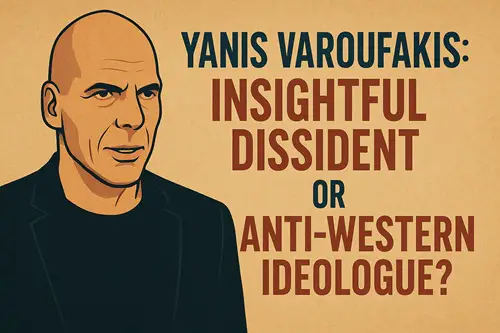 Few contemporary public intellectuals generate such polarized reactions as Yanis Varoufakis. To some, he is one of Europe's most incisive critics of Western economic and foreign-policy orthodoxy—a Cassandra diagnosing structural failures before they erupt into crises. To others, he is a clever ideologue whose commentary consistently blames the West for global instability, thereby undermining its democratic alliances. The truth sits neither in the polemic nor in the hero-worship. Understanding Varoufakis requires recognizing the intellectual architecture he brings to geopolitics—and how sharply it diverges from mainstream Western frameworks. What distinguishes Varoufakis is that he is not, and never pretended to be, a conventional geopolitical analyst. His lens is fundamentally economic, systemic, and ideological. His work, from “Technofeudalism” to his post-finance ministry advocacy in DiEM25 [Democracy in Europe Movement 2025], analyzes power through the interaction of technology, capital, and global institutions. In geopolitics, he applies the same framework: ask what structural dynamics generate conflict; identify how Western institutions consolidate or misuse power; and propose alternative architectures grounded in diplomacy and transnational democracy. This makes him a provocative contributor—and a controversial one. NATO: Stabilizer or Instigator?Varoufakis's critique of NATO encapsulates the broader tension in his views. In the dominant Western narrative, NATO is the anchor of European stability, the institution that ended the Cold War, integrated former Soviet satellites, and presently shields the continent from Russian aggression. States clamored to join it; its expansion was voluntary and stabilizing. In other words, NATO is the solution. Varoufakis reverses the polarity. For him, NATO is a Cold War relic whose continued expansion entrenched insecurity and created predictable flashpoints. It is not intrinsically malign, but structurally misaligned with Europe's long-term needs—an institution that serves American strategic interests as much as, or more than, European ones. Where the mainstream sees deterrence, he sees escalation. Where the mainstream sees voluntary alliance, he sees dependency and strategic miscalculation. These are not trivial disagreements; they expose two incompatible theories of international relations. Varoufakis is not “anti-Western” for holding them, but he does reject the foundational premise of post-1991 European security. It is unsurprising, then, that Atlanticists read his critique as deeply adversarial. The Russia-Ukraine War: Unilateral Aggression or Structural Disaster?The Russia-Ukraine war magnifies the divergence. Mainstream Western analysis frames the invasion as a straightforward act of Russian imperial aggression. Russia violated a sovereign neighbor's borders; Western aid is necessary both for Ukraine's survival and to deter future Russian expansionism; negotiations are impossible until Ukraine achieves meaningful battlefield leverage. The moral and strategic asymmetry is clear. Varoufakis does not dispute that the invasion is criminal. But he embeds the war within a larger story: NATO enlargement, misreadings of Russian security paranoia, and a failure of diplomacy on all sides. He argues that Ukraine has become the battleground of a larger systemic struggle in which both Moscow and Washington have made grave miscalculations. His solution—ceasefire, diplomacy, and ultimately a neutral Ukraine—stems from the assumption that escalation is the core problem, not inadequate deterrence. This perspective is coherent within his framework but lands awkwardly in the Western debate. Critics argue that it downplays Russian agency, misreads deterrence, and ignores the hard realities of conquest. Supporters counter that it is one of the few perspectives capable of envisioning long-term stability rather than indefinite militarization. U.S.-China Relations: Hegemonic Rivalry or Civilizational Contest?Varoufakis's interpretation of the U.S.-China rivalry follows the same structural logic. Mainstream Western analysis increasingly treats the relationship as a competition between liberal democracy and authoritarian revisionism, centered on military balance, supply-chain resilience, and ideological influence. China is framed as an expansionist power seeking regional hegemony and technological supremacy. Varoufakis sees something different. He sees a technological and financial conflict that threatens to fragment the global economy. He does not romanticize China, acknowledging its authoritarian governance, but he rejects the narrative that global politics is fundamentally a battle between political systems. For him, the key driver is the U.S. desire to protect its financial and technological primacy, not an ideological defense of democracy. Western “containment,” in his interpretation, risks catalyzing a crisis similar to early 20th-century great-power rivalries—structural pressures sleepwalking the world into confrontation. Again, this is not pro-China rhetoric. It is a left-internationalist structural critique. But because it redirects analytical attention away from Chinese authoritarianism and toward Western systemic behavior, it conflicts with the moral framing prevalent in Western policy discourse.
Varoufakis's Strongest CriticsVaroufakis attracts criticism from across the political and analytical spectrum, and understanding these critiques helps clarify why his geopolitical positions generate such polarized reactions. 1. Atlanticist and Centrist Policy AnalystsForeign-policy strategists aligned with NATO and the EU argue that Varoufakis systematically underestimates the role of coercive power in maintaining stability. They see his diplomacy-first approach as naïve in the face of revisionist actors who exploit weakness. To these critics, Varoufakis's positions appear to invert moral responsibility, attributing Western structural missteps more explanatory weight than the deliberate actions of authoritarian states. As a result, they contend that his analyses, while intellectually stimulating, fail to offer actionable policy guidance in a world of hard power. 2. Realists and Security PragmatistsClassical realists—those who prioritize balance-of-power dynamics—criticize Varoufakis for overemphasizing economics and ideology at the expense of security logic. They argue that Russia's and China's strategic behavior cannot be adequately explained through financial or systemic narratives alone. From their perspective, Varoufakis's structural framing obscures the core reality that states pursue power regardless of Western behavior, making his proposed solutions strategically brittle. 3. Conservative and Liberal Interventionist VoicesFrom the right and center-left, Varoufakis's skepticism toward Western military alliances is interpreted as ideological anti-militarism that dismisses the historical role of deterrence. These critics stress that NATO's commitments, U.S. presence in Asia, and military support for Ukraine are not optional moral projects but practical instruments of stability. They accuse Varoufakis of treating Western intervention as inherently suspect while downplaying the threat posed by illiberal powers. 4. Some on the Socialist and Marxist LeftSurprisingly, Varoufakis also draws fire from segments of the radical left. For Marxist critics, he is not anti-Western enough. They consider his proposals for “European democratization” and negotiated settlements insufficiently revolutionary, and they challenge his view that capitalist institutions can be reformed from within. These critics accuse him of misdiagnosing imperialism, focusing too much on Western mismanagement rather than global capitalist structures as a whole. 5. Former Political Allies and Practical PolicymakersFigures familiar with the mechanics of statecraft sometimes fault Varoufakis for idealism without implementation. His 2015 tenure as Greek finance minister remains a point of dispute: admirers praise his resistance to austerity, while detractors argue he overestimated leverage and misread institutional motives. Geopolitical analysts in this camp cite his negotiating style as evidence that his strategic intuitions, though bold, can be poorly calibrated to actual power dynamics. SynthesisAcross these critiques, a common theme emerges: Varoufakis is seen as a brilliant diagnostician but an unreliable strategist. His detractors acknowledge his intellectual audacity and his ability to articulate systemic problems with unusual clarity. Yet they argue that his solutions—demilitarization, transnational democracy, negotiated multipolarity—lack the coercive scaffolding required to function in the real world of rivalrous states. Supporters counter that his perspective is precisely what is missing from Western discourse: a systemic critique of power that refuses to accept militarized geopolitics as inevitable. Either way, Varoufakis's critics help illuminate the essential duality of his role: he is a provocative, indispensable dissident whose influence depends less on operational precision and more on the uniquely challenging questions he forces the West to confront. The Real Question: What Kind of Analyst Is Varoufakis?Varoufakis is not neutral, nor does he claim to be. His worldview is shaped by economic structuralism, left-internationalist skepticism of militarism, and a long-standing critique of American hegemony. Within that framework, his analyses are internally consistent, often illuminating, and sometimes prescient. But they are also profoundly out of sync with mainstream Western strategic thinking. This does not make him unreliable; it makes him non-aligned. He challenges assumptions, exposes blind spots, and forces debates that democratic societies should not fear. Yet he also tends to underestimate the role of coercive power in maintaining order and sometimes treats Western structural missteps as more explanatory than the agency of authoritarian regimes. The fairest assessment is therefore this: Varoufakis is a valuable critical voice precisely because he is not aligned with Western orthodoxy—but he is not a neutral analyst of geopolitics, and his insights must be contextualized within his ideological commitments. Those looking for Atlanticist reassurance will find him dissonant; those seeking systemic critiques of Western power will find him indispensable. And in a geopolitical landscape increasingly shaped by rivalry, fragmentation, and great-power tension, such dissenting frameworks, whether one agrees with them or not, serve an essential intellectual function.
THE FALL OF ODESA: The End of Ukraine and the Death of US Hegemony | Yanis Varoufakis
Comment Form is loading comments...
|