|
TRANSLATE THIS ARTICLE
Integral World: Exploring Theories of Everything
An independent forum for a critical discussion of the integral philosophy of Ken Wilber
  Frank Visser, graduated as a psychologist of culture and religion, founded IntegralWorld in 1997. He worked as production manager for various publishing houses and as service manager for various internet companies and lives in Amsterdam. Books: Ken Wilber: Thought as Passion (SUNY, 2003), and The Corona Conspiracy: Combatting Disinformation about the Coronavirus (Kindle, 2020). Frank Visser, graduated as a psychologist of culture and religion, founded IntegralWorld in 1997. He worked as production manager for various publishing houses and as service manager for various internet companies and lives in Amsterdam. Books: Ken Wilber: Thought as Passion (SUNY, 2003), and The Corona Conspiracy: Combatting Disinformation about the Coronavirus (Kindle, 2020).
Check out my other conversations with ChatGPT Ken Wilber and the Burden of the Grand SynthesizerOriginality, Appropriation, and the Perils of Overreach in Integral TheoryFrank Visser / ChatGPT
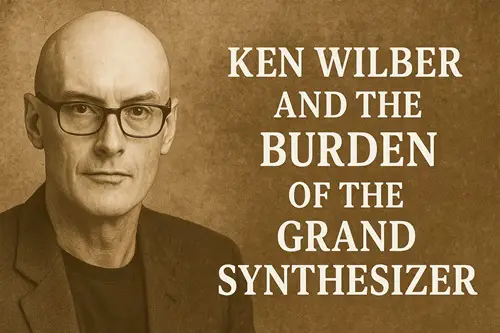 Ken Wilber occupies a peculiar position in contemporary intellectual culture. He is not a scientist, nor a philosopher in the academic sense, nor a theologian, nor a mystic—yet he draws from all of these domains with a confidence that few would dare to exhibit. Admirers call him “the Einstein of consciousness studies”; critics see him as a spiritual system-builder whose grasp routinely exceeds his reach. But Wilber is best understood through a lens rarely applied to him: the same lens through which people scrutinize Darwin, Freud, or Einstein—those giant figures accused of borrowing ideas, ignoring predecessors, or consolidating an entire field into a personal narrative of discovery. To evaluate Wilber clearly, we must ask: What kind of originality does Wilber claim, what kind does he actually possess, and where do his claims slide into overreach, misappropriation, or metaphysical inflation? This essay takes that question seriously. I. The Myth of the Great SynthesizerWilber's admirers often praise him as a thinker of extraordinary breadth: a man who reads everything and then weaves it into a single, coherent framework. This is the myth of the “Great Synthesizer,” the figure whose originality lies not in producing new data or theories but in rearranging existing knowledge into a grand, unifying structure. There is nothing inherently wrong with synthesis. But synthesis is not immune to distortions. It requires:
Wilber's work, particularly from Sex, Ecology, Spirituality onward, frequently violates these conditions. II. Appropriation Without Accountability1. Co-opting Scientific TheoriesWilber's treatment of scientific concepts is emblematic of what critics call “metaphysical appropriation.” Ideas such as:
are invoked to support a spiritualized evolutionary narrative guided by “Eros” or “Spirit-in-action.” Yet in every case, the original theorists explicitly reject any metaphysical reading of their work. Prigogine did not posit a cosmic drive to higher consciousness; Kauffman did not argue for an ascending ladder of spiritual complexity. For them, self-organization is naturalistic, mechanistic, and devoid of teleology. Wilber reinterprets these frameworks for metaphysical ends without attending to their empirical constraints. This is not plagiarism—but it is misappropriation. 2. Borrowing From Depth PsychologyWilber's developmental sequences draw from:
and a handful of transpersonal theorists. But he arranges them into a vertical hierarchy culminating in “nondual consciousness,” a move few of these thinkers would endorse. Jung's archetypes were not higher states; Piaget's stages were not spiritual rungs; Maslow never claimed enlightenment as cognitive development's apex. Again, these are not thefts—they are reinterpretations that outrun their source material. III. When Integration Becomes Overstretch1. Science Bent Into a Spiritual NarrativeWilber's central claim—that evolution is driven by an inner spiritual force aiming at increasing complexity and consciousness—places his entire system outside the empirical sciences. He cites scientists who do not agree with him, weaving their cautious language into a cosmic story they would not recognize. This creates the illusion of scientific support for a metaphysical doctrine. It is not scientific fraud, but it is scientific ventriloquism. 2. The Problem of Confirmation BiasWilber's AQAL (All Quadrants, All Levels) model is designed to incorporate everything—but what incorporates everything cannot be falsified by anything. AQAL functions as an interpretive filter, not a predictive framework. Whatever fits is included; whatever contradicts is reinterpreted. This makes the system resilient but not rigorous. 3. The Soteriological AgendaWilber's system is ultimately a spiritual roadmap, not a scientific theory. It seeks to describe the universe in a way that leads individuals upward toward enlightenment. The problem arises when Wilber claims that this spiritual teleology is validated by science. This is where the boundary-crossing occurs. IV. Originality Revisited: What Wilber Actually AchievedWilber is original in two important ways: 1. He created a taxonomy of worldviewsWilber's ability to arrange psychological, philosophical, and spiritual traditions into a structured developmental model remains his most enduring contribution. Even critics acknowledge the heuristic value of this synthesis. 2. He gave people a sense of intellectual coherenceHis framework offers a way of making sense of modern and postmodern fragmentation. It is more existential than scientific, more therapeutic than empirical. But originality is not license for misrepresentation. Wilber's system only works by stretching scientific ideas to metaphysical proportions. V. Why Wilber's Method Matters TodayWilber symbolizes a broader cultural trend: the collapsing of boundaries between science and metaphysics. In an age starving for meaning, many thinkers attempt to spiritualize science or scientize spirituality. Wilber is a case study in how:
can combine into frameworks that feel profound but wobble under scrutiny. His project is an important reminder that scale is not the same as validity, and that grand synthesis requires even more discipline than specialized research—not less. VI. Final Reflection: The Difference Between Creativity and CredibilityKen Wilber is not a plagiarist. But neither is he a disciplined synthesizer in the manner of Darwin or Einstein. He stands closer to Freud: a system-maker whose narrative of discovery often inflates the novelty and accuracy of his project. The real critique is not ethical but epistemological:
This does not make Wilber unimportant. It makes him instructive. Wilber shows us how seductive grand visions can be—and how vigilant we must remain when synthesis becomes overreach, when interpretation becomes appropriation, and when metaphysics masquerades as science. In that sense, Wilber's role in intellectual history is clear: not as a revolutionary thinker, but as a cautionary figure—a reminder that the human hunger for coherence can easily outrun the world's actual complexity.
Comment Form is loading comments...
|