|
TRANSLATE THIS ARTICLE
Integral World: Exploring Theories of Everything
An independent forum for a critical discussion of the integral philosophy of Ken Wilber
  Frank Visser, graduated as a psychologist of culture and religion, founded IntegralWorld in 1997. He worked as production manager for various publishing houses and as service manager for various internet companies and lives in Amsterdam. Books: Ken Wilber: Thought as Passion (SUNY, 2003), and The Corona Conspiracy: Combatting Disinformation about the Coronavirus (Kindle, 2020). Frank Visser, graduated as a psychologist of culture and religion, founded IntegralWorld in 1997. He worked as production manager for various publishing houses and as service manager for various internet companies and lives in Amsterdam. Books: Ken Wilber: Thought as Passion (SUNY, 2003), and The Corona Conspiracy: Combatting Disinformation about the Coronavirus (Kindle, 2020).
Check out my other conversations with ChatGPT Did Darwin, Freud, and Einstein Plagiarize?The Nuanced History Behind a Persistent AccusationFrank Visser / ChatGPT
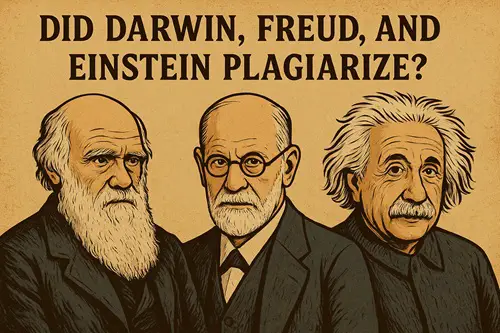 When a thinker changes the world, the world tends to answer with applause—and accusations. It is almost a rule of intellectual history that revolutionary ideas bring forth claims of stolen insights, ignored predecessors, and suspicious parallels. Charles Darwin, Sigmund Freud, and Albert Einstein—giants of biology, psychology, and physics—have all been charged, at various times, with plagiarism or intellectual dishonesty. But are these charges valid? The reality is more subtle than either their defenders or their critics typically allow. What follows is not an apology nor a prosecution, but an attempt to understand how ideas emerge, overlap, and evolve—and why accusing geniuses of theft is often a misunderstanding of how intellectual history works. I. Darwin: The Evolution of an Idea and the Shadow of WallaceThe AccusationDarwin delayed publishing his theory of natural selection for more than 20 years. When Alfred Russel Wallace independently formulated a similar mechanism in 1858, some later critics claimed Darwin “stole” Wallace's insight or rushed it into print in a way that unfairly overshadowed Wallace. The RealityDarwin had mountains of notebooks, correspondence, sketches, and working drafts dating back to the 1830s. His early notebooks clearly show the theory of natural selection developed long before Wallace entered the picture. Wallace's arrival was more a shock than a source. Yet Wallace wasn't a footnote. His insight was independent, elegant, and remarkably similar—and to Victorian eyes, that similarity looked suspicious. But Darwin, Lyell, and Hooker arranged a joint presentation of both ideas at the Linnean Society in 1858. Wallace later expressed gratitude and admiration; he never accused Darwin of theft. In fact, Wallace went on to become one of Darwin's staunchest defenders, even when his own spiritualistic turn placed him at odds with Darwin's naturalism. The Deeper LessonIn science, simultaneous discovery is common. Newton and Leibniz with calculus, Priestley and Lavoisier with oxygen, Mendel and Correns with heredity—complex ideas often ripen in multiple minds at once. Darwin and Wallace represent the perfect case: two naturalists, two continents, one converging idea. Plagiarism? No. A remarkable case of parallel insight. II. Freud: Borrowed Ideas or Transformative Synthesis?The AccusationFreud has been accused many times of appropriating ideas from predecessors—Charcot, Janet, Breuer, Schopenhauer, Nietzsche—and presenting them as his own. Critics point to Freud's reluctance to credit contemporaries and his tendency to narrate psychoanalysis as his heroic invention. The RealityFreud's originality lies neither in discovering the unconscious nor in inventing hypnosis nor in describing repression—these motifs were already in the air. Schopenhauer and Nietzsche had probed the darker, unconscious aspects of human motivation. Janet had detailed “subconscious fixed ideas.” Breuer pioneered the cathartic method. Freud's contribution was a synthesis with a theory of mind:
This is something none of his predecessors created. But Freud's style of claiming originality—his heroic narrative of “my discoveries”—invited suspicion. Even loyal collaborators (Adler, Jung, Rank) broke with him partly because the movement was not structured as a collaborative scientific guild but as a quasi-family around the patriarch. The Deeper LessonFreud was not a plagiarist; he was a mythologizer of his own work. He absorbed, transformed, and repackaged ideas in a distinct, system-building way. If Darwin exemplifies parallel discovery, Freud exemplifies the creative aggregator who oversells the novelty of his synthesis. III. Einstein: From Poincaré to Hilbert—Was Relativity “Borrowed”?The AccusationEinstein's special relativity (1905) and general relativity (1915) were not developed in a vacuum. Lorentz had the transformations; Poincaré had discussed the principle of relativity; Hilbert formulated field equations nearly simultaneously. Some fringe critics go further: Einstein “plagiarized” relativity, especially from Poincaré. The RealityThe mathematics and physical hints existed before Einstein. But Einstein did something radical:
Poincaré came closest—mathematically and philosophically—but he never made the conceptual leap of discarding absolute simultaneity or embracing spacetime geometry as physical. He was on the brink, but did not step through the door. General relativity is similar: Hilbert derived similar field equations, but Einstein alone grasped the physical interpretation, the equivalence principle, and the geometric insight that gravity is curvature of spacetime. The Deeper LessonEinstein did not steal relativity. He solved a puzzle whose pieces were scattered across Europe. Great insights often emerge not from invention ex nihilo, but from reinterpreting existing components in an entirely new key. Why These Accusations PersistSeveral cultural factors make plagiarism accusations tempting: 1. The Myth of the Lone GeniusWhen we reject lone-genius mythology, we feel compelled to attribute innovations to “forgotten” predecessors. This often leads to overcorrection. 2. The Desire to Demystify Revolutionary FiguresToppling heroes is a natural cultural impulse—sometimes justified, but often based on misunderstanding how intellectual ecosystems work. 3. The Rashomon Effect of Intellectual HistoryWitnesses see the same events differently: Wallace saw Darwin as a mentor; some modern critics see him as a thief. Hilbert admired Einstein; some critics see conspiracy. 4. The Confluence of IdeasIdeas mature in a network, not an individual skull. When many people converge, accusations of copying become almost inevitable. So—Were They Plagiarists?Darwin - No. His theory predates Wallace by decades; the overlap is parallel discovery, not appropriation. Freud - Not in the strict sense. Freud assimilated and transformed existing ideas but presented them as original more aggressively than modern norms would accept. Einstein - No. He integrated existing mathematical tools into a conceptual revolution that no predecessor fully articulated. Final Reflection: Genius Is Both Individual and CollectiveThe accusations against Darwin, Freud, and Einstein collapse under scrutiny not because the criticisms are entirely unfounded, but because they misunderstand the real nature of conceptual innovation. Ideas don't emerge in isolation, but neither do they simply float through history waiting to be “stolen.” Great thinkers are both products of their time and creators of something irreducible to that time. They don't invent the ingredients—they invent the dish. Accusations of plagiarism, while occasionally grounded in legitimate concerns about attribution, often underestimate the leap from precursor ideas to world-changing frameworks. That leap—the conceptual reordering of reality—is the mark of genuine originality. Darwin, Freud, and Einstein each made such a leap. That, rather than solitary invention, is why their names endure.
Widget is loading comments...
|