|
TRANSLATE THIS ARTICLE
Integral World: Exploring Theories of Everything
An independent forum for a critical discussion of the integral philosophy of Ken Wilber
  Frank Visser, graduated as a psychologist of culture and religion, founded IntegralWorld in 1997. He worked as production manager for various publishing houses and as service manager for various internet companies and lives in Amsterdam. Books: Ken Wilber: Thought as Passion (SUNY, 2003), and The Corona Conspiracy: Combatting Disinformation about the Coronavirus (Kindle, 2020). Frank Visser, graduated as a psychologist of culture and religion, founded IntegralWorld in 1997. He worked as production manager for various publishing houses and as service manager for various internet companies and lives in Amsterdam. Books: Ken Wilber: Thought as Passion (SUNY, 2003), and The Corona Conspiracy: Combatting Disinformation about the Coronavirus (Kindle, 2020).
Check out my other conversations with ChatGPT The Literary Qualities of Darwin's On the Origin of SpeciesFrank Visser / ChatGPT
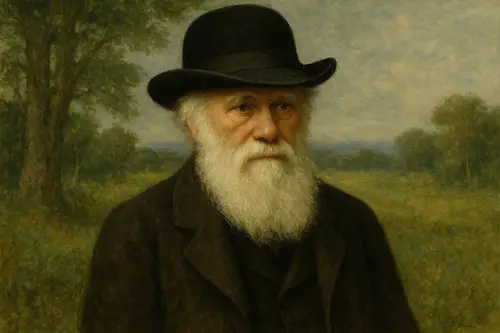 When On the Origin of Species appeared in 1859, readers encountered not only a scientific revolution but a remarkably polished work of literature. Darwin's argument for evolution by natural selection succeeded not only because of its evidential depth, but because it was delivered with narrative skill, rhetorical care, and even moments of quiet lyricism. Far from being a dry treatise, the Origin is an eloquent work shaped by a writer who understood how stories persuade where syllogisms alone cannot. In this sense, Darwin's masterpiece sits at the crossroads of science and literature. 1. A Careful, Conversational VoiceDarwin writes not as an imperious expert but as a careful, self-effacing observer. His tone is measured, personal, and often tentative—traits that make his bold claims approachable. He frequently employs the inclusive “we,” creating a sense that author and reader are embarking together on an investigation rather than a lecture. He pairs this modesty with a meticulous clarity. His sentences, though Victorian in cadence, remain surprisingly accessible. Darwin anticipates objections, acknowledges uncertainty, and builds assent step by step. The effect is not only persuasive but humane; the prose carries the personality of a patient naturalist speaking plainly about what he has seen. 2. The Narrative of DiscoveryThough the Origin is structured as an argument, it unfolds with the rhythm of a narrative. Darwin begins by grounding readers in the familiar world of domesticated animals—pigeons, sheep, cattle—before expanding to the wild, the geological, and finally the cosmic. This movement mirrors a classic narrative arc: from the ordinary to the extraordinary. His opening chapter on variation under domestication reads almost like pastoral literature. The reader is invited into English barns, aviaries, and orchards. Only later does Darwin reveal the deeper significance of such everyday variation: it is the key to nature's hidden mechanism. The structure resembles a detective story, in which mundane clues reveal a profound pattern underlying the living world. 3. Imagery and the Poetics of NatureDarwin's prose often displays an almost poetic sensitivity to nature. His descriptions of tangled banks, coral reefs, and geological strata exhibit an aesthetic appreciation for the complexity of life. The famous final sentence—evoking the “endless forms most beautiful and most wonderful”—is among the most lyrical passages in scientific writing. He uses imagery strategically. Selection is described as a force, a power, even a “breeding hand” of nature. The metaphor of the “struggle for existence” is not purely biological but evokes the drama of life and death, competition and adaptation. These images help translate abstract processes into vivid mental pictures. Darwin also relies on metaphorical framing to make natural selection intuitive. Nature becomes an artist, a selector, a slow sculptor working across geological time. While he insists that this is metaphorical, the imagery performs essential cognitive work: it animates the impersonal mechanism without anthropomorphizing it. 4. Rhetorical Discipline and the Art of PersuasionDarwin's rhetorical strategy is subtle and deliberate. He begins with evidence that his Victorian audience would find incontrovertible—variation in domestication—and builds toward the more controversial claim that species are not fixed. This gradual expansion of scope mirrors his broader argument: small changes, accumulated slowly, can yield immense transformations. He also uses repetition carefully. Certain themes—the ubiquity of variation, the power of selection, the vastness of geological time—recur throughout the text, each time with new evidence. This cumulative method creates a layered persuasive effect. Darwin anticipates and disarms criticism. Sections such as “Difficulties on Theory” demonstrate intellectual honesty, but they also allow him to reframe objections as opportunities for further evidence. This openness strengthens the reader's sense of trust. 5. The Fusion of Description and ArgumentThe Origin reads at times like natural history, at times like philosophical argument. Darwin alternates between empirical description and conceptual synthesis. His descriptions of barnacles, bees, orchids, and island fauna are richly textured; he often builds mini-vignettes of ecological interaction. These function not merely as data points but as windows into the dynamic processes he wants the reader to perceive. This fusion of styles—empirical, narrative, philosophical—creates a hybrid genre. The Origin is not a textbook, nor a monograph, nor a popular book. It is a new kind of scientific literature, one that turns observation into argument without sacrificing literary grace. 6. A Moral and Aesthetic SensibilityAlthough Darwin refrains from explicit ethical conclusions, his prose carries a quiet moral sensibility. He invites readers to see nature not as a static hierarchy but as a dynamic, interconnected web. There is humility in his attempt to understand life without recourse to grandeur or teleology. His final paragraph, in particular, frames evolution as a source of wonder rather than threat. The grandeur he describes is not mystical but naturalistic—a poetic celebration of law-governed complexity. This moral tone softens the radical implications of his theory without diluting them. Conclusion: Darwin as Writer, Not Just ScientistOn the Origin of Species endures not only because it changed our understanding of life but because it is beautifully written. Darwin's voice is patient, clear, modest, and deeply engaged with the textures of the natural world. His narrative structure is deliberate, his metaphors illuminating, his rhetoric carefully calibrated. In combining the precision of a scientist with the sensibility of a storyteller, Darwin created a work that transcends disciplinary boundaries. The Origin is a rare achievement: a scientific revolution expressed through prose that itself has become part of the literary heritage of the modern world.
Widget is loading comments...
|